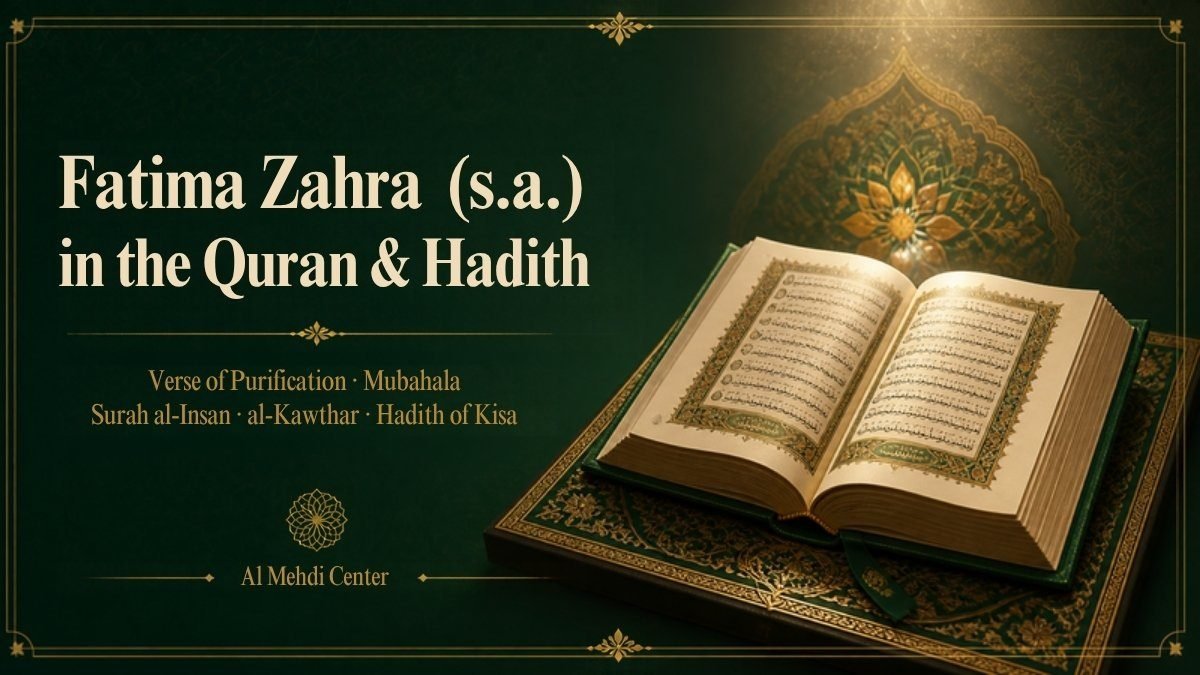
Quick answer: Shia scholars connect Sayyida Fatima Zahra (s.a.) with several Quranic passages: the Verse of Purification (Surah al-Ahzab 33:33), the Verse of Mubahala (Surah Al Imran 3:61), Surah al-Insan (76:5–9), Surah al-Kawthar (108), and the verse on love for the Prophet’s near relatives (Surah ash-Shura 42:23). Hadith such as the Hadith of Kisa and the saying that “Fatima is a part of me” also describe her high rank. Interpretations differ between schools of thought, and this article presents the Shia view with respect for others.
A note on method
Every statement in this article is described as it appears in Shia sources unless stated otherwise. Some of these narrations also appear in Sunni collections, and we mention that where it is well known. Quranic references are given so you can read the verses yourself with a trusted translation and commentary.
1. The Verse of Purification (Surah al-Ahzab 33:33)
The verse says that Allah wishes to remove impurity from the “People of the House” (Ahl al-Bayt) and to purify them thoroughly. Shia scholars understand the verse as referring to the Holy Prophet (s.a.w.w.), Imam Ali (a.s.), Sayyida Fatima (s.a.), Imam Hasan (a.s.) and Imam Husayn (a.s.).
The Hadith of Kisa (the Hadith of the Cloak) describes the occasion: the Prophet (s.a.w.w.) gathered them under a cloak and the verse was revealed. A report of this event is recorded in both Shia sources and well-known Sunni collections, including Sahih Muslim, in the narration of Aisha. Shia families recite the Hadith of Kisa as a dua for relief and blessings.
Why it matters: this is the main reason why al-Tahira (the Pure) is one of her titles. Read about her other titles in Names and Titles of Fatima Zahra (s.a.).
2. The Verse of Mubahala (Surah Al Imran 3:61)
When a delegation of Christians from Najran debated the Prophet (s.a.w.w.), the verse invited both sides to bring “our sons, your sons, our women, your women, and ourselves” and to pray that Allah’s curse fall on the liars. Shia sources, and many Sunni exegetes, report that the Prophet (s.a.w.w.) brought Imam Ali (a.s.), Sayyida Fatima (s.a.), Imam Hasan (a.s.) and Imam Husayn (a.s.). Shia scholars see this as a public sign of their rank and truthfulness.
3. Surah al-Insan (76:5–9)
Shia commentators, and some Sunni ones, report that these verses were revealed about the family of the Prophet (s.a.w.w.) who gave their food to the poor, the orphan and the captive for three days and said, “We feed you only for the sake of Allah.” The verses are often read in discussions of generosity and sincerity. Sayyida Fatima (s.a.) is remembered as part of this family. This is why charity is a natural part of Ayyam-e-Fatimiyah.
4. Surah al-Kawthar (108)
Al-Kawthar means “abundant good”. Many Shia commentators say that it refers to Sayyida Fatima (s.a.) and the many descendants and virtues that came through her. Other commentators give other meanings, such as a river in Paradise or prophethood and the Quran. The point for Shia readers is that Allah promised the Prophet (s.a.w.w.) abundance, and the Ahlulbayt (a.s.) are understood as part of that abundance.
5. Surah ash-Shura 42:23 and love for the Prophet’s family
In this verse the Prophet (s.a.w.w.) is told to say that he asks for no payment for his message except the love of his near relatives. Shia scholars, and a number of Sunni commentators, say this includes Ali, Fatima, Hasan and Husayn (a.s.). It is one of the reasons Shia Muslims emphasise love and loyalty to the Ahlulbayt (a.s.).
Hadith about Sayyida Fatima (s.a.)
- “Fatima is a part of me”: The Prophet (s.a.w.w.) said that whoever angers Fatima angers him. This hadith is well known in both Shia and Sunni collections, including Sahih al-Bukhari, and Muslims of all schools respect it.
- Leader of the women of the worlds: She is described as Sayyidat Nisa al-Alamin. Sunni sources describe her as the leader of the women of Paradise.
- The Tasbih: The Prophet (s.a.w.w.) taught her the dhikr that now carries her name. See Tasbih of Fatima Zahra (AS): Method, Meaning and Shia History.
- Her name and Fire: A Shia narration attributed to Imam al-Sadiq (a.s.) says that Allah kept her and her lovers away from the Fire, and this is why she is named Fatima.
What these texts teach us
- Purity and responsibility. Purity is a gift and also a responsibility to live well.
- Truthfulness. The Mubahala shows confidence in truth.
- Generosity. Surah al-Insan teaches that giving is done for Allah alone.
- Love and loyalty. Love for the Ahlulbayt (a.s.) is connected to following their teachings.
- Connection to the Quran. Understanding their rank begins with reading the Quran with understanding.
Read the Quran with Tajweed and understanding
To study these verses with confidence, a student first needs to read Arabic correctly. Our Quran Reading with Tajweed course teaches accurate recitation in two stages, and our Basic Qaida Reading with Tajweed course is the best place to begin for beginners. For a step-by-step approach, read How to Learn Tajweed Rules Step by Step. Adults can start at any age: see Shia Quran Academy for Adults and Beginners.
For a wider introduction to why we remember her in these days, read Ayyam e Fatimiyah: Remembering Sayyida Fatima Zahra (SA).
Study the Quran with a qualified Shia teacher. Live one-to-one classes for kids and adults, taught since 2012, with 5 free trial classes. Book your free trial · WhatsApp +92 333 1941 225
Frequently Asked Questions
Is Fatima Zahra (s.a.) mentioned by name in the Quran?
No verse names her directly. Shia and some Sunni scholars understand several verses, such as the Verse of Purification and the Verse of Mubahala, to include her, based on hadith that explain when and why the verses were revealed.
What is the Hadith of Kisa?
It is a narration describing the Prophet (s.a.w.w.) gathering Ali, Fatima, Hasan and Husayn (a.s.) under his cloak and reciting the Verse of Purification. Shia families often recite it for blessings and relief from difficulties.
Which verses do Shia scholars connect with the Ahlulbayt (a.s.)?
The main ones are Surah al-Ahzab 33:33, Surah Al Imran 3:61, Surah al-Insan 76:5–9, Surah ash-Shura 42:23, and Surah al-Kawthar. Interpretations differ between schools.
What does Surah al-Kawthar have to do with Fatima (s.a.)?
Many Shia commentators say that al-Kawthar, “abundant good”, includes the many descendants of the Prophet (s.a.w.w.) through Sayyida Fatima (s.a.). Other commentators give other meanings.
Do Sunni sources also narrate the Hadith of Kisa?
Yes. A version of it appears in Sunni collections, such as the narration of Aisha in Sahih Muslim, although Sunni and Shia scholars draw different conclusions from it.
Where can my child learn to read these verses correctly?
At Al Mehdi Center, with a qualified Shia teacher online. Start with Basic Qaida and move to Quran Reading with Tajweed.
Sources
- Al-Islam.org: Sayyida Fatimah al-Zahra
- Wikipedia: Twelver Shia holy days
- The Quran: 3:61, 33:33, 42:23, 76:5–9, 108. Hadith collections: Sahih Muslim, Sahih al-Bukhari, and Shia works such as al-Kafi and Bihar al-Anwar.