Tasbih of Fatima Zahra (AS): The Real Method, Meaning and History According to Shia Teachings
Quick answer: The Tasbih of Fatima Zahra (AS) is a 100-count dhikr taught by the Holy Prophet (SAWW) to his daughter Sayyida Fatima (AS). In the Shia (Fiqah e Jafria) order it is recited 34 times “Allahu Akbar”, then 33 times “Alhamdulillah”, then 33 times “SubhanAllah”. It is highly recommended (mustahab) after every obligatory prayer and before sleeping. Imam Ja’far al-Sadiq (AS) said reciting it after each prayer is more beloved to him than a thousand rak’ahs of prayer.
Tasbih of Fatima Zahra at a glance
- Taught by: Prophet Muhammad (SAWW) to Sayyida Fatima al-Zahra (AS)
- Total count: 100 (34 + 33 + 33)
- Shia order: Allahu Akbar (34) → Alhamdulillah (33) → SubhanAllah (33)
- When: immediately after each wajib salah, and before sleep
- Ruling: mustahab mu’akkad (strongly recommended)
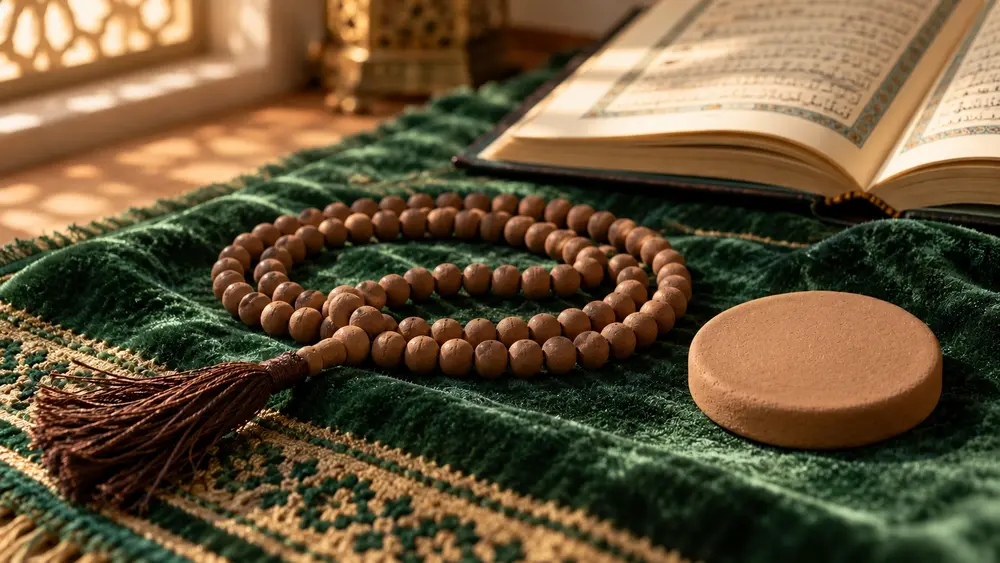
- Preferred beads: a tasbih made of turbah (soil) of Karbala
- Main Shia sources: al-Kafi (Shaykh al-Kulayni), Man La Yahduruhu al-Faqih (Shaykh al-Saduq), Tahdhib al-Ahkam (Shaykh al-Tusi), Wasa’il al-Shi’a
What Is the Tasbih of Fatima Zahra (AS)?
“Tasbih” means glorifying Allah. The Tasbih of Fatima Zahra (also written Tasbih e Fatima or Tasbeeh e Zahra) is a short act of worship of three phrases, each praising Allah in a different way. It takes about two minutes, yet the Ahlulbayt (AS) placed it among the most valuable acts a believer can perform after salah. In Shia households it is one of the first forms of dhikr a child learns, often alongside Namaz, Ahkaam and Wajibaat according to Fiqah e Jafria.
How to Recite the Tasbih of Fatima Zahra: Step-by-Step (Shia Method)
- Finish your obligatory prayer and stay seated in the same place, ideally before getting up or speaking.
- Say “Allāhu Akbar” (اللهُ أكبر) 34 times – “Allah is the Greatest.”
- Say “Al-ḥamdu lillāh” (الحمدُ لله) 33 times – “All praise belongs to Allah.”
- Say “Subḥān Allāh” (سبحانَ الله) 33 times – “Glory be to Allah.”
- Optionally end with “Lā ilāha illallāh” once, as mentioned in some narrations, and continue with your ta’qibat and du’as.
Note on the order: The order above (Takbir, Tahmid, Tasbih) is the well-known order narrated from the Imams of Ahlulbayt (AS) and is the order given by Shia maraji’. Some Sunni narrations place SubhanAllah first; Shia scholars follow the narrations from the Imams. For detailed rulings (for example, what to do if you lose count), refer to the risalah of your marja’ taqlid.
Arabic, transliteration and meaning
| Phrase | Arabic | Count | Meaning |
|---|---|---|---|
| Allahu Akbar | اللهُ أكبر | 34 | Allah is greater than anything that can be described |
| Alhamdulillah | الحمدُ لله | 33 | All praise and gratitude belong to Allah alone |
| SubhanAllah | سبحانَ الله | 33 | Allah is free from every flaw and imperfection |
Correct pronunciation matters: the heavy ḥā’ in “Alhamdu” and “Subhan” is a common mistake among English-speaking learners. Our Basic Qaida with Tajweed course teaches these letters from the ground up.
The Meaning Behind Each Part
1. Allahu Akbar – recognising Allah’s greatness
Imam al-Sadiq (AS) explained that “Allahu Akbar” does not mean Allah is greater than some other thing, but that He is greater than being described. Beginning with Takbir humbles the self right after salah, reminding us that even our prayer is small before Him.
2. Alhamdulillah – gratitude for every blessing
Tahmid is thankfulness. It was taught to Sayyida Fatima (AS) at a moment of physical hardship, which teaches that gratitude is not only for comfort; it is a way of seeing Allah’s care inside difficulty.
3. SubhanAllah – declaring Allah free of all defects
Tasbih completes the sequence by affirming that nothing in Allah’s decree is unjust or lacking. Greatness, gratitude and purity together form a complete statement of Tawhid.
History: How the Tasbih Was Given to Sayyida Fatima (AS)
Shaykh al-Saduq records in Man La Yahduruhu al-Faqih a narration in which Imam Ali (AS) described the home life of Sayyida Fatima (AS) to a man from Banu Sa’d. She carried water in a waterskin until it marked her chest, ground grain on the hand-mill until her hands blistered, and swept the house until her clothes became dusty. Imam Ali (AS) suggested she ask her father for a servant, since captives and help had come to Madinah.
She went to the Prophet (SAWW) but, out of modesty, returned without asking. The Prophet (SAWW) then came to their home and asked what she had needed. Imam Ali (AS) explained the situation. The Prophet (SAWW) replied that he would teach them something better for them than a servant and better than the world and all it contains: to say, before sleeping, Allahu Akbar 34 times, Alhamdulillah 33 times and SubhanAllah 33 times. Sayyida Fatima (AS) responded three times that she was pleased with Allah and His Messenger.
From that day this dhikr carried her name. The Ahlulbayt (AS) preserved it, recited it after every prayer, and taught it to their children. It is a lesson in itself: the daughter of the Messenger chose spiritual wealth over worldly relief.
The first Tasbih beads and the turbah of Karbala
Shia narrations (recorded in Wasa’il al-Shi’a and Makarim al-Akhlaq) report that Sayyida Fatima (AS) first counted on a woollen thread tied with knots. After the martyrdom of Sayyid al-Shuhada Hamza (AS) at Uhud, she made beads from the soil of his grave. After the tragedy of Karbala, the believers turned to the soil of Imam Husayn (AS), and the Imams (AS) encouraged a tasbih made of his turbah. Imam al-Sadiq (AS) is reported to have said that such a tasbih glorifies Allah in the hand of its owner even when he is silent. This is why most Shia homes keep a khak-e-shifa / turbah tasbih from Karbala.
Virtues of the Tasbih of Fatima Zahra in Shia Hadith
- More than a thousand rak’ahs: Imam Ja’far al-Sadiq (AS): “The Tasbih of Fatima (AS) every day after every prayer is more beloved to me than praying a thousand rak’ahs every day.” (al-Kafi, vol. 3)
- The best form of praise: Imam Muhammad al-Baqir (AS): “Allah has not been worshipped with any form of praise better than the Tasbih of Fatima; had there been anything better, the Messenger of Allah would have given it to Fatima.” (al-Kafi, vol. 3)
- Teach it like salah: Imam al-Sadiq (AS): “We command our children to recite the Tasbih of Fatima just as we command them to pray, so hold to it.” (al-Kafi, vol. 3)
- Forgiveness: Imam al-Sadiq (AS) said that whoever recites it after an obligatory prayer, before moving from his place, is forgiven. (Tahdhib al-Ahkam)
- “Dhikr al-Kathir”: Imam al-Sadiq (AS) explained that it is among the “abundant remembrance” (dhikran kathira) commanded in Surah al-Ahzab 33:41.
- Protection from wretchedness: Narrations state that one who keeps this tasbih regularly will not be wretched (shaqi).
When to Recite It
- After each of the five daily prayers – the most emphasised time, as part of the ta’qibat.
- Before sleeping – the original occasion when the Prophet (SAWW) taught it.
- After nafilah (recommended) prayers – also good, though the emphasis is on wajib salah.
Teaching the Tasbih of Fatima to Children
Since the Imams instructed families to teach this tasbih like salah, it is an ideal first dhikr for children aged 5 and above. Practical tips for parents in the UK, USA, Canada and Australia:
- Give your child their own small turbah tasbih and make it “their” special prayer item.
- Tell the story of Sayyida Fatima (AS) and the servant – children connect with stories more than counts.
- Start with the three phrases and correct pronunciation, then build up to the full 100.
- Recite it together as a family after Maghrib.
At Al Mehdi Online Quran Center, qualified Shia teachers include duas, ta’qibat and the Tasbih of Fatima Zahra (AS) in live one-to-one lessons for kids and adults. Many families also choose a Shia female Quran teacher for daughters and mothers. You can read parent reviews and see how we vet our teachers.
Learn Quran, Duas and Fiqah e Jafria with a qualified Shia teacher
Live 30-minute one-to-one classes on Microsoft Teams, male or female teachers, flexible timings. Start with 5 free trial classes.
Book your free trial classes · See monthly pricing · WhatsApp +92 333 1941 225
Frequently Asked Questions
What is the correct order of the Tasbih of Fatima Zahra in Shia Islam?
Allahu Akbar 34 times, then Alhamdulillah 33 times, then SubhanAllah 33 times, for a total of 100. This order is narrated from the Imams of Ahlulbayt (AS).
Why is it called Tasbih of Fatima?
Because the Prophet (SAWW) taught it to his daughter Sayyida Fatima al-Zahra (AS) when she needed help with household work, telling her it was better than a servant and better than the world.
Is the Tasbih of Fatima wajib?
No. It is mustahab mu’akkad (strongly recommended), but the Imams emphasised it so much that they taught it to their children alongside salah.
Can I recite it without beads?
Yes. You may count on your fingers. Using a tasbih of Karbala turbah is recommended and carries extra reward according to narrations.
Can women recite the Tasbih of Fatima during menstruation?
Dhikr is generally permissible at all times, including for women who are not praying. For specific rulings, follow your marja’ taqlid.
How long does it take to recite?
About two to three minutes at a calm pace.
Where can my child learn this tasbih and other Shia duas online?
Al Mehdi Online Quran Center has taught Shia families since 2012. See our courses, read the FAQs, or contact us. Families abroad can see our pages for the UK, USA, Canada, Australia and New Zealand.
Conclusion
The Tasbih of Fatima Zahra (AS) is a gift from the Prophet (SAWW), preserved by the Ahlulbayt (AS) and handed to every Shia believer: 100 words, two minutes, and a reward the Imams valued above a thousand rak’ahs. Make it a fixed part of every salah and teach it to your children, just as the Imams did.
Written by Agah Abbas Naqvi, Al Mehdi Online Quran Center. Sources: al-Kafi (al-Kulayni), Man La Yahduruhu al-Faqih (al-Saduq), Tahdhib al-Ahkam (al-Tusi), Wasa’il al-Shi’a (al-Hurr al-Amili), Makarim al-Akhlaq (al-Tabrisi). More articles on our blog; free resources on the downloads page.