

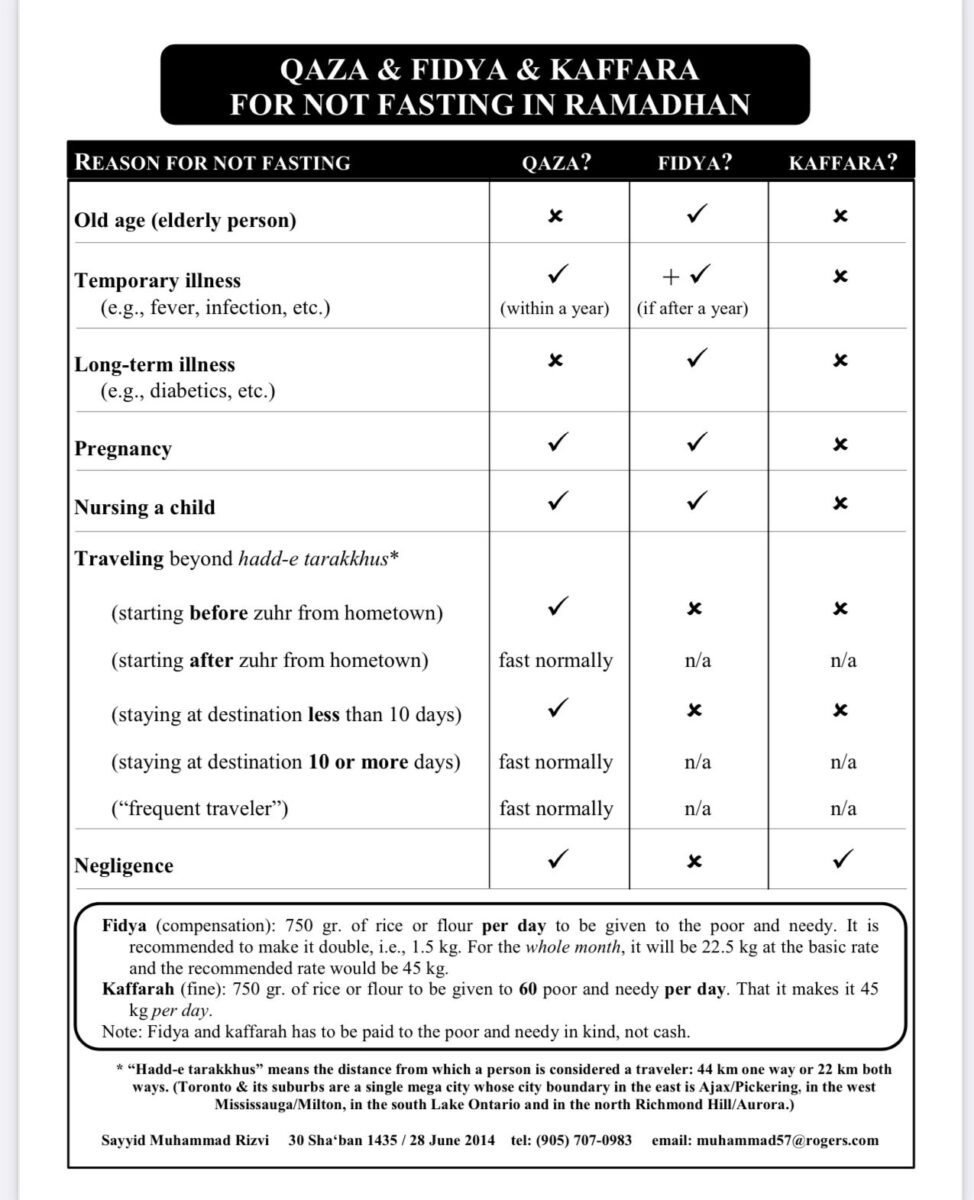
Fidya (compensation): 750 grams of rice or flour per day for the poor. It is better to give 1.5 kg.
Kaffarah (fine): 750gr. rice or flour for 60 poor people per day. That makes it 45kg per day. Note: Fidya and kaffarah have to be paid to the poor and needy, not cash.
* “Hadd-e tarakkhus” means the distance from which a person is considered a traveller: in a one-way journey, it would be 44 km from the city and in the case of a round trip, it would be 22 km from the city.
(Toronto & its suburbs constitute a single megacity from Ajax in the east, Milton in the west, Lake Ontario in the south and Aurora in the north.)
** “Negligence” means knowingly not fulfilling the obligation. However, if the fasts were missed in the early years of bulugh because of ignorance, then the person is exempted from kaffarah but he/she still has to do the qaza.
Those Exempted From Fasting
1. Elderly persons who cannot fast at all. There is no qaza for them either.
2. Elderly persons who can fast but with great difficulty. There is no qaza for them; however, they must pay fidya.
Question: Who decides whether it is easy or difficult to fast? The doctor or you?
Answer: It is your judgment.
3. Temporary illness: those who cannot fast due to a temporary illness (e.g., fever, severe cold, infection, etc.). Such persons are exempted from fasting; however, they have to do qaza before next Ramadhan.
4. Long-term illness: those who cannot fast due to a long-term illness (e.g., diabetics, etc.). Such persons are exempted from fasting: there is no qaza for them either; however, they have to pay fidya for each day of fasting.
5. A pregnant or a nursing woman: if fasting harms her or the child’s health, she is exempted from fasting. However, she has to do qaza after pregnancy or weaning the child and pay vidya for each day of fasting.
Qaza, Fidya and Kaffarah: What Is the Difference?
- Qaza means making up a missed fast later, one day for each day missed, before the next Ramadan where possible.
- Fidya is a compensation given to the poor, usually for each day a person cannot fast, for example because of long-term illness or old age, or when a missed fast is delayed without excuse until the next Ramadan.
- Kaffarah is the heavier penalty for breaking a Ramadan fast deliberately without a valid reason.
Practical Tips
- Keep a written record of the days you missed and why.
- Make up qaza fasts as early as you can, on non-Ramadan days.
- Give fidya and kaffarah as food to people in need, as explained above.
- Rulings on travel, illness, pregnancy and breastfeeding have detailed conditions, so check the risalah of your marja or ask a scholar.
Frequently Asked Questions
What is the difference between fidya and kaffarah?
Fidya is compensation given to the poor when a person cannot fast or delays a qaza fast without excuse. Kaffarah is the penalty for deliberately breaking a Ramadan fast without a valid reason.
How much is fidya per day?
The post above gives 750 grams of staple food such as rice or flour per day, given to a poor person. Check your marja’s ruling for your situation.
Do I still have to make up a fast if I pay fidya?
It depends on the reason. Someone who will be able to fast later must make up the fast; fidya alone applies in specific cases such as permanent inability. Ask your marja for your case.