
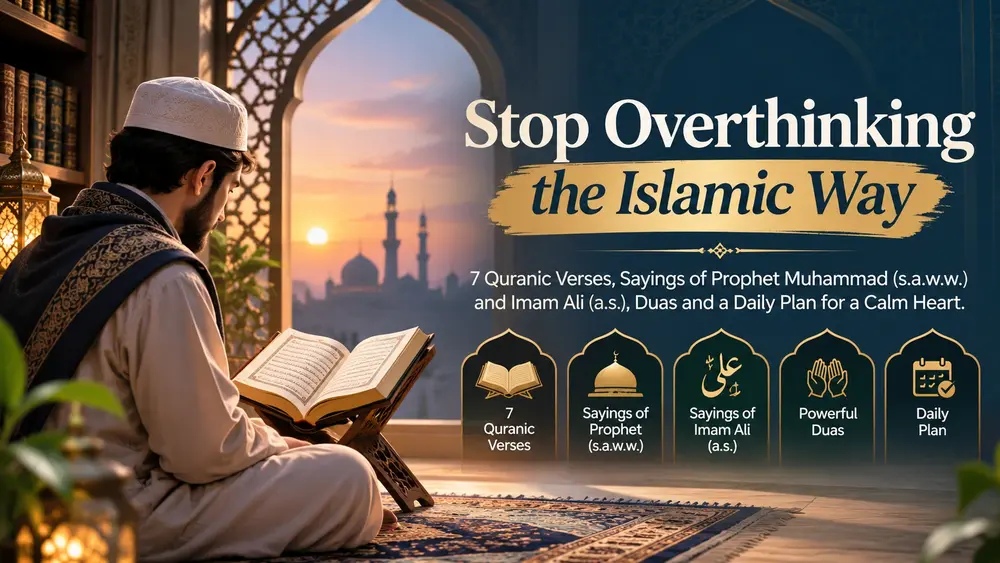
Islam treats overthinking as a heart that has stopped trusting Allah with what it cannot control. The Quran’s cure is dhikr (remembrance), tawakkul (reliance on Allah), husn al-zann (thinking well of Allah and of people) and living in today. Prophet Muhammad (s.a.w.w.) and Imam Ali (a.s.) added clear habits: do your part, then hand the result to Allah; act on what scares you instead of circling it; and do not carry tomorrow’s worry into today.
In practice, that means five daily anchors: Salah on time, Tasbih of Sayyida Fatima Zahra (s.a.) after every prayer, a short Quran recitation with meaning, the four Quranic phrases Imam Ja’far al-Sadiq (a.s.) taught for fear, grief, plots and desire, and one action step on whatever is worrying you.
Key takeaways
- Overthinking is not a sin, but feeding it with suspicion, despair or endless “what ifs” goes against Quranic teaching.
- The Quran promises that hearts find rest in the remembrance of Allah (13:28).
- Imam Ali (a.s.) said worry is “half of old age” and told us to plunge into what we fear rather than dread it.
- Tawakkul is not passivity: tie your camel, then trust Allah.
- If overthinking comes with panic, sleeplessness or low mood for weeks, see a doctor or counsellor as well. Seeking treatment is part of Islam, not against it.
Why do Muslims overthink, and what does Islam say about it?
Overthinking is the habit of replaying the past and rehearsing the future until the present disappears. You go over a conversation fifty times, imagine every way a plan can fail, or read hidden meanings into a short WhatsApp message. The mind is busy, but nothing gets solved.
The Quran does not use the modern word “overthinking”, but it describes its roots very precisely. It speaks of waswas (whispers that unsettle the heart, 114:4–5), zann (suspicion and assumption, 49:12), hamm and huzn (worry about the future and grief about the past), and qunut (despair of Allah’s mercy, 39:53). Each of these feeds the loop. Each also has a Quranic answer.
Islam also honours thinking. The Quran asks again and again, afala tatafakkarun — “will you not reflect?” So the goal is not to stop thinking. The goal is to move from tafakkur (purposeful reflection that leads to action and nearness to Allah) away from wasawis (restless loops that lead to fear and paralysis).
Imam Ali (a.s.) drew this line clearly. He praised reflection that “invites to goodness and acting on it”, and he warned that worry ages a person faster than years. In Nahj al-Balagha he says: الْهَمُّ نِصْفُ الْهَرَمِ — “Worry is half of old age.” Anyone who has lain awake at 3 a.m. replaying a mistake knows how true that is.
7 Quranic cures for an overthinking mind
1. Remembrance of Allah calms the heart (Surah al-Ra’d 13:28)
أَلَا بِذِكْرِ اللَّهِ تَطْمَئِنُّ الْقُلُوبُ — “Truly, in the remembrance of Allah do hearts find rest.”
This is the master verse for overthinking. The mind loops because it is searching for certainty in things that are uncertain: people, money, health, the future. Dhikr gives it something that never changes to hold on to. The opposite is also stated: “Whoever turns away from My remembrance, for him is a narrow, constricted life” (20:124). Many people feel that “narrowness” in the chest when they overthink.
Dhikr is not only words on the tongue. Imam Ali (a.s.) described remembrance as the “polish of the hearts” that makes them hear after deafness and see after blindness. Start with words, and let the meaning reach the heart.
2. Tawakkul: Allah is enough for the one who relies on Him (65:3)
وَمَن يَتَوَكَّلْ عَلَى اللَّهِ فَهُوَ حَسْبُهُ — “And whoever relies upon Allah, He is sufficient for him.”
Overthinking is often an attempt to control outcomes that belong to Allah. Tawakkul splits every problem into two parts: your part (effort, planning, asking, working) and Allah’s part (the result). The famous Prophetic advice “tie your camel, then trust” captures it. Once you have tied the camel, re-checking the knot one hundred times is not caution. It is waswas.
3. Allah never burdens a soul beyond its capacity (2:286)
لَا يُكَلِّفُ اللَّهُ نَفْسًا إِلَّا وُسْعَهَا
The overthinker usually believes “I cannot handle this.” The Quran replies that whatever reached you is, by definition, within your capacity. Read this verse when a scenario in your head feels unbearable. The real situation, with Allah’s help, is lighter than the imagined one.
4. With hardship comes ease (Surah al-Sharh 94:5–6)
إِنَّ مَعَ الْعُسْرِ يُسْرًا
Allah says it twice. Scholars of tafsir note that “hardship” comes with the definite article and “ease” without it, so one hardship is met by more than one ease. Surah al-Sharh opens with “Did We not expand your chest?” — the exact opposite of the tight chest that overthinking creates. Reciting it slowly after Fajr is a simple daily practice.
5. Avoid much suspicion (Surah al-Hujurat 49:12)
اجْتَنِبُوا كَثِيرًا مِّنَ الظَّنِّ إِنَّ بَعْضَ الظَّنِّ إِثْمٌ — “Avoid much assumption; some assumption is sin.”
A large part of social overthinking is zann: “She didn’t reply, so she must be angry.” “He looked at me, so he must be judging me.” The Quran forbids building on such guesses. Imam Ali (a.s.) gave the practical rule, narrated in al-Kafi: ضَعْ أَمْرَ أَخِيكَ عَلَى أَحْسَنِهِ — “Put your brother’s affair in its best light”, as long as you can find a good reading for it. That one habit ends many sleepless nights.
6. Don’t grieve over what is gone or be proud of what you get (57:22–23)
لِّكَيْلَا تَأْسَوْا عَلَىٰ مَا فَاتَكُمْ وَلَا تَفْرَحُوا بِمَا آتَاكُمْ
These verses say every event is already written before it happens, “so that you do not despair over what has escaped you, nor exult over what He has given you.” Imam Ali (a.s.) said that the whole of zuhd (detachment) lies between these two phrases of the Quran. Replaying the past (“if only I had…”) is exactly the grief this verse heals. What passed you was never meant for you; what reached you could never have missed you.
7. Seek help through patience and prayer (2:153)
اسْتَعِينُوا بِالصَّبْرِ وَالصَّلَاةِ
When something worried the Holy Prophet (s.a.w.w.), narrations say he turned to prayer. Salah physically interrupts the loop: you stand, bow, prostrate and speak to Allah five times a day. A long sajdah, with your forehead on the turbah, is one of the most calming acts in Islam. If you want your Salah to feel less rushed, a teacher can help you understand what you are reciting; our Fiqah e Jafria Namaz, Ahkaam & Wajibaat course covers this step by step.
What Prophet Muhammad (s.a.w.w.) taught about worry
The Prophet (s.a.w.w.) lived through orphanhood, boycott, exile, war and the loss of his children, yet he is described as the calmest of people. His teachings on worry are practical.
Seek refuge from worry by name. Among the well-known Prophetic supplications is seeking refuge in Allah “from worry and grief, from weakness and laziness”. Notice that worry is paired with laziness. Overthinking often replaces action.
Istighfar opens a way out. It is narrated from the Prophet (s.a.w.w.), in both Shia and Sunni collections, that whoever keeps up istighfar, Allah makes for him a way out of every worry and provides for him from where he does not expect. Many overthinkers carry hidden guilt. Istighfar puts that weight down. Astaghfirullaha rabbi wa atubu ilayh, 70 times after Asr, is a common Shia practice.
The Tasbih he gave to Fatima (s.a.). When Sayyida Fatima Zahra (s.a.) was worn out by hard housework, the Prophet (s.a.w.w.) did not give her a servant. He gave her a dhikr: 34 times Allahu Akbar, 33 times Alhamdulillah, 33 times SubhanAllah. Imam al-Sadiq (a.s.) described it as more beloved to him than a thousand rak’ahs of prayer every day. It takes two minutes after each Salah and it resets the mind. Read more about her station in Fatima Zahra (s.a.) in the Quran and Hadith.
Salawat lifts the heart. Sending blessings on Muhammad and the family of Muhammad is described in many narrations as a cause of dua being answered and worries being removed. When your mind starts racing, Allahumma salli ‘ala Muhammadin wa Ale Muhammad is the simplest reset there is.
Imam Ali (a.s.) on overthinking: 6 sayings to live by
Amir al-Mu’minin Ali ibn Abi Talib (a.s.) speaks in Nahj al-Balagha and Ghurar al-Hikam with striking psychological insight. These six sayings fit overthinking exactly.
- “Worry is half of old age.” (Nahj al-Balagha) Worry wears down body and mind. Treat it as a health issue, not a personality trait.
- “When you fear something, plunge into it, for the intensity of guarding against it is greater than what you fear.” (Nahj al-Balagha, Short Saying 175) — إِذَا هِبْتَ أَمْراً فَقَعْ فِيهِ. This is the Islamic version of “do it scared”. Make the phone call, send the email, take the exam. Avoidance feeds the loop; action ends it.
- Do not carry tomorrow’s worry into today. In Short Saying 267, the Imam tells the son of Adam not to load today with the worry of a day that has not come, because if that day is part of your life, Allah will bring your provision with it. Live one day at a time.
- “Satisfaction is an excellent companion.” (Nahj al-Balagha, Short Saying 4) and “The root of satisfaction is good trust in Allah.” (Ghurar al-Hikam). Overthinking fades when you are at peace with Allah’s choice for you. See the collected narrations on satisfaction with Allah’s decree.
- Think well of your brother. “Put your brother’s affair in its best light” (al-Kafi). Most social overthinking ends here.
- Reflect to act, not to drown. The Imam praised reflection that leads to good deeds. A useful test: if a thought gives you a next step, it is tafakkur; if it gives you only fear, it is waswas.
The Imams after him taught the same. Imam Zayn al-Abidin (a.s.) left us al-Sahifa al-Sajjadiyya, whose Dua 7, Ya man tuhallu bihi ‘uqad al-makarih (“O He through whom the knots of hardship are untied”), is recited for distress. Learn more about him in Shahadat Imam Zain ul Abideen (a.s.).
The 4 Quranic phrases of Imam al-Sadiq (a.s.) for fear, grief, plots and desire
Shaykh al-Saduq narrates, in al-Khisal and al-Amali, that Imam Ja’far al-Sadiq (a.s.) said he was amazed at four kinds of people who do not use four Quranic phrases, followed in each verse by Allah’s promise. This is one of the most practical teachings on overthinking in Shia hadith.
| When you feel… | Recite | Quran | The promise that follows in the Quran |
|---|---|---|---|
| Fear (of people, the future) | حَسْبُنَا اللَّهُ وَنِعْمَ الْوَكِيلُ Hasbunallahu wa ni’mal wakil | 3:173 | “They returned with grace and bounty from Allah; no harm touched them” (3:174) |
| Grief and inner distress | لَا إِلَٰهَ إِلَّا أَنتَ سُبْحَانَكَ إِنِّي كُنتُ مِنَ الظَّالِمِينَ (dhikr of Prophet Yunus) | 21:87 | “We saved him from distress, and thus do We save the believers” (21:88) |
| Plots and people working against you | وَأُفَوِّضُ أَمْرِي إِلَى اللَّهِ إِنَّ اللَّهَ بَصِيرٌ بِالْعِبَادِ | 40:44 | “So Allah protected him from the evils they plotted” (40:45) |
| Longing for the world | مَا شَاءَ اللَّهُ لَا قُوَّةَ إِلَّا بِاللَّهِ | 18:39 | “Perhaps my Lord will give me better than your garden” (18:40) |
Write these four on a card and keep it in your wallet or phone. When a specific worry starts looping, match it to its row and recite the phrase slowly with its meaning.
A daily anti-overthinking routine from the Quran and Ahlulbayt (a.s.)
- Fajr: Pray on time, then recite Surah al-Sharh (94) and Ayat al-Kursi. Do not pick up your phone until you have finished.
- After every Salah: Tasbih of Sayyida Fatima Zahra (s.a.), then one minute of silent sajdah.
- Morning: Write tomorrow’s worries on paper. Next to each, write “my part” (one action) and “Allah’s part” (the outcome). Do your part today.
- When a loop starts: Match it to one of Imam al-Sadiq’s four phrases above and recite it 7 times.
- After Asr: Istighfar 70 times.
- Evening: Read one page of Quran with its translation or tafseer. Understanding what you recite is what turns it into calm. Our Quran Tafseer course in English and Urdu is built for this.
- Thursday night: Recite Dua Kumayl, taught by Imam Ali (a.s.) to Kumayl ibn Ziyad. It is a long conversation with Allah that lets you pour out everything the mind is holding. For other powerful supplications, see our guide to Dua e Mujeer: meaning, benefits and how to recite it.
- Before sleep: Recite the four Quls, make wudu if you can, and sleep on your right side as the Prophet (s.a.w.w.) did. Hand the day to Allah.
If reciting Arabic correctly is itself a source of stress, that is easily fixed. Our teachers start from Basic Qaida with Tajweed or Quran Reading with Tajweed, and our step-by-step Tajweed guide shows where to begin. For the supplications of the Ahlulbayt (a.s.), our Dua & Ziyarat recitation classes teach Dua Kumayl, Sahifa Sajjadiya duas and ziyarat with meaning.
Overthinking vs. waswas vs. anxiety: when to seek more help
Not all overthinking is the same. A simple guide:
| Type | What it looks like | Islamic response | Extra help |
|---|---|---|---|
| Everyday overthinking | Replaying conversations, worrying about plans | Dhikr, tawakkul, the routine above | Usually enough on its own |
| Waswas in worship | Repeating wudu or Salah, doubting purity again and again | Learn the Fiqh rule on doubt (shakk) and ignore excessive doubt, as the maraji’ advise | A teacher or scholar for the rulings |
| Anxiety or depression | Panic, constant fear, poor sleep or appetite for 2+ weeks, loss of interest | All of the above, plus treatment | A doctor, psychologist or counsellor |
The Prophet (s.a.w.w.) said Allah has not sent down an illness without sending down its cure. Taking medicine or therapy is not weak faith. It is using the means Allah created, just as you would for a broken arm. If you are ever in crisis, contact local emergency services or a crisis line straight away.
For waswas about Salah, wudu or taharah, Shia jurists generally rule that a person with excessive doubt (kathir al-shakk) should not pay attention to it. Always check your own Marja’s ruling. You can ask a Shia scholar online for a personal answer.
Frequently asked questions
Is overthinking a sin in Islam?
No. Thoughts that come to you without choice are not counted as sins. What Islam warns against is acting on suspicion (49:12), despairing of Allah’s mercy (39:53) and letting waswas stop you from worship or duties. Overthinking becomes a spiritual problem when you feed it instead of answering it with dhikr and action.
Which surah is best for overthinking and anxiety?
Surah al-Sharh (94) speaks directly to a tight chest and promises ease with hardship. Ayat al-Kursi (2:255), Surah al-Ra’d 13:28, the four Quls and Surah Yasin are also widely recited for calm. Reciting with meaning has the strongest effect.
What did Imam Ali (a.s.) say about worry?
Imam Ali (a.s.) said “Worry is half of old age”, told us to “plunge into” what we fear because dreading it is worse than facing it, and advised not to burden today with tomorrow’s worry (Nahj al-Balagha). He also taught that satisfaction with Allah’s decree begins with trusting Allah.
What is a short dua for overthinking in Shia Islam?
Use the dhikr of Prophet Yunus: La ilaha illa anta subhanaka inni kuntu minaz-zalimin (21:87). Imam al-Sadiq (a.s.) recommended it for grief, and the Quran promises “thus do We save the believers” right after it. For fear, use Hasbunallahu wa ni’mal wakil (3:173).
Does tawakkul mean I should stop planning?
No. Tawakkul means doing your full part and then trusting Allah with the result. The Prophet (s.a.w.w.) told a man to tie his camel and then trust. Plan once, act, and then stop re-planning the same thing.
How can I stop overthinking at night?
Recite the four Quls and Ayat al-Kursi, do the Tasbih of Fatima Zahra (s.a.) before sleep as the Prophet (s.a.w.w.) taught her, write down any worry with one action for tomorrow, and leave your phone outside the bed. If sleeplessness lasts for weeks, also speak to a doctor.
Can learning the Quran help with anxiety?
Yes. Understanding what you recite turns Salah and dhikr from fast words into real conversation with Allah. When you know the meaning, the Quran’s promises start to speak to your own worries. You can start with online Shia Quran classes for adults or Quran classes for kids.
Conclusion: from a racing mind to a resting heart
Overthinking tells you that if you think about something enough, you can control it. The Quran and the Ahlulbayt (a.s.) teach the opposite: do your part, hand the result to Allah, and let His remembrance settle the heart. Prophet Muhammad (s.a.w.w.) gave us istighfar, salawat and the Tasbih of Fatima Zahra (s.a.). Imam Ali (a.s.) gave us the courage to face what we fear and the wisdom to live one day at a time. Imam al-Sadiq (a.s.) gave us four Quranic phrases for four kinds of worry.
Start small. Pick two practices from the routine above this week, such as Tasbih after every Salah and one page of Quran with meaning. Peace grows from consistency, not intensity.
Learn the Quran and duas with a Shia teacher, one-to-one. Mehdi Quran Center offers live online classes with male and female Shia teachers in English, Urdu, Arabic and Persian, for kids and adults. Book 5 free trial classes, explore our free Shia Islamic courses, or see monthly hadya (fees).
Sources and further reading
- The Holy Quran: 2:153, 2:286, 3:173–174, 13:28, 18:39–40, 20:124, 21:87–88, 39:53, 40:44–45, 49:12, 57:22–23, 65:3, 94:5–6
- Nahj al-Balagha, sermons and short sayings of Imam Ali (a.s.)
- Ghurar al-Hikam wa Durar al-Kalim, compiled by al-Amidi
- al-Kafi, Shaykh al-Kulayni; al-Khisal and al-Amali, Shaykh al-Saduq
- al-Sahifa al-Sajjadiyya, Imam Zayn al-Abidin (a.s.)
- Satisfaction with Allah’s Divine Decree, narrations (al-islam.org)
This article is for spiritual guidance. For rulings, follow your Marja; for mental health concerns, speak to a qualified professional.