Islamic Calendar · Rabi ul Awal · Shia Tradition · 260 AH
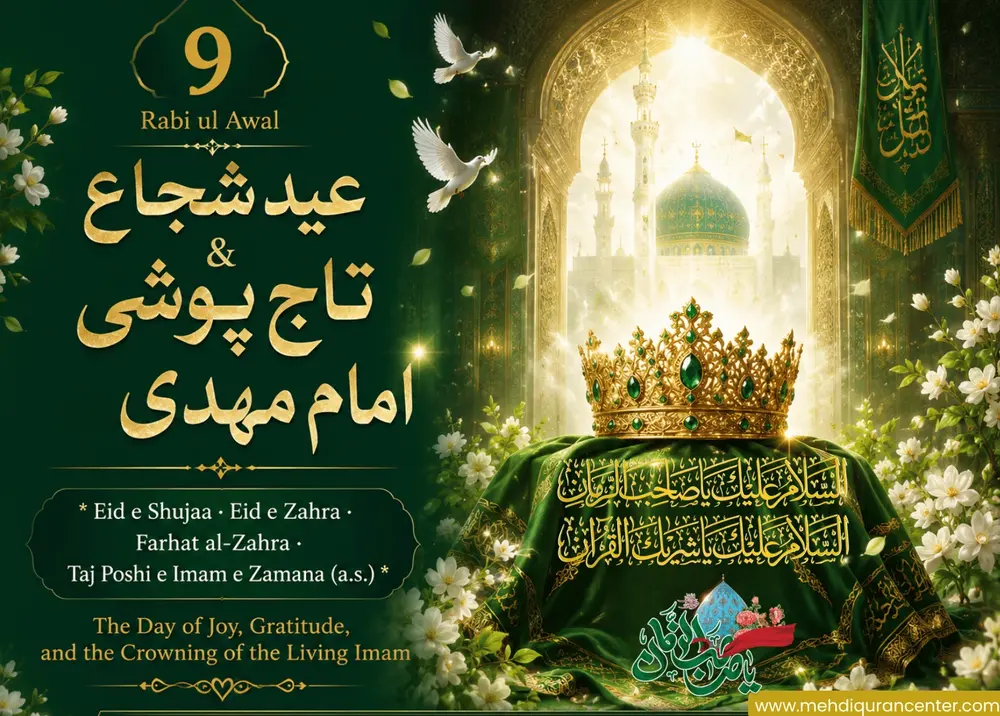
9 Rabi ul Awal
عید شجاع & تاج پوشی امام مهدی (ع.ج)
Eid e Shujaa · Eid e Zahra · Farhat al-Zahra · Taj Poshi e Imam e Zamana (a.s.)
The Day of Joy, Gratitude, and the Crowning of the Living Imam
یا صاحب الزمان · عجل اللہ فرجہ · یا مهدی ادرکني
◆ Article at a Glance — Key Facts
- Date: 9th Rabi ul Awal (3rd month of the Islamic Hijri calendar)
- Also known as: Eid e Shujaa, Eid e Zahra (s.a.), Farhat al-Zahra, Taj Poshi e Imam Mahdi, Yawm Raf’ ul-Qalam
- Primary significance: Beginning of the Imamate of Imam al-Mahdi (a.s.) — 9 Rabi ul Awal, 260 AH
- Historical event: Mukhtar al-Thaqafi sent the heads of the murderers of Imam Hussain (a.s.) to Imam Zain ul Abideen (a.s.) — first smile of Imam Sajjad (a.s.) since Karbala
- End of mourning: Marks the close of the 60-day period of Azadari spanning Muharram and Safar
- Recommended acts: Shukr prayers, Ziarat of Imam Mahdi, salutations on Ahlul Bayt, joyful gatherings
✦ بسم الله الرحمن الرحیم ✦
Introduction: The Dawn After Two Months of Darkness
For the followers of Ahlul Bayt (a.s.), the months of Muharram and Safar are the heaviest months of the Islamic year. They begin with the tragedy of Karbala and continue through sixty days of grief, lamentation, and remembrance of the martyrs. Then — on the 9th of Rabi ul Awal — the sky of sorrow breaks open, and the light of celebration returns.
The 9th of Rabi ul Awal is not merely the end of mourning. It is a day layered with multiple historical events of extraordinary significance — each one a cause for gratitude, joy, and renewed connection with the Ahlul Bayt (a.s.). It is known by several names: Eid e Shujaa, Eid e Zahra, Farhat al-Zahra, and most importantly — Taj Poshi e Imam e Zamana — the day the twelfth and living Imam, Imam al-Mahdi (a.s.), assumed the mantle of divine Imamate.
◆ Quick Answer — What is 9 Rabi ul Awal?
9 Rabi ul Awal is a day of joy in the Shia Islamic calendar that marks: (1) the beginning of the Imamate of Imam al-Mahdi (a.s.) — the 12th Imam — in 260 AH, (2) divine justice reaching the murderers of Imam Hussain (a.s.) through Mukhtar al-Thaqafi, and (3) the end of the 60-day mourning period of Muharram and Safar. It is also called Eid e Shujaa, Eid e Zahra, and Taj Poshi e Imam Mahdi.
The Many Names of 9 Rabi ul Awal
This blessed day carries multiple titles in Shia tradition, each reflecting a different dimension of its significance:
عید شجاع
Eid e Shujaa
Named for the courage (shuja’at) of Mukhtar al-Thaqafi in avenging the blood of Karbala. The day valour was rewarded.
عید زہرا
Eid e Zahra (s.a.)
Named for the joy attributed to Sayyida Fatima Zahra (s.a.) at the divine justice reaching the enemies of her son.
فرحت الزہرا
Farhat al-Zahra
Meaning “the happiness of Zahra” — another expression of the celestial joy of Lady Fatima (s.a.) on this date.
تاج پوشی امام
Taj Poshi e Imam
The “crowning” or coronation of Imam al-Mahdi (a.s.) as the 12th Imam — beginning of his divine Imamate on 9 Rabi ul Awal, 260 AH.
یوم رفع القلم
Yawm Raf’ ul-Qalam
Narrated in some traditions as the day when Allah lifts the pens of accountability from believers — a day of immense divine mercy.
جشن امام زمانه
Jashan e Imam Zamana
The celebration of the beginning of the era of Imam e Zamana (a.s.) — the awaited guide of all of humanity during the age of occultation.
Historical Events of 9 Rabi ul Awal
Multiple significant events are associated with this day in Islamic and Shia historical sources. Understanding each one deepens the believer’s connection to this blessed date:
260 AH
Taj Poshi e Imam al-Mahdi (a.s.) — The Beginning of the 12th Imamate. On 8 Rabi ul Awal 260 AH, Imam Hasan al-Askari (a.s.) — the 11th Imam — was martyred by the Abbasid Caliph al-Mu’tamid. His son, the young Imam al-Mahdi (a.s.) — born in Samarra in 255 AH — officially assumed the Imamate. The 9th of Rabi ul Awal is observed as the first full day of his blessed Imamate, which continues to this day during the period of the Major Occultation (Ghaybat al-Kubra). This is the primary and most significant reason for celebration on this day.
66 AH
Mukhtar al-Thaqafi kills the murderers of Karbala — First Smile of Imam Sajjad (a.s.). According to classical narrations, around 66 AH, Mukhtar al-Thaqafi — the avenger of the blood of Karbala — sent the heads of Umar ibn Saad (the commander of Yazid’s army), Ubaidullah ibn Ziyad, and Harmala to Imam Zain ul Abideen (a.s.). The narrations record that Imam Sajjad (a.s.) had prayed to Allah to grant him enough life to witness this justice. When the heads arrived, the Imam (a.s.) performed Sajda-e-Shukr (prostration of gratitude) and smiled for the first time since the tragedy of Karbala.
Rabi ul Awal
Marriage of the Holy Prophet (ص) to Sayyida Khadija al-Kubra (s.a.). According to some narrations, the 9th of Rabi ul Awal is also considered the date of the blessed marriage of the Holy Prophet Muhammad (صلی اللہ علیہ وآلہ وسلم) to Sayyida Khadija al-Kubra (s.a.) — his first wife and a pillar of early Islam. This adds yet another layer of blessing to the day.
End of Safar
Conclusion of the 60-Day Mourning Period (Ayam-e-Aza). Since the tragedy of Karbala in 61 AH, the Ahlul Bayt (a.s.) and their followers have observed the months of Muharram and Safar as days of mourning (Azadari). The 8th of Rabi ul Awal — Shahadat of Imam Hasan al-Askari (a.s.) — is the final day of mourning. On the 9th, believers remove the garments of grief and begin celebrations. It marks the day when — as tradition holds — the Ahlul Bayt (a.s.) themselves first removed the black and returned to expressions of joy.
Taj Poshi e Imam Mahdi (a.s.) — The Crowning of the Living Imam
◆ Imam al-Mahdi (a.s.) — Identity at a Glance
| Full name | Muhammad ibn Hasan al-Askari (a.s.) |
| Title | Al-Mahdi · Al-Qa’im · Sahib al-Asr wal-Zaman · Hujjat ibn al-Hasan |
| Father | Imam Hasan al-Askari (a.s.) — 11th Imam |
| Mother | Sayyida Narjis Khatun (s.a.) |
| Date of birth | 15 Sha’ban 255 AH · Samarra, Iraq |
| Beginning of Imamate | 8–9 Rabi ul Awal, 260 AH |
| Minor Occultation (Ghaybat Sughra) | 260 AH — 329 AH (69 years) |
| Major Occultation (Ghaybat Kubra) | 329 AH — present |
| Status | Living Imam · Will return before the Day of Judgement |
Why 9 Rabi ul Awal is Called Taj Poshi
The word Taj Poshi (تاج پوشی) literally means “placing of the crown” — the moment a king or Imam is formally invested with leadership. In the context of 9 Rabi ul Awal, it refers to the divine appointment of Imam al-Mahdi (a.s.) as the 12th Imam of the Ahlul Bayt (a.s.) — the seal of the line of Imamate that began with Imam Ali (a.s.) and was bestowed by Allah upon the progeny of the Holy Prophet (ص).
His father, Imam Hasan al-Askari (a.s.), was martyred on the 8th of Rabi ul Awal, 260 AH, poisoned by orders of the Abbasid Caliph al-Mu’tamid. He was only 28 years old. The very next day — the 9th — the Imamate passed, by divine decree, to his young son. The Holy Prophet Muhammad (ص) had already foretold this transfer fourteen generations earlier:
“One who dies without knowing the Imam of his time, dies the death of ignorance.”— narrated in classical Hadith collections
Imam al-Mahdi (a.s.) is alive today. He is in the Major Occultation (Ghaybat al-Kubra), hidden from physical sight by the will of Allah, yet present as the divine authority on earth. He will reappear — by Allah’s permission — to establish justice and truth across all of humanity. The 9th of Rabi ul Awal is the annual reminder of his Imamate and the believer’s connection to their living Imam.
Eid e Shujaa — The Justice of Mukhtar al-Thaqafi
Among the most celebrated aspects of 9 Rabi ul Awal is the story of Mukhtar al-Thaqafi — one of the brave Muslim leaders who rose to avenge the blood of the martyrs of Karbala.
After the tragedy of Ashura in 61 AH, Imam Hussain (a.s.), his companions, and the young men of Bani Hashim had been martyred. Their killers — Umar ibn Saad, Ubaidullah ibn Ziyad, Shimr ibn Dhil Jawshan, and Harmala ibn Kahil — had gone free. For years, this injustice weighed upon Imam Zain ul Abideen (a.s.), the family of the Prophet (ص), and the believing community.
It is narrated that when the head of Ubaidullah ibn Ziyad was brought to Imam Sajjad (a.s.), he was eating. He put down his meal, prostrated before Allah, and said: “All praise is to Allah who answered my supplication, and granted me enough life to see this day.”— classical narration, Bihar al-Anwar
The name Eid e Shujaa — the Festival of Courage — honours the bravery of those who stood against oppression even after the tyrants felt secure in their power. It is a reminder that the cause of truth is never truly lost, and that divine justice, though it may be delayed, is never absent.
End of Ayam-e-Aza — Removing the Garments of Grief
The months of Muharram and Safar are marked by Azadari — the mourning, lamentation, and remembrance of the martyrs of Karbala and the sorrows of the Ahlul Bayt (a.s.). Believers wear black, abstain from celebrations, attend majalis, and keep the memory of Imam Hussain (a.s.), his family, and companions alive.
On the 9th of Rabi ul Awal, this period of grief formally closes. Tradition holds that the Ahlul Bayt (a.s.) themselves would mark this day with expressions of joy. Believers exchange greetings, attend joyful gatherings (jashans), and congratulate one another on the Taj Poshi of Imam e Zamana (a.s.). The phrase most commonly exchanged is:
ربیع الاول مبارک ہو
9 Rabi ul Awal Mubarak ho — Eid e Shujaa Mubarak!
Recommended Acts (Amaal) of 9 Rabi ul Awal
Islamic scholars and classical sources have recommended several acts of worship and devotion for this blessed day. Among them:
◆ Amaal of 9 Rabi ul Awal
- Ghusl (Ritual Bath): Performing ghusl on this day as an act of purification and celebration, as recommended for major Islamic observances.
- Namaz-e-Shukr (Prayer of Gratitude): Offering a two-unit prayer of gratitude to Allah for the blessings of this day — the beginning of the Imamate of Imam Mahdi (a.s.) and the divine justice upon the enemies of Karbala. Learn proper Namaz and Ahkaam here.
- Ziarat of Imam Mahdi (a.s.): Reciting the salutation of Imam e Zamana (a.s.) and sending salawat upon him and his noble forefathers. Recite Du’a al-Ahd (the Covenant Supplication) to renew your pledge to the living Imam.
- Ziarat of Imam Hussain (a.s.): Reading the Ziarat e Ashura as an expression of continued love for the martyrs of Karbala on this day of their vindication.
- Sadaqah (Charity): Giving in charity on this joyful day as an expression of gratitude to Allah and to spread the blessings of the occasion.
- Attending Jashans and Gatherings: Participating in joyful Islamic gatherings that celebrate the Taj Poshi of Imam e Zamana (a.s.) and educate the community about the significance of this day.
- Recite Dua Nudba: It is highly recommended to recite Dua Nudba — the supplication of longing for the appearance of Imam Mahdi (a.s.) — on this day.
- Express congratulations: Exchanging greetings of Mubarak with fellow believers on the Eid e Shujaa and the Taj Poshi of the 12th Imam (a.s.).
Frequently Asked Questions — 9 Rabi ul Awal
These questions are commonly searched by believers seeking to understand this sacred day.
What is the significance of 9 Rabi ul Awal in Shia Islam?
In Shia Islam, 9 Rabi ul Awal is one of the most joyful days of the Islamic calendar. It marks the beginning of the Imamate of Imam al-Mahdi (a.s.) — the 12th Imam — in 260 AH, divine justice upon the killers of Karbala through Mukhtar al-Thaqafi, and the end of the 60-day mourning period of Muharram and Safar.
Why is it called Eid e Shujaa?
Eid e Shujaa (“Festival of Courage”) commemorates the bravery of Mukhtar al-Thaqafi, who avenged the blood of the martyrs of Karbala by killing Umar ibn Saad and Ubaidullah ibn Ziyad. Their deaths brought the first moment of joy and relief to Imam Zain ul Abideen (a.s.) and the Ahlul Bayt (a.s.) after years of grief.
What is Taj Poshi e Imam Mahdi?
Taj Poshi (meaning “coronation” or “crowning”) refers to the divine appointment of Imam Muhammad al-Mahdi (a.s.) as the 12th Imam on 9 Rabi ul Awal, 260 AH, the day after the martyrdom of his father Imam Hasan al-Askari (a.s.). Shia believers celebrate this as the beginning of the living Imam’s era, which continues today during the Major Occultation.
Why is 9 Rabi ul Awal called Eid e Zahra?
It is called Eid e Zahra because the events of this day — particularly the elimination of the murderers of Imam Hussain (a.s.) — brought divine joy and spiritual relief attributed to Lady Fatima al-Zahra (s.a.) and the entire household of the Prophet (ص). The name also honours the occasion as a day that would finally bring happiness to the grieving mother of the martyrs.
What is Dua Nudba and should it be recited on 9 Rabi ul Awal?
Dua Nudba is a heartfelt supplication expressing longing for the reappearance of Imam Mahdi (a.s.). It is traditionally recited on Fridays and on major occasions connected to Imam e Zamana (a.s.). On 9 Rabi ul Awal — the day of his Taj Poshi — reciting Dua Nudba is especially recommended as a way to renew one’s bond with the living Imam.
When did Imam Hasan al-Askari (a.s.) pass away?
Imam Hasan al-Askari (a.s.), the 11th Imam, was martyred on the 8th of Rabi ul Awal, 260 AH (approximately January 1, 874 CE) in Samarra, Iraq, by poisoning ordered by the Abbasid Caliph al-Mu’tamid. He was only 28 years old. His martyrdom is mourned on the 8th, and the next day — 9 Rabi ul Awal — marks the beginning of the Imamate of his son, Imam al-Mahdi (a.s.).
Is 9 Rabi ul Awal observed differently in different communities?
Yes. While the core significance — the Taj Poshi of Imam Mahdi (a.s.) and the end of the mourning period — is universally observed by Shia Muslims, different communities may emphasize different aspects. Some focus primarily on the joy of the Imamate of Imam Mahdi (a.s.), others on the justice of Mukhtar al-Thaqafi, and others on the combined occasion as Eid e Zahra. All expressions are united in love for the Ahlul Bayt (a.s.).
A Day of Living Hope
The 9th of Rabi ul Awal stands at the threshold between grief and joy, between the darkness of injustice and the light of divine truth. It is the day that tells every believer: the mourning is real, the sacrifice was real — and so is the justice of Allah.
Most profoundly, it is the day that reminds us that we are not left without a guide. The chain of Imamate did not end with the tragedy of Karbala, nor with the martyrdom of the youth of Bani Hashim, nor with the sufferings of the Ahlul Bayt (a.s.) across the centuries. On the 9th of Rabi ul Awal, 260 AH, Allah placed the crown of Imamate upon the head of Imam al-Mahdi (a.s.) — and it has not been removed since.
He is alive. He is our Imam. And this day is his coronation — renewed every year in the hearts of those who love him.
“Imam al-Mahdi (a.s.) is the Imam of our era. As the verse of the Holy Quran says (17:71): ‘The Day when We shall call every people with their Imam.’ Know your Imam today.”— inspired by classical narration on the importance of knowing the Imam of one’s time
Also read our full coverage of the sacred days of Muharram: The 70 Steps: Bibi Zainab & Bibi Sakina Witness Imam Hussain’s Last Sajda at Karbala and the martyrdom of Hazrat Ali Asghar (a.s.) — Shahadat, Story & Lessons .
◆ Related Posts You May Find Beneficial
- Browse all posts on Imam Mehdi (a.s.) at Al Mehdi Center
- The 70 Steps: Bibi Zainab & Bibi Sakina Witness Imam Hussain’s Last Sajda at Karbala
- Who Was Ali Asghar (a.s.)? Shahadat, Story & Lessons
- Hazrat Ali Akbar (a.s.) Biography: The Life, Valor, and Martyrdom of the Prophet’s Mirror
- The Powerful Virtues of Ziarat e Ashura
- The Arrival of Imam Hussain (a.s.) at Karbala: The Story of 2nd Muharram
- Majlis 9: Hazrat Ali Akbar (a.s.) – The Ultimate Sacrifice of a Son in Karbala
- Ziyarah Taziyah – Condolence Salutation on Ashura
- Dua Nudba – Full Text, Translation & Significance
- Browse all Majlis & Muharram posts at Al Mehdi Center
Deepen your knowledge of Islam and the Ahlul Bayt (a.s.) with qualified online teachers.
Al Mehdi Center offers Quran, Tajweed, and Islamic Studies classes for all ages — worldwide.📚 Book a Free Trial Class Today