بِسْمِ اللَّهِ الرَّحْمَٰنِ الرَّحِيمِ
In the Name of Allah, the Most Gracious, the Most Merciful
Shahadat e Ali Asghar (A.S.) — The Youngest Martyr of Karbala
علی اصغر علیہ السلام — کربلا کا معصوم شہید
Introduction
Among the countless sacrifices offered on the plains of Karbala on the 10th of Muharram, 61 AH (680 CE), the martyrdom of Hazrat Ali Asghar (A.S.) stands as one of the most heart-wrenching events in Islamic history. He was the infant son of Imam Hussain ibn Ali (A.S.), the grandson of Prophet Muhammad (S.A.W.W.), and the youngest martyr in the tragedy of Karbala.
His shahadat (martyrdom) was not merely the death of a six-month-old child — it was a divine testimony against the cruelty of the Yazidi forces, and a symbol of the ultimate sacrifice a father can make in the way of truth and justice.
To read more articles about Hazrat Ali Asghar (A.S.) or Imam Hussain (A.S.), visit our dedicated blog categories at Mehdi Quran Center.
Who Was Hazrat Ali Asghar (A.S.)?
Hazrat Ali Asghar (A.S.) was the youngest son of Imam Hussain (A.S.) and his wife Hazrat Rubaab (S.A.), daughter of Imra’ al-Qais al-Kalbi. His full name was Ali ibn Hussain, also known as Abdullah ibn Hussain. The title Ali Asghar — meaning “the younger Ali” — distinguished him from his elder brother Ali Akbar (A.S.).
At the time of the Battle of Karbala, Ali Asghar was merely an infant — a nursing baby approximately six months of age. He had barely opened his eyes to the world when fate called him to offer the supreme sacrifice for the preservation of Islam’s true message.
The Journey to Karbala
Imam Hussain (A.S.) departed from Madina in Rajab 60 AH after refusing to pledge allegiance to Yazid ibn Muawiyah, whose corrupt rule was incompatible with the teachings of Islam. Accompanied by his family, children, and loyal companions, the Imam traveled toward Kufa at the invitation of its people.
Surrounded by the massive Yazidi army under Ibn Sa’d, the Imam was forced to halt at the land of Karbala. For days they endured the burning desert heat with no access to water. Among those suffering most was the infant Ali Asghar, who cried from hunger and thirst as his mother’s milk had dried up from the heat and distress.
You can read the detailed account of this arrival in our article: The Arrival of Imam Hussain (A.S.) at Karbala: The Story of 2nd Muharram.
Historical Note: The denial of water to Imam Hussain’s family — including nursing infants — is considered one of the gravest crimes of the Yazidi army and is commemorated annually during the month of Muharram. Learn more in our Majlis / Muharram articles.
The Day of Ashura — 10th Muharram
On the morning of Ashura, the battle began. One by one, the companions and family members of Imam Hussain (A.S.) fell as martyrs. Inside the tent of Hazrat Rubaab, the infant Ali Asghar cried with thirst. He had not been fed for days. His lips had cracked, and his little body was weakened beyond measure.
Seeing the desperate condition of his infant son, Imam Hussain (A.S.) went to his sister Hazrat Zainab (S.A.) and asked her to wrap the baby in swaddling clothes. He then made his way to the battlefield — not to fight, but to seek a final mercy from the enemy: a few drops of water for his dying infant.
The Plea for Water — A Father’s Appeal
Standing before the enemy army of tens of thousands, Imam Hussain (A.S.) raised the infant Ali Asghar toward the sky and called out to the soldiers:
“O people! If you consider me your enemy, then this infant is innocent. He has committed no crime. He is thirsty and dying. Give him even a few drops of water — for he is a child, and a child has no enmity with anyone.”
— Imam Hussain (A.S.), Karbala, 10 Muharram 61 AH
The appeal of Imam Hussain (A.S.) moved many within the enemy ranks to tears. Historians record that soldiers wept openly at the sight of the parched infant — but this emotion was quickly suppressed by their commanders.
The Arrow of Harmala — The Shahadat of Ali Asghar (A.S.)
Fearing that the Imam’s appeal was winning the hearts of his troops, Umar ibn Sa’d ordered one of his most ruthless archers — Harmala ibn Kahil al-Asadi — to silence the infant. Harmala drew his bow without hesitation.
The three-pronged arrow flew across the burning air of Karbala and pierced the soft, delicate neck of the six-month-old infant Ali Asghar (A.S.) while he lay in his father’s arms.
The baby’s blood spurted onto the hands and chest of Imam Hussain (A.S.). Ali Asghar looked up at his father with eyes still shining — and within moments, breathed his last. He had been answered not with water, but with an arrow.
A full majlis account of this night is available in our article: Majlis 10: Hazrat Ali Asghar (A.S.) — The Youngest Martyr of Karbala.
هَوَّنَ عَلَيَّ مَا نَزَلَ بِي أَنَّهُ بِعَيْنِ اللهِ
“What makes this tragedy easy to bear is that it is witnessed by the eyes of Allah.”
— Imam Hussain (A.S.) upon the martyrdom of Ali Asghar
The Imam’s Response — Dignity in the Face of Barbarity
Imam Hussain (A.S.) did not scream. He did not collapse. He raised his blood-soaked hands toward the heavens and addressed Allah (S.W.T.) with the prayer preserved above. He then dug a small grave with his sword in the scorching earth of Karbala, placed the tiny body of Ali Asghar within it, and returned to the battlefield — carrying nothing but grief and an unshakeable conviction.
He had carried no weapon when he came with his child. He needed none. The innocence of Ali Asghar was the most powerful argument against tyranny that history has ever witnessed.
Spiritual Significance of Ali Asghar’s Shahadat
1. An Irrefutable Argument Against Tyranny
By bringing Ali Asghar to the battlefield, Imam Hussain (A.S.) made the moral argument visible and undeniable. An infant has no political agenda, no military purpose. His martyrdom stripped away every pretense of the Yazidi regime and exposed their barbarity before all of history.
2. A Reflection of Prophetic Sacrifice
Islamic scholars draw a powerful parallel between the sacrifice of Ali Asghar and the near-sacrifice of Prophet Ibrahim’s (A.S.) son Ismail (A.S.). In both cases, a father stood ready to surrender what was most precious for Allah’s command. In Karbala, however, there was no ram from heaven. The sacrifice was completed.
3. The Eloquence of Silence
Ali Asghar (A.S.) never spoke a word — he could not, he was an infant. Yet his silence was more eloquent than a thousand sermons. The speechless testimony of this infant has done more to awaken the conscience of humanity than entire volumes of religious discourse across 1,400 years.
4. A Test of Moral Courage
For the soldiers of the Yazidi army who wept at the sight of the infant yet did not leave their positions, the martyrdom of Ali Asghar stands as a testament to how even the hardest of hearts can recognize truth — and yet choose power over conscience.
The Grief of Hazrat Rubaab (S.A.) — A Mother’s Loss
Hazrat Rubaab (S.A.), the mother of Ali Asghar, was among the women in the tents of Karbala. When Imam Hussain (A.S.) returned with the lifeless body of her infant, her grief was beyond description. Historical accounts describe her as inconsolable, clutching the small form of her child.
After the events of Karbala and the subsequent captivity in Kufa and Damascus, it is recorded that Hazrat Rubaab never accepted another husband after the martyrdom of Imam Hussain (A.S.) and refused to sit under a roof for an entire year — grieving her husband and her child beneath the open sky.
Remembrance in Azadari — The Living Legacy
Each year during the sacred month of Muharram, Muslims — particularly the Shia community worldwide — hold majalis (mourning gatherings) in which the tragedy of Karbala is recounted. Among all narrations, the account of the martyrdom of Ali Asghar (A.S.) invariably reduces the audience to tears.
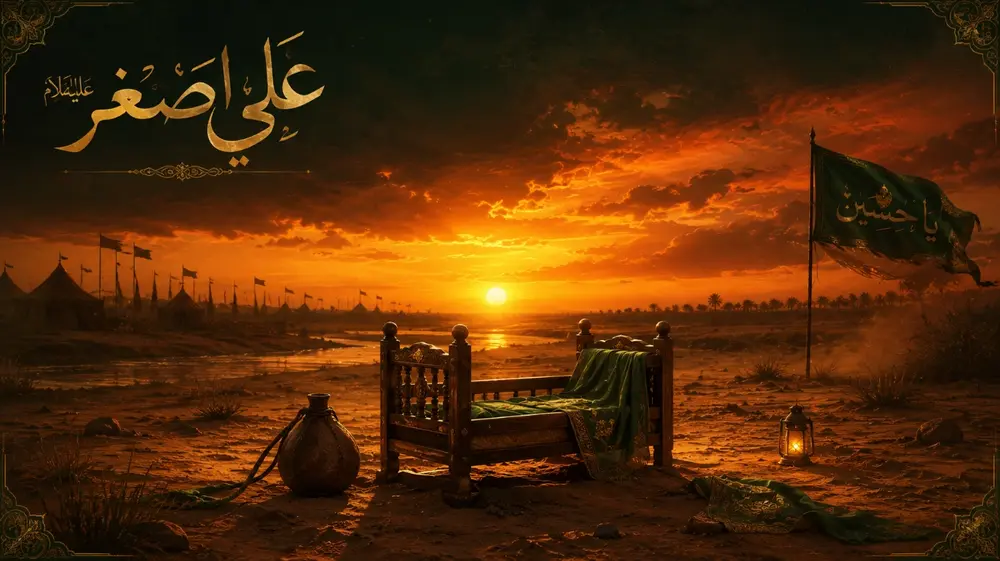
Poets in Urdu, Arabic, Farsi, and countless other languages have penned marsiya and noha dedicated to Ali Asghar (A.S.). His small cradle (jhoola) is carried in Muharram processions as a symbol of his martyrdom — a reminder that on the plains of Karbala, even a nursing child was not spared.
Explore our full collection of Majlis and Muharram articles for more reading on Azadari, Ashura, and the remembrance of the Ahlul Bayt (A.S.).
Offer Condolences — Ziyarah on Ashura
On the day of Ashura, it is recommended to recite Ziyarah as condolences to the Prophet (S.A.W.W.) and the Ahlul Bayt (A.S.) for the tragedy of Karbala. We have published the full text with translation:
Lessons from the Shahadat of Ali Asghar (A.S.)
- Truth requires no weapons — even an infant can be a hujjat (divine proof) of God.
- Tyranny exposes itself — the greater the cruelty, the more clearly injustice stands condemned before history.
- Faith demands sacrifice — Imam Hussain (A.S.) gave what no father should ever have to give, yet remained steadfast in truth.
- Silence can be the most powerful sermon — Ali Asghar (A.S.) said nothing, yet his shahadat has been spoken of for over 1,400 years.
- Love for Ahlul Bayt is a duty — the Prophet (S.A.W.W.) said: “I leave among you two precious things: the Book of Allah and my Ahlul Bayt.”
Conclusion
The shahadat of Hazrat Ali Asghar (A.S.) is not a story confined to the sands of seventh-century Arabia. It is a universal cry against oppression — proof that the conscience of humanity, however suppressed, can never be entirely extinguished. Every year, when the faithful gather to mourn and remember, they do so not merely in grief, but in recognition that this sacrifice was not in vain.
Karbala continued through the mission of Hazrat Zainab (S.A.) and Imam Zain ul Abideen (A.S.), who carried the message forward from the ruins of the tents to the courts of Kufa and Damascus. And it continues today — in every majlis, every noha, every tear shed for the innocent infant who asked for water and received a three-pronged arrow.
السَّلَامُ عَلَيْكَ يَا عَلِيَّ الأَصْغَرَ، يَا شَهِيدَ كَرْبَلَاء
Peace be upon you, O Ali Asghar — O Martyr of Karbala
Related Articles at Mehdi Quran Center
- Majlis 10: Hazrat Ali Asghar (A.S.) — The Youngest Martyr of Karbala
- The Love of Today’s Children for Bibi Sakina (S.A.) and Ali Asghar (A.S.)
- The Arrival of Imam Hussain (A.S.) at Karbala: The Story of 2nd Muharram
- The Powerful Virtues of Ziarat e Ashura
- Ziyarah Taziyah — Condolence Salutation on Ashura
- Browse All Hazrat Ali Asghar (A.S.) Articles
- Browse All Imam Hussain (A.S.) Articles
- Browse All Majlis / Muharram Articles
Compiled in remembrance of the Martyrs of Karbala • 10th Muharram 61 AH • MehdiQuranCenter.com