A Caravan Stopped in the Desert
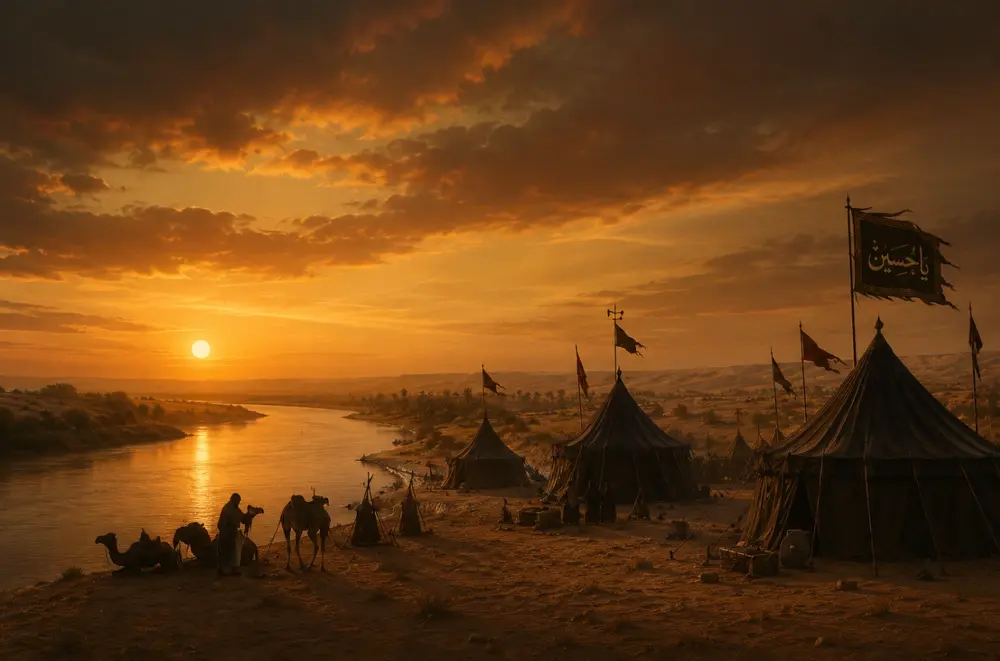
It was a Thursday, the 2nd day of Muharram in the year 61 AH (2 October 680 CE), when a small caravan came to a halt on a barren, windswept plain beside the Euphrates River. At its head rode Imam Hussain ibn Ali (A.S.), the grandson of Prophet Muhammad (PBUH) and the son of Imam Ali (A.S.) and Lady Fatimah (S.A.). With him were his family, his sisters and wives, his young children, and a devoted band of companions numbering little more than seventy. The land had no name worth remembering. By nightfall, it would be called Karbala, and it would never be forgotten again.
Why Imam Hussain Was on This Road
To understand what happened that day, it helps to remember how the journey began. After the death of the Umayyad ruler Muawiya, his son Yazid demanded that Imam Hussain pledge allegiance to his rule. Imam Hussain refused. Yazid’s leadership, in the Imam’s eyes, represented corruption and tyranny dressed in the robes of the caliphate, and to give him bay’ah would mean lending legitimacy to the destruction of the values his grandfather had built Islam upon. So instead of submission, Imam Hussain chose to leave Medina for Mecca, and from there, in response to thousands of letters from the people of Kufa pleading for his leadership against Umayyad oppression, he set out toward Iraq.
The road was not kind. Partway through the journey, devastating news reached the caravan: Muslim ibn Aqeel, the Imam’s cousin and trusted envoy sent ahead to Kufa, had been betrayed and martyred. The people who had written so many letters of support had, under threat and intimidation, abandoned their cause. Still, Imam Hussain continued forward. Soon, a thousand-strong battalion under Hurr ibn Yazid al-Riyahi intercepted the caravan, blocking the road to Kufa and refusing passage back to Medina as well. There was only one direction left: into the open desert, toward the land known as Naynava, toward Karbala.
The Moment of Arrival
When the caravan reached the plain, witnesses recount that Imam Hussain asked his companions the name of the land. Told that it was called Karbala, he is reported to have responded with words that would echo through history: this was the land of grief and trials, the place where their camels would kneel, where their blood would be spilled, and where their graves would be dug. Rather than resist or turn back, he ordered the camp to be set.
There was something deliberate in this. Imam Hussain had long known, through the words of his grandfather the Prophet and through divine knowledge passed through his family, that this barren stretch of earth was destined to be the site of his martyrdom. Outwardly, he had been forced here by an army determined to stop him from reaching Kufa. Inwardly, he walked toward it with full acceptance, understanding that his sacrifice would become the line separating truth from tyranny for all generations after him.
The tents were pitched along the bank of the Euphrates. It was the second of Muharram, and for one day, there was a strange and fragile calm. Imam Hussain is said to have approached the local tribe, the Banu Asad, and asked to purchase the land itself, so that he, his family, and his companions might be laid to rest there. It was a request made with the quiet certainty of a man who knew exactly what was coming.
The Net Closes
That calm did not last. On the very next day, the third of Muharram, a force of four thousand soldiers from Kufa arrived under the command of Umar ibn Sa’d, sent by the governor Ubaydullah ibn Ziyad. They set their camp directly opposite the Imam’s small band. Umar ibn Sa’d, it is said, had little appetite for this confrontation and had only just been recalled from another posting to carry it out, but the threat of losing his governorship secured his compliance.
Messages passed between the two camps. Imam Hussain made his position plain: he had not come to Iraq uninvited. The people of Kufa themselves had summoned him with countless letters, and if his arrival was unwelcome now, he was willing to return to the Hijaz in peace. For a moment, Ibn Sa’d seemed prepared to accept this and wrote to Ibn Ziyad relaying the offer. But Ibn Ziyad’s reply left no room for peace: Hussain must surrender unconditionally, or be subdued by force. And to hasten that surrender, Ibn Ziyad ordered that the Imam’s camp be cut off from the Euphrates entirely.
Soldiers were stationed along the riverbank. The family that had camped beside the water on the night of the second of Muharram would soon be denied even a single drop of it, a deprivation that would deepen with each passing day until the suffering became almost unbearable, particularly for the children. It was the beginning of a siege that would end, eight days later, on the tenth of Muharram, the day known to history and to the hearts of millions as Ashura.
Why This Day Still Matters
The arrival at Karbala on the 2nd of Muharram is remembered not simply as a date on a calendar, but as the threshold moment when faith, justice, and sacrifice converged on a single patch of desert. Imam Hussain did not seek political power, nor did he ride into Karbala blind to what awaited him. He walked toward it understanding that some causes are worth more than survival, and that silence in the face of tyranny is its own kind of surrender.
This is why, even today, the days of Muharram are marked the world over with mourning gatherings, recitations, and processions that retrace the steps of that caravan. The story of the 2nd of Muharram is the story of a choice: to halt in a forsaken land rather than bow to falsehood, and in doing so, to turn that land into a permanent symbol of resistance against oppression. It is remembered every year not as ancient history, but as a living call to stand for truth, no matter the cost.
Frequently Asked Questions
What happened on the 2nd of Muharram? Imam Hussain (A.S.) and his caravan of family members and companions arrived at Karbala and set up camp beside the Euphrates River, marking the beginning of the events that would lead to his martyrdom eight days later on Ashura.
Why did Imam Hussain stop at Karbala instead of reaching Kufa? His caravan was intercepted and blocked by an army under Hurr ibn Yazid al-Riyahi, acting on the orders of Ibn Ziyad, which forced him to halt in the open desert rather than enter the city.
How many companions were with Imam Hussain at Karbala? Historical accounts place the number of his family members and loyal companions at a little more than seventy.
What is the significance of Karbala in Islamic history? Karbala became the site of Imam Hussain’s martyrdom and stand against tyranny, a moment that shaped Shia Islamic identity and remains commemorated annually during Muharram and the Arba’een pilgrimage.