A Bond That Crosses Thirteen Centuries
There is a particular kind of tear that falls when a child today hears the story of Bibi Sakina and Ali Asghar. It is different from the grief shed for the grown martyrs of Karbala. It is the grief of recognition, of one child somehow reaching across more than thirteen hundred years to hold the hand of another. Every year during Muharram, in majalis halls and homes around the world, young azadars sit beside their parents and weep not because someone has told them to, but because something in the story feels close enough to touch. A six-month-old baby. A four or five-year-old girl. These are not distant historical figures to a child. They are, in the most literal sense, someone just like them.
Who Was Bibi Sakina (S.A.)?
Bibi Sakina, whose given name was Ruqayyah, was the youngest daughter of Imam Hussain (A.S.) and his wife Bibi Rubab. Her name itself means peace, given to her because Imam Hussain had prayed for a daughter who would bring sakoon, tranquility, to his heart. By all accounts she was a lively, affectionate child with a sweet and cheerful nature, so loved by her father that he was known to say a house without Sakina would not be worth living in. She had a particularly tender bond with her uncle, Hazrat Abbas (A.S.), who doted on her more than his own children, often riding alongside her howdah during the journey just to make sure she wanted for nothing.
At night, she would rest her head on her father’s chest as he told her stories of the prophets, and he would not move until she had fallen asleep. It is recorded that as the armies of Yazid began gathering at Karbala from the 2nd of Muharram, Imam Hussain gently told his sister Zainab that the time had come to help Sakina grow used to sleeping without him. He already knew what was coming.
The Thirst That Children Still Feel Today
When water was cut off from the camp from the seventh of Muharram onward, Bibi Sakina shared whatever little she had with the other children before taking any herself. On the day of Ashura, she handed her empty water skin to her beloved uncle Abbas and asked him to bring water for the thirsty children. He went, fought his way to the riverbank, filled the mashk, and was martyred on his return, his arms severed one after the other rather than let the standard and the water fall.
When Imam Hussain returned to the camp carrying Abbas’s blood-soaked standard, Sakina understood at once what had happened. From that moment, witnesses say, she never again asked for water or complained of thirst, even as her own lips remained parched. This single detail is often what breaks the hearts of children listening to the story today: a little girl who stopped asking for something she desperately needed, simply because she could not bear to add to anyone else’s pain.
The Tiny Soldier: Ali Asghar (A.S.)
Ali Asghar was Imam Hussain’s youngest son, only six months old at Karbala, too small to lift a sword or understand what was happening around him, yet inseparably written into the story of Ashura. As the siege wore on and the infant’s thirst became unbearable, Imam Hussain carried him to the edge of the battlefield, lifting him up before the enemy lines as a final, wordless appeal: even if you have no mercy for me, surely you can spare a few drops of water for a baby. The chroniclers describe Imam Hussain turning to his infant son and gently telling him that since he was too young to fight with sword or spear, his jihad would have to be fought with his tongue, the small gesture of a parched infant moving his dry tongue across cracked lips being arrow enough to pierce the conscience of onlookers.
It was at that moment that an arrow, said to have three blades, was shot toward the child. Imam Hussain moved to shield him, and the arrow passed through the father’s arm into the infant’s tiny neck. Ali Asghar was martyred in his father’s arms, the youngest of the seventy-two martyrs of Karbala, a soldier who fought, in the only language available to him, with nothing but his thirst and his innocence.
Why Children Today Love Them So Deeply
Ask any parent who has raised a child within the Husseini tradition, and they will tell you: somewhere between the ages of four and ten, a child stops simply listening to the story of Karbala and starts living inside it. They picture Sakina as a girl who could have been their classmate, their cousin, their little sister. They picture Ali Asghar as the baby brother or nephew at home, the one who cries when there’s no milk for even a few hours.
This is, in many ways, exactly the function these two figures have always served within the tradition of azadari. They make the tragedy of Karbala impossible to keep at a comfortable distance. An adult companion’s bravery in battle can feel heroic and somewhat removed, the stuff of legend. But a thirsty toddler holding back her own tears so she doesn’t upset her mother, or an infant whose only weapon was his innocence, collapses that distance entirely. Children recognize themselves in Sakina and Asghar, and in recognizing themselves, they begin to understand, far earlier than any lecture could teach them, what sacrifice, patience, and loyalty actually look like.
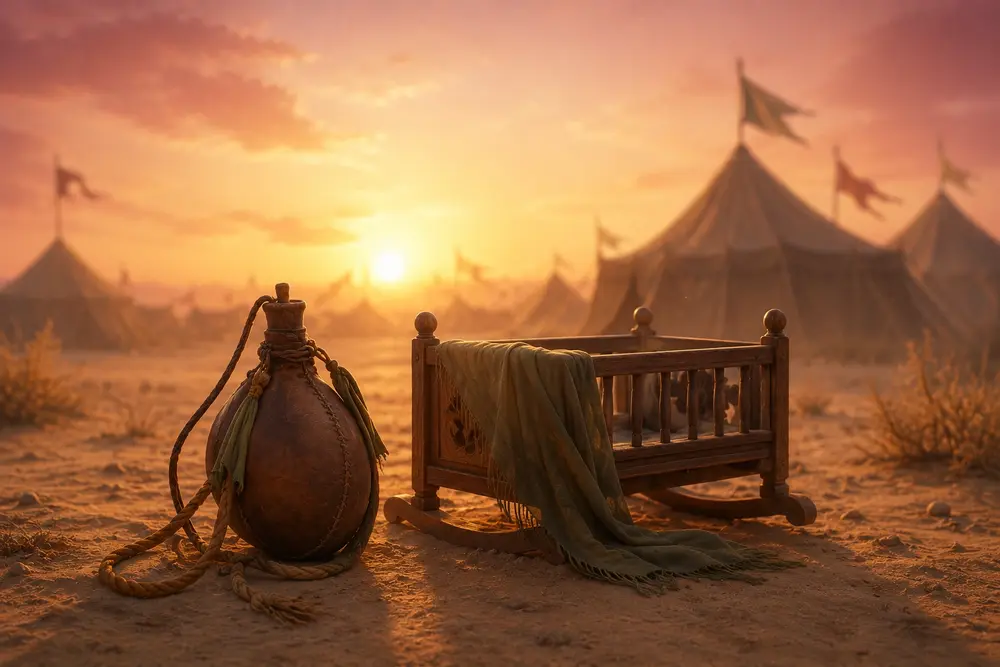
Across processions and majalis today, it is common to see children carrying small cradles representing Ali Asghar’s, or holding model mashks in honor of Sakina, reenacting in miniature the symbols of thirst and sacrifice that ran through Karbala. Tabut processions and mourning gatherings dedicated to Bibi Sakina, often observed around the 13th of Safar marking her martyrdom in the prison of Damascus, regularly draw the youngest members of the community, who arrive not out of obligation but because they have, in their own way, fallen in love with a little girl who lived and died so long ago.
A Love That Teaches Without Lecturing
What makes this bond between modern children and these two young martyrs so enduring is that it asks nothing of a child except empathy. No child needs a history lesson to feel for a baby denied water, or a little girl quietly comforting her grieving mother instead of asking for comfort herself. The story does the teaching on its own. It plants, gently and early, the values that the entire tragedy of Karbala stands for: that even the smallest and most powerless among us can carry immense dignity, that love and sacrifice are not separate things, and that some kinds of courage have nothing to do with swords at all.
This is why, generation after generation, the youngest azadars keep finding their way back to Sakina and Asghar, not as distant figures from the seventh century, but as a little girl and a little boy who somehow still feel like family.
Frequently Asked Questions
Who was Bibi Sakina (S.A.)? Bibi Sakina, also known as Ruqayyah, was the youngest daughter of Imam Hussain (A.S.) and Bibi Rubab. She was around four to five years old at Karbala and is remembered for her patience, generosity, and the deep bond she shared with her uncle Hazrat Abbas (A.S.).
Who was Ali Asghar (A.S.)? Ali Asghar was the six-month-old infant son of Imam Hussain (A.S.), the youngest martyr of Karbala, who was struck by an arrow while his father held him up before the enemy lines pleading for water.
Why do children feel such a strong connection to Bibi Sakina and Ali Asghar? Because their age makes them relatable in a way adult companions of Karbala are not; children see in them a reflection of themselves, which makes the lessons of patience, sacrifice, and compassion easier to absorb emotionally.
When is Bibi Sakina’s martyrdom commemorated? Her martyrdom in the prison of Damascus is generally remembered between the 3rd and 13th of Safar, with many communities, particularly in the Indian subcontinent, observing it on the 10th or 13th of Safar through majalis and mourning processions.