Chehlum of Imam Hussain (AS) in Karbala: History and Recommended Amaal
Karbala holds a singular place in the heart of every Shia Muslim, and nowhere is that more visible than on the day of Chehlum. Forty days after the tragedy of Ashura, the land of Karbala itself becomes the center of the largest act of remembrance in the Muslim world. This article looks at what happened in Karbala on that first Arbaeen, why the pilgrimage there continues to grow every year, and what acts (amaal) are recommended for the day according to Fiqah e Jafria.
Read Ziyarat of Arbaeen.
What Happened in Karbala on the First Arbaeen
According to Shia historical sources, two significant events converged in Karbala on the 20th of Safar, 61 AH – exactly forty days after Imam Hussain (AS) was martyred.
The return of the captive family. After being marched through Kufa and Sham following the tragedy, the surviving family of Imam Hussain (AS) – including his sister, Sayyida Zainab (SA), and his son, Imam Zain-ul-Abideen (AS) – were finally permitted to make their way back toward Madinah. According to widely cited Shia scholarship, including the accounts of Shaykh al-Tusi and Allamah al-Majlisi, their route brought them back through Karbala on this exact day, where they were able to grieve openly at the graves of their loved ones for the first time.
The first Ziyarat of Arbaeen. On that same day, a companion of Prophet Muhammad (PBUH) named Jabir ibn Abdullah al-Ansari arrived in Karbala from Madinah, making him – according to Shaykh al-Tusi’s account in Misbah al-Mutahajjid – the first person to formally visit the grave of Imam Hussain (AS). Jabir, who was elderly and reportedly losing his eyesight by this point, travelled with a younger companion, Atiyyah al-Awfi. Historical accounts describe Jabir performing ghusl in the Euphrates River, applying fragrance, and walking the final distance to the grave barefoot out of reverence, before he was overcome with grief upon reaching it.
This single act of pilgrimage by Jabir is considered the origin of what is now known as Ziyarat al-Arbaeen, and the spiritual foundation for everything that followed.
The Modern Arbaeen Walk: Millions Return to Karbala Every Year
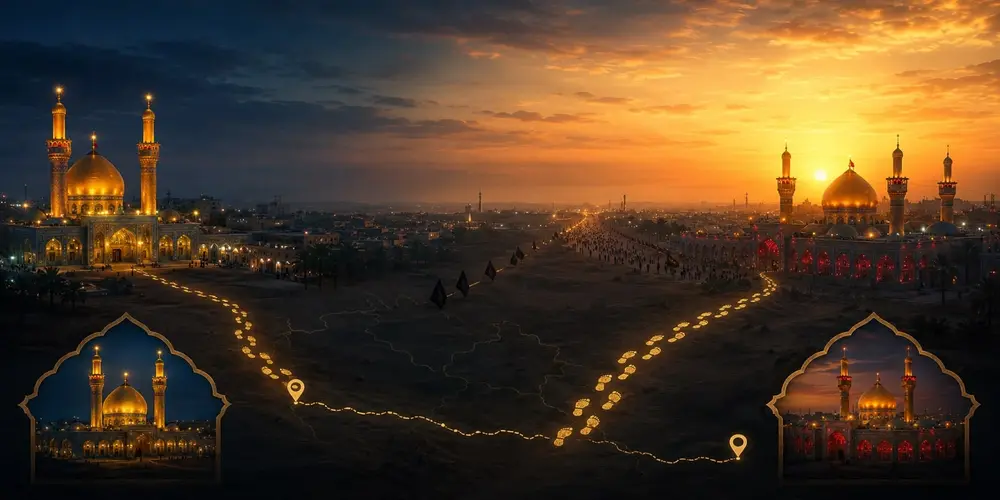
What started with one elderly companion and his student has grown into what is now widely regarded as the largest annual peaceful gathering on Earth. Every year, millions of pilgrims walk to Karbala from Najaf and other Iraqi cities – a journey of roughly 80 kilometers that typically takes two to three days on foot. Recent years have seen turnout estimated well into the tens of millions.
What makes the walk especially distinctive is the tradition of hospitality along the route. Thousands of mawakib (volunteer service stations) line the roads, offering pilgrims free food, water, tea, medical care, and rest, regardless of their nationality, sect, or background. Pilgrims of many faiths – not only Shia Muslims – have taken part or observed the walk over the years, drawn by its scale and its message of sacrifice, hospitality, and standing against oppression.
Recommended Amaal for Chehlum According to Fiqah e Jafria
Beyond the historical significance, Chehlum carries a specific set of recommended acts (amaal) within Fiqah e Jafria. The most authoritative reference point is a hadith from Imam Hasan al-Askari (AS), narrated by Shaykh al-Tusi, describing what are known as the five signs of a true believer:
- Praying 51 rakats within the 24 hours of the day – 17 rakats of obligatory (wajib) prayer, and 34 rakats of nafilah (recommended) prayer, which is simply the standard daily prayer schedule observed with care rather than something extra to memorize.
- Performing Ziyarat of Imam Hussain (AS) and the martyrs of Karbala – ideally in person in Karbala, but if that isn’t possible, reciting the Ziyarat of Arbaeen from wherever one is.
- Wearing a ring on the right hand.
- Placing the forehead on the earth during sajdah – preferably on a turbah made from the soil of Karbala.
- Reciting “Bismillah ir-Rahman ir-Raheem” audibly during the daily prayers, rather than silently.
Alongside this hadith, Imam Ja’far al-Sadiq (AS) specifically advised reciting the Ziyarat of Arbaeen on this day. Scholars note that after completing the recitation, it is recommended to follow it with a two-rakat prayer.
How to Perform Ziyarat Arbaeen if You Can’t Travel to Karbala
Not every believer is able to physically travel to Karbala, and Fiqah e Jafria accounts for this directly – the hadith itself specifies reciting the Ziyarat “from wherever you are” as the accepted alternative. In practice, this means:
- Performing ghusl (ritual bath) beforehand, in emulation of Jabir’s own preparation
- Facing the direction of Karbala if possible, though this is a matter of custom rather than a strict requirement
- Reciting the Ziyarat of Arbaeen text with presence of heart, ideally while in a state of purity (wudhu)
- Following the recitation with two rakats of prayer
Other Recommended Acts Commonly Observed
Beyond the five signs hadith specifically, many Shia communities also observe the following on Chehlum, in keeping with the broader spirit of the day:
- Attending or hosting a Majlis, where scholars recount the events of Karbala and their lessons
- Reciting Noha and Marsiya as an expression of grief and remembrance
- Giving charity (Sadaqa) or organizing Niyaz – the distribution of food in the name of Imam Hussain (AS), echoing the hospitality tradition of the mawakib along the Arbaeen walk
- Increased Quran recitation, particularly Surah Yasin, which is commonly read during days of mourning
- Renewing one’s commitment to the values Imam Hussain (AS) stood for – justice, truth, and resistance to oppression – as much a personal reflection as a ritual act
As with many matters of fiqh, small details such as the exact method of performing certain acts can vary between scholars, so it’s always worth confirming specifics with your own marja’ or local scholar where you’re uncertain.
Passing This Understanding to the Next Generation
Knowing the history behind Chehlum – not just the mourning rituals themselves – helps children understand why the day carries the weight it does. This kind of grounding is often built into structured Islamic education alongside Quran learning. At Al Mehdi Online Quran Center, the history of Karbala and its associated amaal are taught as part of a broader Fiqah e Jafria curriculum, alongside core Quran and Tajweed courses, so students grow up understanding the reasoning behind the practices, not just the practices themselves.
If you’d like your family to learn Fiqah e Jafria alongside Quran studies, explore the full range of classes on the Shia Online Quran Center page, or book a free trial class to get started.
Frequently Asked Questions
Who was the first person to perform Ziyarat Arbaeen? Jabir ibn Abdullah al-Ansari, a companion of Prophet Muhammad (PBUH), is recorded as the first person to visit Imam Hussain’s (AS) grave on the 20th of Safar, accompanied by his student Atiyyah al-Awfi.
Is it obligatory to travel to Karbala for Arbaeen? No. While being physically present in Karbala for Ziyarat is highly recommended and spiritually significant, the same hadith that recommends it explicitly allows for reciting the Ziyarat of Arbaeen from anywhere if travel isn’t possible.
What is the Ziyarat of Arbaeen? It is a specific supplication, advised by Imam Ja’far al-Sadiq (AS), recited in honor of Imam Hussain (AS) on the day of Arbaeen, expressing love, loyalty, and renewed commitment to his cause.
What are the “five signs of a believer” mentioned in relation to Chehlum? According to a hadith from Imam Hasan al-Askari (AS): praying 51 rakats in the day, performing or reciting Ziyarat of Imam Hussain (AS), wearing a ring on the right hand, prostrating on earth (preferably from Karbala), and reciting Bismillah audibly in prayer.
Why do so many pilgrims walk to Karbala rather than travel by vehicle? The walk itself is considered part of the spiritual practice, echoing the historical journey undertaken by Jabir and by pilgrims for generations since, and is supported along the way by thousands of volunteer-run rest stations offering free food and care.
To learn more about the history of Karbala alongside structured Quran and Fiqah e Jafria education, visit the courses page or sign up for a class suited to your family.