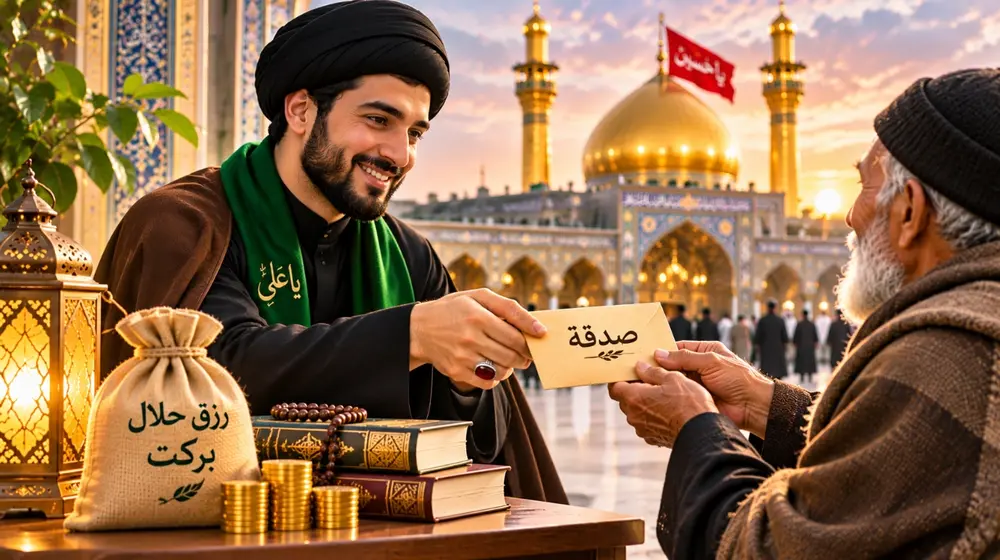
Islam allows, and even encourages, becoming wealthy, as long as the money is halal, the rights in it are paid, and the heart does not become its slave. The Quran links rizq (provision) to taqwa, istighfar, gratitude, hard work and spending in Allah’s way. Prophet Muhammad (s.a.w.w.) and Imam Ali (a.s.) add the secret of peace of mind: true richness is contentment of the heart, and wealth with barakah is wealth that serves you, your family and others, not wealth you serve.
The ten habits that bring both money and peace, according to the Quran and Ahlulbayt (a.s.): earn halal and avoid riba, work with effort and skill, keep up istighfar, give sadaqah daily, pay khums and zakat, be grateful, keep Salah on time, wake for Fajr and do not sleep through the morning, keep family ties, and practise qana’ah (contentment).
Key takeaways
- Wealth is not evil in Islam. Imam Ali (a.s.) called poverty “the greater death”.
- Allah has guaranteed provision for every creature (11:6), but He asks you to go out and seek it.
- Istighfar is promised to bring wealth (71:10–12); gratitude is promised to bring increase (14:7).
- Sadaqah does not reduce wealth. Imam Ali (a.s.) said: “Bring down provision through charity.”
- Peace of mind comes from qana’ah. Imam Ali (a.s.) said contentment is a wealth that never runs out.
Is it allowed to want to be rich in Islam?
Yes. Many prophets and Imams were wealthy at some point in their lives. Prophet Sulayman (a.s.) asked Allah for a kingdom like no other. Sayyida Khadijah (s.a.) was one of the richest merchants of Makkah, and her wealth supported Islam in its hardest years. Imam Ali (a.s.) worked with his own hands, planted date palms, dug wells and endowed them for the poor.
The Ahlulbayt (a.s.) were also clear about the danger of poverty. Imam Ali (a.s.) told his son Muhammad ibn al-Hanafiyya that he feared poverty for him, because it weakens faith, confuses the mind and breeds resentment (Nahj al-Balagha). He also called poverty “the greater death”. You can read these narrations collected in Mizan al-Hikmah on poverty.
So the question is not whether to seek wealth. It is how to earn it and what it does to your heart. The Quran says: “Wealth and children are the adornment of this worldly life, but lasting good deeds are better with your Lord” (18:46). Wealth is an adornment and a test, never the goal.
This is why the Quran’s ideal is a balance. Allah praises those who say: “Our Lord, give us good in this world and good in the Hereafter, and protect us from the punishment of the Fire” (2:201). Seeking good in this world, including money, is part of the dua the Quran itself teaches.
What the Quran says about rizq: 6 foundations
1. Your provision is guaranteed (11:6)
وَمَا مِن دَابَّةٍ فِي الْأَرْضِ إِلَّا عَلَى اللَّهِ رِزْقُهَا — “There is no creature on earth except that its provision is upon Allah.”
This is the first source of peace of mind. Your rizq is written; no competitor, boss or rival can take what is yours. Imam Ali (a.s.) described it beautifully in Nahj al-Balagha (Sermon 185): Allah named every bird, the crow, the eagle, the dove and the ostrich, and guaranteed each its sustenance. Anxiety about money often comes from forgetting this.
2. Taqwa opens doors you cannot see (65:2–3)
وَمَن يَتَّقِ اللَّهَ يَجْعَل لَّهُ مَخْرَجًا وَيَرْزُقْهُ مِنْ حَيْثُ لَا يَحْتَسِبُ — “Whoever is mindful of Allah, He makes a way out for him and provides for him from where he does not expect.”
Taqwa in business means honest weights, honest ads, honest invoices and honest tax. It means refusing the “easy” haram deal. The verse promises that what you give up for Allah’s sake comes back through doors you never planned.
3. Istighfar brings wealth (Surah Nuh 71:10–12)
فَقُلْتُ اسْتَغْفِرُوا رَبَّكُمْ إِنَّهُ كَانَ غَفَّارًا يُرْسِلِ السَّمَاءَ عَلَيْكُم مِّدْرَارًا وَيُمْدِدْكُم بِأَمْوَالٍ وَبَنِينَ
Prophet Nuh (a.s.) told his people: seek forgiveness, and Allah will send rain, increase you in wealth and children, and give you gardens and rivers. A well-known narration in the books of tafsir tells of people who complained of drought, poverty and childlessness, and each was told to do istighfar, citing these very verses. Sins block provision; istighfar removes the block.
4. Gratitude multiplies what you have (14:7)
لَئِن شَكَرْتُمْ لَأَزِيدَنَّكُمْ — “If you are grateful, I will surely increase you.”
Gratitude is both a feeling and a practice. Say Alhamdulillah for what you have before asking for more, look after what you own, and do not waste food or money. Peace of mind starts the moment you stop measuring your life against other people’s.
5. Spend, and Allah multiplies it (2:261)
Allah compares spending in His way to a seed that grows seven ears, with a hundred grains in each ear, “and Allah multiplies for whom He wills.” He also says: “Whatever you spend, He will replace it, and He is the best of providers” (34:39). In Islamic economics, charity is not a cost. It is an investment with a guaranteed return.
6. Work after worship (62:10) and keep Salah first (20:132)
فَإِذَا قُضِيَتِ الصَّلَاةُ فَانتَشِرُوا فِي الْأَرْضِ وَابْتَغُوا مِن فَضْلِ اللَّهِ — “When the prayer is finished, spread through the land and seek Allah’s bounty.”
And: “Command your family to pray and be steadfast in it. We do not ask you for provision; We provide for you” (20:132). The order matters: Salah first, then business. A shop that closes for Salah does not lose; it gains barakah.
What Prophet Muhammad (s.a.w.w.) taught about wealth and contentment
Real richness is in the heart. A well-known Prophetic teaching says that richness is not having many possessions; richness is the richness of the soul. You can have millions and feel poor, or have little and feel rich.
Make the Hereafter your main concern. Imam Ja’far al-Sadiq (a.s.) is narrated in al-Kafi as saying that whoever wakes and sleeps with the Hereafter as his greatest concern, Allah places richness in his heart and gathers his affairs for him. Whoever makes the world his greatest concern, Allah places poverty between his eyes and scatters his affairs. This is the exact formula for wealth with peace of mind.
Ask through charity. Imam Musa al-Kazim (a.s.) said: “Bring down sustenance through charity” (al-islam.org). The Prophet (s.a.w.w.) also taught that sadaqah wards off calamity, which protects the wealth you already have.
Honest trade is worship. The Holy Prophet (s.a.w.w.) was known in Makkah as al-Sadiq al-Amin, the truthful and trustworthy, long before prophethood, and he traded honestly with Sayyida Khadijah’s (s.a.) caravans. Honesty was his brand.
Shun riba completely. The Quran says Allah “destroys riba and makes charity grow” (2:276) and declares war on those who insist on interest (2:279). Interest can grow numbers on a screen while removing barakah and peace. Ask your Marja about permissible alternatives for mortgages, savings and business finance.
Imam Ali (a.s.) on wealth: 8 sayings for a rich and peaceful life
Imam Ali (a.s.) had ruled an empire and yet slept on simple bedding and ate barley bread. No one speaks about money with more authority.
- “Go out and seek your livelihood, for it is guaranteed to the one who seeks it.” (al-Irshad) Tawakkul does not mean sitting at home.
- “Provision is of two kinds: provision you seek, and provision that seeks you.” (Ghurar al-Hikam; see narrations on sustenance). Do your part, and let the second kind find you.
- “Bring down provision through charity.” (Nahj al-Balagha) and “If you become poor, trade with Allah through charity.” (narrations on charity).
- “Protect your wealth with zakat.” (Bihar al-Anwar). Paying the rights in your money is what keeps it safe. Read more in narrations on zakat.
- “The zakat of prosperity is kindness to neighbours and keeping ties with relatives.” (Ghurar al-Hikam). Wealth carries social duties.
- “Contentment is a wealth that never runs out.” (Nahj al-Balagha) — الْقَنَاعَةُ مَالٌ لَا يَنْفَدُ. This is the core of peace of mind.
- “Greed is permanent slavery.” (Nahj al-Balagha). The rich man who is never satisfied is not free.
- “Do not burden today with the worry of tomorrow.” In Short Saying 267, the Imam says that if tomorrow is part of your life, Allah will bring its provision with it. Plan for the future, but do not live in fear of it.
He also said that the one who is certain of being repaid gives generously. Generous people are often the calmest, because they trust that Allah replaces what they give.
10 practical steps to halal wealth with barakah
| Step | What to do | Basis |
|---|---|---|
| 1. Purify your income | Remove any haram, riba or deceptive source, even if it hurts at first | 2:275–279; 65:2–3 |
| 2. Work hard and build skill | Treat work as worship; master your trade | Imam Ali: “seek your livelihood” (al-Irshad) |
| 3. Consider trade and business | Imam al-Sadiq (a.s.) is narrated in al-Kafi saying nine-tenths of provision is in trade | al-Kafi |
| 4. Daily istighfar | Astaghfirullaha rabbi wa atubu ilayh, 70 times after Asr or 100 times daily | 71:10–12 |
| 5. Daily sadaqah | Give something every morning, even a small coin, to start the day | 2:261; 34:39; Imam Ali |
| 6. Pay khums and zakat | Calculate khums on your yearly surplus and pay according to your Marja’s guidance | 8:41; 9:103 |
| 7. Salah on time, especially Fajr | Narrations from the Imams warn that sleeping between Fajr and sunrise keeps away provision | 20:132; al-Kafi |
| 8. Keep family ties | Visit and help relatives; it is narrated to lengthen life and increase rizq | Imam Ali, Ghurar al-Hikam |
| 9. Recite Surah al-Waqi’ah at night | Imam al-Sadiq (a.s.) is narrated in Thawab al-A’mal saying its nightly reciter will not be struck by poverty | Thawab al-A’mal |
| 10. Practise qana’ah | Budget, avoid debt for luxuries, and stop comparing | Imam Ali: “contentment is wealth that never runs out” |
A note on khums: for Shia Muslims, khums on the annual surplus of income is a wajib duty and part of keeping your wealth clean. Our Fiqah e Jafria course explains the basics, and you can ask a Shia scholar online for help with your own calculation.
Duas for rizq from the Ahlulbayt (a.s.)
- Dua for debt and hardship from al-Sahifa al-Sajjadiyya. Dua 30 of Imam Zayn al-Abidin (a.s.) asks Allah for help in repaying debts, and Dua 7 is recited in any hardship. Learn about the Imam in our post on Shahadat Imam Zain ul Abideen (a.s.).
- Ma sha Allah, la quwwata illa billah (18:39). Imam al-Sadiq (a.s.) recommended this for the one who wants the good of this world, and the Quran follows it with “perhaps my Lord will give me better than your garden” (18:40).
- Salawat before and after every dua. Narrations teach that a dua placed between two salawat is not rejected.
- Dua Kumayl on Thursday nights and Dua e Mujeer for forgiveness, which clears the way for provision. See Dua e Mujeer: meaning, benefits and how to recite.
- Ziyarat of Imam Ali (a.s.). Many believers recite Ziyarat Ameenallah, a ziyarat narrated from Imam Zayn al-Abidin (a.s.), asking Allah through the Commander of the Faithful.
If you want to recite these duas correctly and understand them, our Dua & Ziyarat recitation classes teach them one-to-one with meaning, and our Arabic classes help you understand them directly.
Why some rich people have no peace (and how to avoid it)
The Quran warns about “competition in increase” that distracts people until they reach the graves (102:1–2). It describes Qarun, who said “I was given this because of my own knowledge” (28:78) and was swallowed by the earth with his treasures. These are the four signs that wealth is hurting you:
- You credit yourself, not Allah. Qarun’s mistake. Cure: Alhamdulillah and Ma sha Allah in every success.
- You withhold what is due. Unpaid khums, zakat, wages or debts remove barakah. Cure: pay promptly. The Prophet (s.a.w.w.) taught that a worker should be paid before his sweat dries.
- You are never satisfied. Imam Ali (a.s.) called greed permanent slavery. Cure: qana’ah and a clear “enough” number for your lifestyle.
- Money is taking you away from Salah and family. Cure: 62:9–10 — leave trade at the call to prayer, then return to it.
The Quran promises a different life for those who combine faith and good deeds: فَلَنُحْيِيَنَّهُ حَيَاةً طَيِّبَةً — “We will surely give them a good life” (16:97). A good life is wealth with peace.
Frequently asked questions
Is it haram to want to be rich in Islam?
No. Seeking halal wealth is allowed and even praised when it is used to support your family, help others and serve the faith. What Islam forbids is haram earning (riba, fraud, gambling), withholding the rights in wealth, and letting money become your god. Imam Ali (a.s.) warned against poverty and called it “the greater death”.
What is the fastest way to increase rizq in Islam?
The Quran names istighfar (71:10–12), taqwa (65:2–3), gratitude (14:7) and spending in Allah’s way (2:261). Imam Ali (a.s.) said: “Bring down provision through charity.” Combine these with honest, skilled work. There is no shortcut that skips effort.
Which surah is recited for rizq in Shia Islam?
Surah al-Waqi’ah (56) is widely recited every night for protection from poverty, based on a narration from Imam Ja’far al-Sadiq (a.s.) in Thawab al-A’mal. Many also recite Surah Yasin in the morning and Surah al-Mulk at night.
How do I get barakah in my money?
Earn halal, pay your khums and zakat, give daily sadaqah, avoid riba, be grateful, keep family ties and pray on time. Barakah means a little money doing a lot of good. It is the difference between wealth that serves you and wealth that worries you.
Does giving sadaqah really increase wealth?
Yes, according to the Quran (34:39, 2:261) and the Ahlulbayt (a.s.). Imam Ali (a.s.) advised the poor to “trade with Allah through charity”, and Imam al-Sadiq (a.s.) said charity helps settle debts and leaves blessings behind.
How can I be rich and still have peace of mind?
Make the Hereafter your main concern, as Imam al-Sadiq (a.s.) taught, and Allah places richness in your heart. Practise qana’ah, avoid debt for luxuries, keep Salah first and give regularly. Imam Ali (a.s.) said contentment is a wealth that never runs out.
Is sleeping after Fajr bad for rizq?
Narrations from the Imams (a.s.) in al-Kafi discourage sleeping between Fajr and sunrise and link it to reduced provision. The time after Fajr is best for dhikr, Quran and starting work.
Conclusion: rich hands, calm heart
The Quran and the Ahlulbayt (a.s.) do not ask you to choose between money and peace. They show you how to have both. Earn halal with effort and skill. Keep istighfar, gratitude and Salah at the centre. Give daily, pay khums and zakat, and keep family ties. Then let qana’ah protect your heart, so that whatever Allah gives you becomes a means of good rather than a source of worry.
As Imam Ali (a.s.) taught, provision is of two kinds: the kind you seek and the kind that seeks you. Do your part with honesty, and trust Allah with the rest.
Bring these teachings into your home. At Mehdi Quran Center, children and adults learn the Quran, duas and Fiqh e Jafria with qualified Shia teachers, live and one-to-one. Book 5 free trial classes, browse all courses, or read reviews from families. For children, our free Akhlaaq Juniors interactive book teaches honesty and sharing from an early age.
Sources and further reading
- The Holy Quran: 2:201, 2:261, 2:275–279, 8:41, 9:103, 11:6, 14:7, 16:97, 18:39–40, 18:46, 20:132, 28:78, 34:39, 62:9–10, 65:2–3, 71:10–12, 102:1–2
- Nahj al-Balagha, sermons and short sayings of Imam Ali (a.s.)
- Ghurar al-Hikam, al-Amidi; al-Irshad, Shaykh al-Mufid
- al-Kafi, Shaykh al-Kulayni; Thawab al-A’mal, Shaykh al-Saduq; Bihar al-Anwar, Allama Majlisi
- al-Sahifa al-Sajjadiyya, Imam Zayn al-Abidin (a.s.)
- al-islam.org: Sustenance · Charity · Zakat · Poverty · Sadaqah narrations
This article is general religious guidance, not financial advice. For rulings on khums, riba or business contracts, follow your Marja.