شہادتٲ حضرت علي اكبر (ع.س)
Shadat e Hazrat Ali Akbar (a.s.)
The Martyrdom of the Most Beautiful Youth of Karbala — The Living Image of the Holy Prophet (ص)
Introduction: The Flower of the Ahlul Bayt
Among all the martyrs who gave their lives on the plains of Karbala on the 10th of Muharram 61 AH,
none struck the heart of Imam Hussain (a.s.)
with a grief more intimate and more shattering than the martyrdom of his own beloved son,
Hazrat Ali Akbar (a.s.).
He was not only the firstborn son of the Imam — he was the living, breathing image of the
Holy Prophet Muhammad (صلی اللہ علیہ وآلہ وسلم).
To look upon Ali Akbar (a.s.) was, for all who had known the Prophet (ص), to see that most beloved face once more upon the earth.
His martyrdom was the moment Karbala broke the heart of its Imam — and in doing so, broke the heart of every
believer who has ever wept for Hussain across the centuries. To read more about the tragedy of Karbala,
visit our full collection of
Majlis & Muharram posts
at Al Mehdi Center.
Who Was Hazrat Ali Akbar (a.s.)?
| Full name | Ali ibn Hussain ibn Ali ibn Abi Talib (a.s.) |
| Title | Ali Akbar (“Ali the Elder”) · Shabih al-Nabi |
| Father | Imam Hussain ibn Ali (a.s.) |
| Mother | Layla binte Abi Murra al-Thaqafi |
| Paternal grandfather | Imam Ali ibn Abi Talib (a.s.) |
| Paternal grandmother | Lady Fatima al-Zahra (s.a.) |
| Age at Karbala | 18 years (narrations vary: 17–25 years) |
| Martyrdom | 10 Muharram 61 AH · Karbala, Iraq |
| Martyred by | Murra ibn Munqidh al-Abdi (spear) · followed by sword blows |
| Resting place | Haram of Imam Hussain (a.s.), Karbala, Iraq |
Shabih al-Nabi — The Living Image of the Prophet (ص)
The most extraordinary distinction of Hazrat Ali Akbar (a.s.) was his remarkable resemblance to his
great-grandfather, the Holy Prophet Muhammad (ص). Classical maqtal accounts describe him as
matching the Prophet (ص) in his face, his voice, his manner of walking, and his noble character.
Companions who had known the Prophet (ص) could not look upon Ali Akbar (a.s.) without being
overcome with longing and love for the one they had lost.
Imam Hussain (a.s.) himself would say:
“Whenever I longed for the face of the Holy Prophet (ص), I would look at Ali Akbar.”
This resemblance was not merely physical — it extended to his manner of speech, his recitation of
the Quran, and the light of his character. He was his great-grandfather reborn in the youth of Karbala.
It is narrated that when Ali Akbar (a.s.) called out the talbiya on the plains of Karbala
before riding to battle, those who heard him wept and said: “By Allah, we hear the voice of the
Messenger of Allah (ص).”
— classical maqtal narration
You can read more about the full biography of Hazrat Ali Akbar (a.s.) in our dedicated article:
Hazrat Ali Akbar (a.s.) Biography: The Life, Valor, and Martyrdom of the Prophet’s Mirror
.
The Night Before Ashura — Ali Akbar and His Father
On the eve of the 9th of Muharram, Imam Hussain (a.s.)
gathered his family and companions, extinguished the lamps, and released them all from their pledge —
urging them to leave under the cover of darkness and preserve their lives. One by one, the companions
and the men of Bani Hashim declared they would not leave their Imam.
Among the first and most resolute voices was that of Hazrat Ali Akbar (a.s.). He spoke words that
have echoed through every century of Muharram since that night:
“O Father — are we not upon the truth? Then why should we fear death? The one who dies for
truth does not truly die.”
Imam Hussain (a.s.) embraced his son and wept. It was an embrace between a father and his child —
tender, sacred, and final. The Imam held the face of the Prophet (ص) in the face of his son,
and knew that the morning would take it from the world. To understand the events of that night more
deeply, read our post on
The Arrival of Imam Hussain (a.s.) at Karbala: The Story of 2nd Muharram
.
The Day of Ashura — Ali Akbar Seeks Permission to Fight
A son before his father
On the morning of the 10th of Muharram, as the companions of Imam Hussain (a.s.) rode out to battle
one by one, the time came for the youth of Bani Hashim. Hazrat Ali Akbar (a.s.) came before his
father and requested permission to go to the battlefield.
Imam Hussain (a.s.) looked upon the face of his son for a long and silent moment. In that face he saw
the face of the Holy Prophet (ص). He gave his permission — because refusing would have been to deny
his son the highest honour a believer can attain. And then he raised his eyes to the heavens and made a
du’a that is among the most moving ever recorded:
“O Allah, be witness — for there has gone toward these people a youth who most resembles
Your Prophet Muhammad (ص) in his character, his appearance, and his speech. Whenever we longed for
the face of Your Prophet, we would look at him. O Allah — withhold from them the blessings of
the earth, divide them into factions, and never let their rulers be pleased until You are pleased
— for they invited us, and now they have turned against us.”
— Bihar al-Anwar, Vol. 45 · classical maqtal narration
His announcement on the battlefield
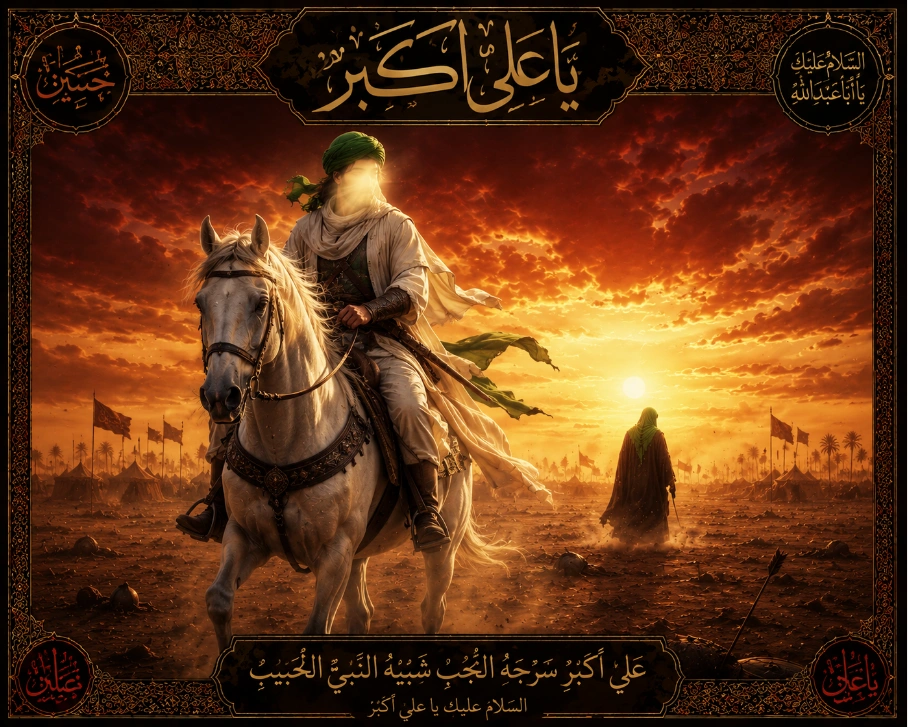
Ali Akbar (a.s.) rode forward onto the plain of Karbala and announced himself in the traditional
manner of single combat — giving his noble name and lineage. Even soldiers in the enemy ranks
wept when they heard his voice. Some said among themselves:
“How can we fight this young man? He is the voice and face of the Prophet (ص).”
Yet greed and blind obedience silenced their conscience.
Read our full dedicated Majlis post on this event:
Majlis 9: Hazrat Ali Akbar (a.s.) – The Ultimate Sacrifice of a Son in Karbala
.
The Battle — Courage and Thirst on the Field of Karbala
skill, cutting through the ranks of the enemy army. He was unstoppable in his first charges —
a warrior carrying the blood of Ali (a.s.) and the face of the Prophet (ص).
Ali Akbar (a.s.) returned to Imam Hussain (a.s.) and said: “O Father, thirst has finished me.”
The Imam wept, placed his own tongue against his son’s parched lips, and gave him his ring
to press against his mouth — for there was no water on the plains of Karbala. This exchange
is among the most grief-laden moments in the entire narrative of Karbala.
rest. He returned to the field and continued to fight with the same ferocity and nobility. Unable
to defeat him in single combat, the enemy began to attack in massed groups.
chest of Ali Akbar (a.s.), fatally wounding him. As his horse carried him forward, others fell
upon him with swords. He fell from his horse onto the earth of Karbala.
his father: “O Father — here is the greeting of my grandfather the Messenger of
Allah (ص). He says: come to us, for you are coming to us.” Even in his last breath,
he brought his father the glad tidings of what awaited beyond.
Imam Hussain Reaches His Son — A Father’s Grief
When Imam Hussain (a.s.)
heard the cry of his son, he ran to the battlefield. He reached the body of Ali Akbar (a.s.) and
placed his cheek against his son’s face. He held his son’s head in his lap. He looked into that
face — the face of the Holy Prophet (ص) — lying in the dust of Karbala, and he wept.
He wept openly, without restraint. He said:
“May the world be ended after you, O Ali! After you, what is the worth of this life? These
people have killed you — and by doing so, they have killed the Messenger of Allah (ص).
May Allah’s curse be upon those who killed you!”
— Bihar al-Anwar, Vol. 45
Bibi Zainab (s.a.)
came running from the tents when the news reached her, crying out: “O nephew! O Ali Akbar!”
She threw herself upon the body of her nephew. Imam Hussain (a.s.) held her gently and guided her
back toward the tents — he himself barely able to walk, for the grief was greater than any wound.
He returned from his son with his hand pressed to his heart. Those who saw him said they had never
witnessed a grief so complete, so annihilating — and yet so composed in surrender to the will of Allah.
For he was the son of Ali (a.s.) and Fatima (s.a.): he knew where his Ali Akbar had gone. And yet he was
human. And he was a father.
You can also read about another beloved martyr of that same day —
Who Was Ali Asghar (a.s.)? Shahadat, Story & Lessons
— the six-month-old infant son of Imam Hussain (a.s.), also martyred on Ashura.
Why This Martyrdom Holds a Place Apart
Ali Akbar (a.s.) was the first of the Bani Hashim youth to be martyred at Karbala. His sacrifice opened the way for all other young men of the Prophet’s family to give their lives on that day.
In sacrificing one who bore the very face and voice of the Holy Prophet (ص), Imam Hussain (a.s.) demonstrated that the Ahlul Bayt withheld nothing from Allah — not even the most beloved and irreplaceable image upon the earth.
The supplication of Imam Hussain (a.s.) at the departure of Ali Akbar is a father presenting his most beloved to Allah and calling upon God as witness to the injustice of those who stood against truth.
Ali Akbar’s final words — that the Prophet (ص) calls his father to join him — are understood as a divine comfort: the sacrifice is received, the reward is waiting, and the reunion is near.
A specific salutation (ziyarat) for Hazrat Ali Akbar (a.s.) is recited at the Haram of Imam Hussain (a.s.) in Karbala. Read our post on
Ziyarah Taziyah on Ashura.
The majalis of Muharram — in particular the 8th night — fill with nawhas and marsiyas recounting his youth, his likeness to the Prophet (ص), and his martyrdom.
The Grief That Made History Weep
Every martyrdom at Karbala carries its own unbearable weight. Every drop of blood that fell on that
earth was the blood of the household of the Prophet of Allah (ص). But the grief of
Imam Hussain (a.s.)
over Ali Akbar holds a particular quality — one that the narrations do not fully contain, that
the elegies of fourteen centuries cannot exhaust, and that every majlis touches but never fully reaches.
It is the grief of a father who sees in his son the face of his grandfather — and then watches that
face fall into the dust of Karbala. It is the grief that became a message: that truth costs everything,
that faith without sacrifice is not faith, and that the blood of the Ahlul Bayt (a.s.) is the eternal
seal upon the covenant of Islam.
Hazrat Ali Akbar (a.s.) was eighteen years old. He was the image of the Prophet. He was the son of
Hussain. He was the inheritor of Ali and Fatima. And he was the first jewel of the Ahlul Bayt youth
to be surrendered to the earth of Karbala — so that Islam would live in every age, and so that
we, across fourteen hundred years, would know what truth truly costs.
Also read:
The 70 Steps: Bibi Zainab & Bibi Sakina Witness Imam Hussain’s Last Sajda at Karbala
— another sacred narrative from the Day of Ashura.
◆ Related Posts You May Find Beneficial
Hazrat Ali Akbar (a.s.) Biography: The Life, Valor, and Martyrdom of the Prophet’s Mirror
Majlis 9: Hazrat Ali Akbar (a.s.) – The Ultimate Sacrifice of a Son in Karbala
The 70 Steps: Bibi Zainab & Bibi Sakina Witness Imam Hussain’s Last Sajda at Karbala
Who Was Ali Asghar (a.s.)? Shahadat, Story & Lessons
The Powerful Virtues of Ziarat e Ashura
The Arrival of Imam Hussain (a.s.) at Karbala: The Story of 2nd Muharram
Ziyarah Taziyah – Condolence Salutation on Ashura
Dua Nudba – Full Text & Transliteration
Deepen your connection with the Ahlul Bayt (a.s.) through authentic Islamic education.
Al Mehdi Center offers online Quran, Tajweed, and Islamic Studies classes for all ages.
Categories:
Hazrat Ali Akbar a.s ·
Imam Hussain a.s ·
Majlis / Muharram ·
Ahlulbayt a.s
السلام علیک یا شبیہ النبی المختار
السلام علیک یا شہید کربلا
Peace be upon you, O Ali son of Hussain the Elder
Peace be upon you, O image of the Chosen Prophet
Peace be upon you, O martyr of Karbala