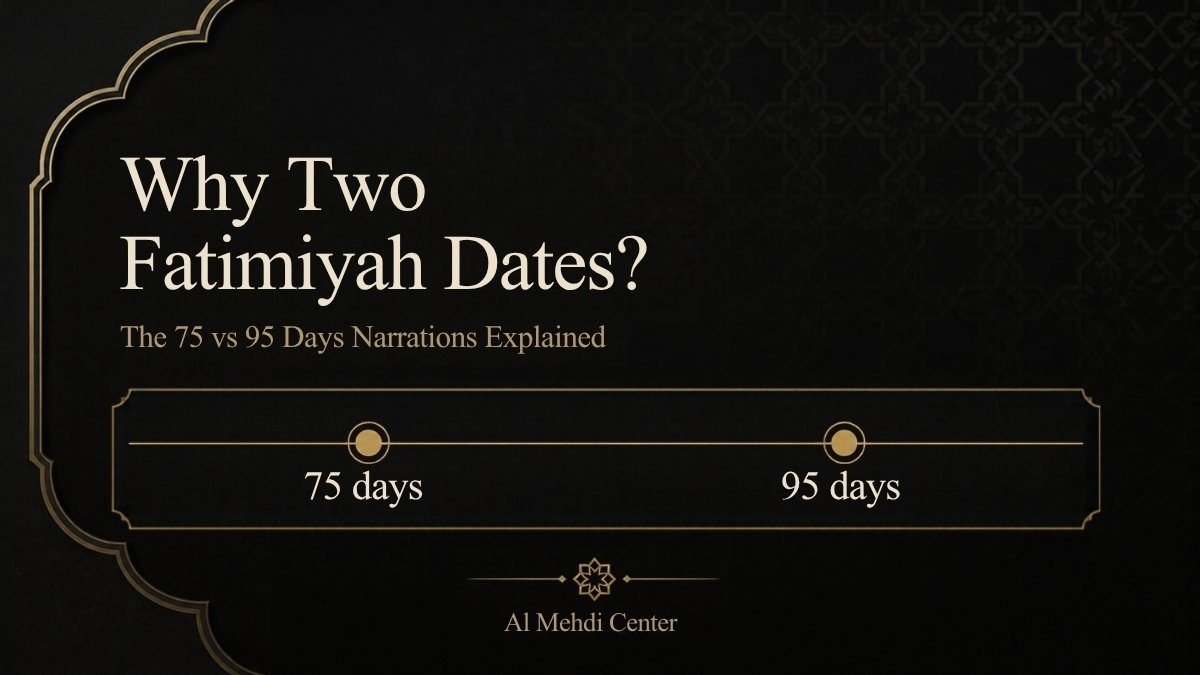
Quick answer: Shia scholars have recorded several reports about how long Sayyida Fatima al-Zahra (s.a.) lived after the Holy Prophet (s.a.w.w.) passed away. The two most widely observed are 75 days (13 Jumada al-Awwal) and 95 days (3 Jumada al-Thani). Because the exact date is not agreed, Shia communities mourn on both, calling them the first and second Fatimiyah.
The short version
| Report | Date it points to | Who commemorates it |
|---|---|---|
| About 40 days after the Prophet’s passing | 8 Rabi al-Thani | Some Iraqi communities |
| About 75 days | 13 Jumada al-Awwal | Iraq, Pakistan, India, diaspora centres, Iran (first Fatimiyah) |
| About 95 days | 3 Jumada al-Thani | Iran (official holiday since 2000), Iraq, diaspora centres (second Fatimiyah) |
| About 3 or 6 months | Not fixed to one day | Mentioned in historical works |
This is how a standard reference on Shia history summarises it: the date of her martyrdom is uncertain because the historical reports differ, ranging from forty days to six months, and communities in Iraq mark three of the dates while communities in Iran mark the last two.
Why do the reports differ?
Three reasons are usually given by historians and scholars:
- Her burial was not public. Shia traditions report that she was buried quietly at night, and her grave is not known with certainty. Several locations are mentioned in Shia works, so there was never a public funeral date to record.
- Early historical writing was done decades later. Different narrators recorded the interval between the two events differently.
- Different chains of narration. Each report reached later scholars through its own chain of transmitters, and the scholars weighed them differently.
The 95-day narration and Imam al-Sadiq (a.s.)
A well-known report narrated from Abu Basir quotes Imam Ja’far al-Sadiq (a.s.) as saying that Sayyida Fatima (s.a.) was martyred on a Tuesday, 3 Jumada al-Thani. This report is recorded in Dala’il al-Imama by al-Tabari. Many Shia scholars regard 3 Jumada al-Thani as the more strongly supported date, which is why Iran made it a public holiday. The revival of large public Fatimiyah mourning in the modern period is linked to the seminary of Qom established by Shaykh Abd al-Karim Ha’iri.
The 75-day narration
The 75-day report places her passing on 13 Jumada al-Awwal. It is the date marked on the calendars of many Shia centres across Pakistan, India and the West, and in Iraq. Observing both days is therefore not a contradiction: it is a way of honouring every well-supported report without insisting on a single one.
What do Sunni sources say?
Many Sunni historians report that she lived about six months after the Prophet (s.a.w.w.). Muslims of every school agree on the heart of the matter: she was the beloved daughter of the Messenger of Allah, and the Prophet said that she is a part of him. Shia Muslims commemorate her loss through mourning gatherings, while the details of the events after the Prophet’s passing, such as the dispute over Fadak and her sermon, are narrated in Shia and some Sunni books. We recommend reading original sources with a qualified teacher rather than online debates.
So which date should I follow?
- Follow the programme of your local imambargah and the calendar of your marja’.
- If your family can only attend one, many families choose the second Fatimiyah because it is commonly considered the more reliable date. Others attend both. Both are valid ways of showing love for Ahlulbayt (a.s.).
- Remember that the purpose is remembrance and learning, not winning an argument about dates.
For the actual calendar dates this year, see Ayyam-e-Fatimiyah 2026 Dates, and for the bigger picture of why these days matter, read Ayyam e Fatimiyah: Remembering Sayyida Fatima Zahra (SA).
How to explain this to your children
Children often ask, “Why do we have two days?” A simple answer for ages 6 to 10:
“Long ago, people wrote down how many days Bibi Fatima (s.a.) lived after the Prophet (s.a.w.w.) left this world. Some wrote 75 days and some wrote 95 days. Because we love Bibi Fatima (s.a.) so much, we remember her on both days.”
Our age-by-age guide to teaching children about Bibi Fatima Zahra has more child-friendly wording.
Want your child to learn Shia history and Fiqah e Jafria from a qualified teacher? Al Mehdi Center offers live one-to-one classes since 2012. Explore the Fiqah e Jafria course or book 5 free trial classes.
Frequently Asked Questions
What is the date of Bibi Fatima Zahra’s martyrdom?
There is no single agreed date. The two most commonly observed Shia dates are 13 Jumada al-Awwal (75-day report) and 3 Jumada al-Thani (95-day report). Some communities also mark 8 Rabi al-Thani, based on a 40-day report.
Which date is more authentic, 13 Jumada al-Awwal or 3 Jumada al-Thani?
Scholars differ. Many give more weight to 3 Jumada al-Thani because of the report from Imam al-Sadiq (a.s.) that she was martyred on a Tuesday, 3 Jumada al-Thani. Others observe the 75-day date. Observing both is common and acceptable. For a personal ruling, ask your marja’.
What is the difference between the first and second Fatimiyah?
The first Fatimiyah commemorates the 75-day date, 13–15 Jumada al-Awwal. The second commemorates the 95-day date, 3–5 Jumada al-Thani.
Where is Sayyida Fatima Zahra (s.a.) buried?
Her burial place is not known with certainty. Shia sources mention several possibilities in Madinah, including Jannat al-Baqi’, her own house and the area between the Prophet’s grave and his pulpit.
Do Sunni Muslims mourn Fatima Zahra (s.a.) too?
Sunni Muslims honour her as the daughter of the Prophet and the leader of the women of Paradise, but the Fatimiyah mourning gatherings are a distinctly Shia tradition.
Is it wajib to attend Fatimiyah majalis?
No. Attending mourning gatherings is a recommended and widely practised way of remembering the Ahlulbayt (a.s.), not an obligation. Your marja’ can give you detailed guidance.
Sources
- WikiShia: Fatimiyya (variance of historical reports, Iraq and Iran practice, Imam al-Sadiq narration)
- Wikipedia: Fatimiyya
- Wikipedia: Twelver Shia holy days
- Al-Islam.org: Sayyida Fatimah al-Zahra
- Classical source cited by the above: al-Tabari, Dala’il al-Imama.
This is educational information, not a fatwa. For rulings, please refer to your own marja’.