The 70 Steps: Bibi Zainab & Bibi Sakina Witness Imam Hussain’s Last Sajda at Karbala
In the annals of Islamic history — and most profoundly in the living tradition — no event carries the weight, grief, and divine significance of the tragedy of Karbala. On the 10th of Muharram, 61 AH (680 CE), Imam Hussain ibn Ali (a.s.), the grandson of the Holy Prophet Muhammad (صلی اللہ علیہ وآلہ وسلم), the son of Imam Ali (a.s.) and Lady Fatima Zahra (s.a.), accepted the ultimate sacrifice to preserve the truth of Islam.
Two figures stood at the centre of the most shattering moments of that day — moments that the faithful of Fiqah e Jafria have wept over for fourteen centuries: Bibi Zainab bint Ali (s.a.), the sister of Imam Hussain (a.s.), and Bibi Sakina bint Hussain (s.a.), his beloved young daughter. According to the narrations preserved in Shia tradition, both of these sacred women witnessed, from across those burning sands, the last earthly moments of their Imam — as he fell into his final Sajda (prostration) on the ground of Karbala.
“Every day is Ashura, and every land is Karbala.” — attributed narration in Shia tradition
✦
The 70 Steps
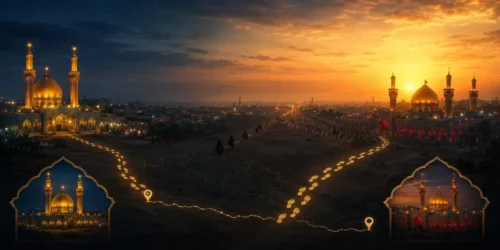
Among the most heart-rending narrations preserved in the Shia oral and written tradition is the account known as the Seventy Steps. According to classical scholars of Fiqah e Jafria — drawing from sources such as Maqtal al-Hussain by Khwarazmi, Bihar al-Anwar by Allama Majlisi, and narrations attributed via the chain of Ahlul Bayt (a.s.) — the tents of the women and children of Imam Hussain (a.s.) were located approximately seventy steps (roughly 50–70 metres in traditional reckoning) from the battlefield.
This distance of seventy steps was not merely physical — it was the distance between life and death, between the world of the living and the moment of the greatest martyrdom. According to these narrations, when Imam Hussain (a.s.) was struck down by the army of Yazid ibn Muawiya and fell to the earth, both Bibi Zainab (s.a.) and Bibi Sakina (s.a.) saw him from across those steps. Each, in their own way — separated by age, by role, by the nature of their grief — made their way toward him.
Key Fiqah e Jafria Historical Facts — The 70 Steps Context
1 The tents (khaimgah) were set at the instruction of Imam Hussain (a.s.) himself, placed at a deliberate distance from the battlefield to protect the women and children (ahlul bayt) from direct assault.
2 Imam Hussain (a.s.) had said his farewells to the women and children multiple times on the night of Ashura (9th Muharram) and the morning of the 10th, urging patience and steadfastness in the tradition of the Prophets.
3 According to narrations cited by Allama Majlisi in Bihar al-Anwar, Bibi Zainab (s.a.) had been watching the battlefield throughout the day from near the tents, as she was responsible for the safety of the women and children.
4 The “seventy steps” figure is cited in classical maqtal literature (accounts of martyrdoms) and is referenced in elegies (marsiyas) and lamentations (nauhas) in the Shia tradition as representing the unbridgeable yet painfully close distance of grief.
5 According to Shia narrations, at the moment Imam Hussain (a.s.) fell to the ground wounded and exhausted, the sound of the wailing from the tents arose. It is narrated that Bibi Zainab (s.a.) cried out: “O Muhammad! O Ali! O Fatima!”
6 Bibi Sakina (s.a.), a child estimated by scholars to be between 3 and 6 years of age at the time of Karbala, was described as extremely close to her father, often sleeping on his chest. Her grief at witnessing his fall is recorded as one of the most moving episodes in maqtal literature.
7 The narrations unanimously preserve that Imam Hussain (a.s.), even in his final moments, performed Sajda — prostration before Allah — and breathed his last in that position of complete submission to God. This Sajda became known as Sajda-e-Shahdat (the prostration of martyrdom).
✦
Bibi Zainab bint Ali (s.a.)
Daughter of Imam Ali (a.s.) and Lady Fatima Zahra (s.a.) · Sister of Imam Hussain (a.s.)
Bibi Zainab (s.a.) — The Lion-Hearted Witness
The Last Watch
All through the morning of Ashura, Bibi Zainab (s.a.) had been a mountain of strength for the women and orphaned children huddled within the tents. She had helped prepare the men for battle. She had said farewell to her brother — her Hussain — knowing, as she knew, that this farewell was unlike all others. She had comforted the weeping mothers of those who rode out to give their lives. She had been the keeper of the soul of the camp.
But with each passing hour, the sounds from the battlefield had grown fewer. One by one, the companions of Imam Hussain (a.s.) had fallen. Then the Bani Hashim — the men of his own family. Then his sons. Then his brothers. Bibi Zainab (s.a.) had watched and wept and remained firm. The narrations tell us she did not allow herself to collapse — because Imam Hussain (a.s.) himself had asked her to be the guardian of those who remained.
The Moment of Falling
According to the narrations when the final assault came upon Imam Hussain (a.s.) — when he was left alone, when his horse had been hamstrung, when arrows had found him from every side — Bibi Zainab (s.a.) could no longer remain behind. She came to the entrance of the tent. She looked across those seventy steps of burning Karbala sand.
She saw her brother — tall even in his wounds, noble even in his exhaustion — surrounded by enemies. She saw him sway. She saw him dismount. She saw him fall to his knees.
And then — as the narrations from Maqtal al-Hussain describe — she saw him place his blessed forehead upon the earth of Karbala in Sajda. His lips moved in the words of remembrance of Allah. His body, torn by wounds, stilled as he submitted himself completely to his Lord. It was the Sajda of the most perfect of men — and it would be his last.
It is narrated that Bibi Zainab (s.a.) cried out to her grandfather the Prophet (ص): “O Grandfather! The stars of heaven today bear witness to the martyrdom of Hussain!”
Crossing the 70 Steps
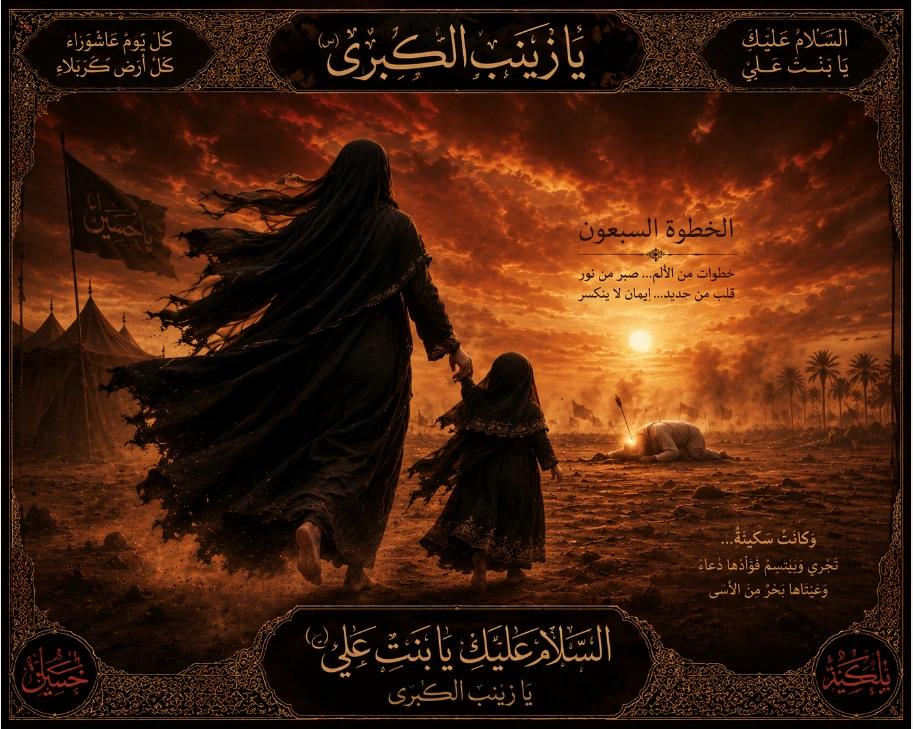
Bibi Zainab (s.a.) ran — barefoot, her veil in disarray from the wind and the grief — across those seventy steps. The narrations tell us she fell more than once. The sand was hot enough to burn. The cries of the women behind her mingled with the sounds of the enemy. Yet she ran, because her heart could not be severed from her Hussain.
She reached him — or as close as the enemy would permit. She cried out to those who stood over his fallen body. According to narrations cited in Luhuf by Sayyid ibn Tawus, she called out: “O Umar ibn Sa’d! Is this Abu Abdillah? Is this the grandson of the Messenger of Allah?”
The narrations record that even hardened soldiers wept at the sight of this noble woman’s grief — the daughter of Fatima Zahra (s.a.), the granddaughter of the Prophet (ص), standing beside the fallen body of her brother, who lay in his final Sajda before Allah.
In that moment, Bibi Zainab (s.a.) transformed forever. She had been the protector of the camp. Now she became the voice of Karbala — the one who would carry its message to Kufa, to Sham, and to all of history. Her grief did not break her; it became the sword by which Imam Hussain’s mission conquered every heart in every age.
✦
Bibi Sakina bint Hussain (s.a.)
Beloved daughter of Imam Hussain (a.s.) · The Light of his Eye
Bibi Sakina (s.a.) — The Child Who Knew
A Father Like No Other
Among all the children in the tents of Karbala, none was closer to Imam Hussain (a.s.) than his daughter Sakina (s.a.). The classical Shia sources — including Bihar al-Anwar and the accounts of the maqtal tradition — describe her as a child of extraordinary beauty, intelligence, and devotion, who was inseparable from her father. It is narrated that she would sleep upon his chest each night and that Imam Hussain (a.s.) would refer to her as the light of his eyes, the solace of his heart.
On the night of Ashura, when Imam Hussain (a.s.) gathered his family to speak his last will and to grant them permission to leave if they wished, it is narrated that Bibi Sakina (s.a.) clung to him and wept — the pure and untainted weeping of a child who understood, in the deepest part of her soul, that tomorrow would change everything. The Imam held her close and recited poetry of consolation. He told her: “My Sakina, do not let your tears destroy my resolve.”
The Morning of Ashura
On the morning of the 10th Muharram, as the army of Yazid drew into formation and the sounds of drums and arrows filled the air, Bibi Sakina (s.a.) watched from within the tents. She is described in narrations as holding the garment of her aunt Bibi Zainab (s.a.), her small face turned always toward the direction of her father’s voice.
As the day passed and the companions and family of Imam Hussain (a.s.) fell one by one, the narrations describe Bibi Sakina (s.a.) calling for her father with a child’s unconditional certainty — “Where is Baba? Has he drunk water yet? Is Baba coming back?” She had been told he would return. A child does not understand that the greatest of men return only in spirit, in message, in the immortality of their sacrifice.
The Last Sight Across 70 Steps
When the sound of the final battle reached the tents — when the cries of the women rose and the horses were heard in turmoil — Bibi Sakina (s.a.) broke away from those around her. According to narrations preserved in the Shia tradition, she ran from the tent toward the sounds of her father.
She crossed part of those seventy steps — this small child in her dusty clothes — before the women caught up to her or the chaos of the enemy drove her back. But in that terrible, sacred moment, she saw across the burning plain: her father, her Hussain, fallen on the earth of Karbala, his body still, his forehead pressed to the ground in his last Sajda before Allah.
The narrations preserve that Bibi Sakina (s.a.) called out: “Baba! Baba! Who has laid you on the ground? Who has covered your face with dust? Baba, why do you not answer Sakina?”
This cry of Bibi Sakina (s.a.) is preserved in countless elegies, lamentations, and majalis of Muharram across the Muslim world. It is not merely poetry — it is the crystallisation of the grief of an innocent soul watching the best of men give everything for the truth of Islam.
The Sajda She Witnessed
According to narrations, Imam Hussain (a.s.), even after being struck by the final blow of Shimr ibn Dhil Jawshan and the sword of Sinan ibn Anas, did not die in a position of defeat. Rather, he lowered himself — in full consciousness, with the remembrance of Allah on his lips — into the position of Sajda. His forehead touched the earth that bore his blood. His final breath was drawn in complete submission to Allah.
What Bibi Sakina (s.a.) witnessed from those seventy steps was this: her father, the Imam, not conquered — but bowing before the only One to whom he had ever bowed. She had seen him perform Sajda in prayer her entire life. And now she saw him perform his last Sajda — not in the mihrab of a mosque, but on the burning sands of Karbala, with the blood of his companions and family around him and the sky above turned red with the grief of the heavens.
It is from this vision — this unbearable and yet transcendent sight — that Bibi Sakina (s.a.) carried a wound in her heart for the rest of her short life. The narrations of Fiqah e Jafria record that she never recovered from the loss of her father. She wept for him in the prison of Sham (Damascus), she wept for him in the court of Yazid, and she returned his name to the lips of every soul she encountered.
She passed away, according to most narrations, in the prison of Yazid in Damascus — still a child, still weeping for Baba — and her shrine stands in Damascus, Syria, as a place of visitation and lamentation to this day.
✦
The Last Sajda of Imam Hussain (a.s.) — Its Meaning
The scholars hold the final Sajda of Imam Hussain (a.s.) in extraordinary reverence. It is understood not merely as a physical act, but as the ultimate theological statement of his mission. Throughout his life, Imam Hussain (a.s.) refused to bow before falsehood — before Yazid ibn Muawiya, before tyranny, before the corruption of Islam’s sacred trust. His entire stand at Karbala was his refusal to give bay’ah (allegiance) to a ruler who had made lawful what Allah made forbidden.
And yet, in his very last moment — having refused to bow to any human power — he bowed before Allah. The Sajda that both Bibi Zainab (s.a.) and Bibi Sakina (s.a.) witnessed from those seventy steps was the completion of his message: I bow to none but God. I live for none but God. And I die in submission to none but God.
Fiqah e Jafria — Historical Reference
The account of the final Sajda of Imam Hussain (a.s.) is preserved in Bihar al-Anwar (Vol. 45) by Allama Muhammad Baqir Majlisi and in Maqtal al-Hussain by Abu Mikhnaf, among other classical Shia sources.
Significance in Ziyarat
The Ziyarat of Ashura and Ziyarat-e-Warith — recited by Shia Muslims worldwide — reference Imam Hussain’s complete submission to Allah and his sacrifice in preserving the Deen of the Prophet (ص).
Bibi Sakina’s Resting Place
Bibi Sakina (s.a.) passed away in captivity in Damascus. Her mausoleum (Maqam Sayyida Ruqayya / Bibi Sakina) in Damascus, Syria, remains one of the most visited Shia shrines in the world.
Bibi Zainab’s Legacy
Bibi Zainab (s.a.) delivered her historic sermon in the court of Yazid in Damascus, publicly exposing the injustice of Karbala. Her mausoleum in Damascus is also a major pilgrimage site. She is honoured as the “Heroine of Karbala.”
✦
70 Steps That Echo Through All of History
The seventy steps between the tents and the place where Imam Hussain (a.s.) fell were not merely a measure of distance. They were the distance between the human and the divine, between grief and eternity, between what is seen and what is understood only by those whose hearts have been opened by love.
Bibi Zainab (s.a.) crossed those seventy steps as a sister and as the voice of Karbala. She carried the message of Imam Hussain (a.s.) from the dust of that plain to the courts of kings, to the ears of generations, and to the hearts of all who seek truth. Her grief did not silence her — it empowered her to speak the greatest sermon of courage in Islamic history.
Bibi Sakina (s.a.) crossed those steps as a child — as the innocence of humanity standing witness to the sacrifice of the best among us. Her cry for her father across those steps has never ceased. It echoes in every majlis, in every marsiya, in every tear shed for Hussain on the night of Ashura, in every corner of the world where the faithful of Fiqah e Jafria gather to remember.
Hussain is the Imam of the free — in every age, in every land. And Zainab and Sakina are the eternal witnesses that truth, once spoken with one’s life, can never be silenced.
السلام علیک یا اباعبداللہ الحسین — السلام علیک یا زینب الکبری — السلام علیک یا سکینۃ البتول