🔊 Audio will play automatically after you click anywhere on this page (browser policy). Press play button if needed.
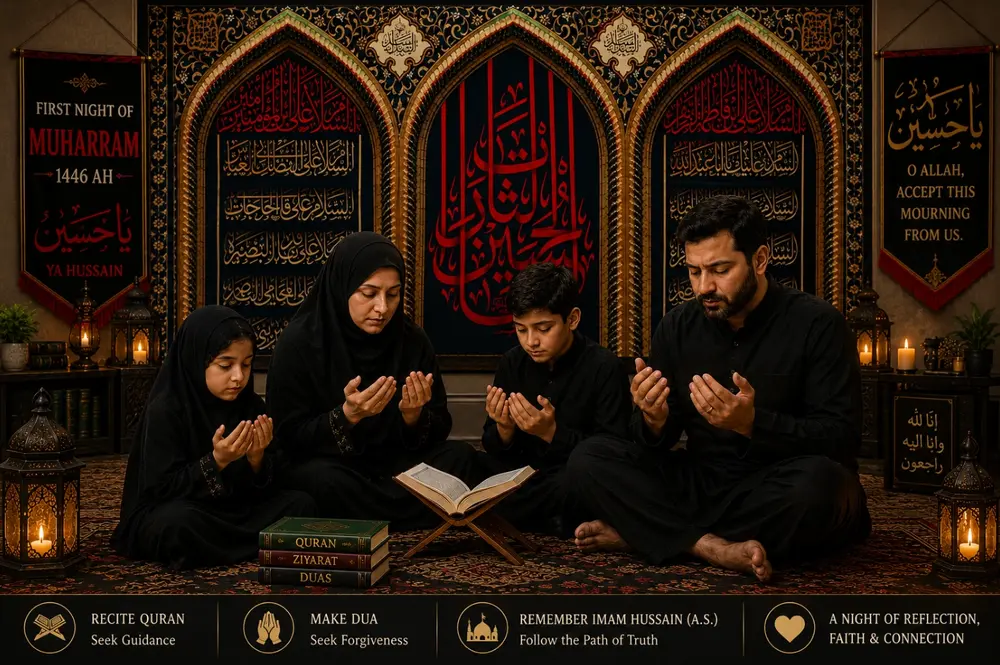
As the new moon of Muharram is sighted and the black flags rise over the shrines of Karbala, the Islamic year 1448 AH begins. For Shia Muslims around the world, 1st Muharram is not a day of celebration in the conventional sense — it is a day of solemn reflection, renewal of faith, and remembrance of the supreme sacrifice of Imam Hussain (AS) and his companions at Karbala.
Hadith on Recommendation of Fasting on first Muharram
Rāyyan bin Shabeeb (the maternal uncle of Mo’tasim), says that I went to meet Imām Ali ar Rezā (a.s.) on the First day of the month of Muharram
Imām Alī ibn Mūsā al-Rezā (A.S.) asked:”“O son of Shabeeb! Are you in the state of fasting today”?
I (Rāyyan bin Shabeeb) replied in the negative. Imām (a.s.) continued,“This is the day when Prophet Zakariyyah (a.s.) prayed to his Lord thus:“Lord grant me from unto Thee a good offspring, Verily Thou art the Hearer of Prayers” (Surah al-Ali Imran, 3:38).
Then Allāh (s.w.t.) accepted his Prayers and commanded His Angels to go and give him glad tidings regarding the birth of his son Prophet Yahyā (a.s.). The Angels came and called out to him while he was engaged in Prayers in the niche. Hence the one who fasts on this day and asks for his desires from Allāh, his Prayer will be answered as was of Zakariyāh.”
[References: Nafasul Mahmum, Chapter 3, Section 2, Tradition 1]
Sayyid Ibn Tawus has mentioned the merits of observing fasting during the whole month of Muharram adding that such a deed protects against committing any sin.
Take a Ghusl /bath,
with the intention(Niyat) of “Rija” for cure/protection from illness .Recite the following Dua on the water to be used:-
Subh’anallahi maal-al mizaan Subh’anallahi muntahal h’ilm
Glory be to Allah the Supreme balance ,Glory be to Allah the Ultimate in gentleness,
Subh’anallahi mublaghar riz’aa Subhanallahi zinatal a’rsh
Glory be to Allah the Goal of devotedness, Glory be to Allah the splendor of the Arsh
Yet alongside this remembrance, our tradition gives us something beautiful: specific duas (supplications) and amaal (recommended acts) for the first night and first day of Muharram — ways to turn to Allah (SWT), seek His protection, and set the spiritual tone for the year ahead.
This guide brings together the Dua to recite on the first night of Muharram, along with the recommended Amaal-e-Muharram as preserved in Shia tradition.
📍 The Significance of 1st Muharram
Muharram is one of the four sacred months mentioned in the Holy Quran, and it holds special importance in Shia Islam for several reasons:
- It marks the beginning of the Islamic Hijri calendar, commemorating the migration (Hijrah) of Prophet Muhammad (SAW) from Makkah to Madinah.
- It is the month in which the tragedy of Karbala took place — culminating in the martyrdom of Imam Hussain (AS) on the 10th of Muharram (Ashura).
- Good deeds performed in this month carry greater weight, and it is considered a time when Allah’s mercy and forgiveness are especially abundant.
For these reasons, the first night of Muharram has been given special importance by the Ahlul Bayt (AS), who have taught us specific duas to recite as we enter this sacred month.
🌙 Dua for the First Night of Muharram
According to a narration from Imam Ali Ridha (AS), the Holy Prophet (SAW) used to perform two units (rakats) of prayer on the first night of Muharram, and after completing the prayer, would recite the following dua three times.
This dua is a powerful supplication — it asks Allah for protection from Satan, control over one’s own self and desires, and to be granted a year filled with closeness to Allah.
How to Perform This Amaal:
- Perform Wudu (ablution) with sincerity and presence of heart.
- Offer two Rakat Nafl Namaz (a simple two-unit voluntary prayer).
- After completing the prayer, recite the following dua three times, with focus and humility.
بِسْمِ اللَّهِ الرَّحْمَٰنِ الرَّحِيمِ
اَللَّهُمَّ أَنْتَ ٱلإِلٰهُ ٱلْقَدِيمُ
allahumma anta al-ilahu alqadimu
O Allah, You are the Eternal God
وَهٰذِهِ سَنَةٌ جَدِيدَةٌ
wa hadhihi sanatun jadidatun
and this is a new year;
فَأَسْأَلُكَ فِيهَا ٱلْعِصْمَةَ مِنَ ٱلشَّيْطَانِ
fa-as’aluka fiha al`ismata mina alshshaytani
I therefore request Your safety from Satan,
وَٱلْقُوَّةَ عَلَىٰ هٰذِهِ ٱلنَّفْسِ ٱلأَمَّارَةِ بِٱلسُّوءِ
walquwwata `ala hadhihi alnnafsi al-ammarati bilssu’i
control over my self, which is inclined to sinning,
وَٱلاِﹾشْتِغَالَ بِمَا يُقَرِّبُنِي إِلَيْكَ يَا كَرِيمُ
walishtighala bima yuqarribuni ilayka ya karimu
engagement in all that which draws me near You, O All-generous!
يَا ذَا ٱلْجَلاَلِ وَٱلإِكْرَامِ
ya dha aljalali wal-ikrami
O Lord of majesty and honor!
يَا عِمَادَ مَنْ لاَ عِمَادَ لَهُ
ya `imada man la `imada lahu
O Supporter of him who has no supporter!
يَا ذَخِيرَةَ مَنْ لا ذَخِيرَةَ لَهُ
ya dhakhirata man la dhakhirata lahu
O Provider of him who has no provisions!
يَا حِرْزَ مَنْ لاَ حِرْزَ لَهُ
ya hirza man la hirza lahu
O Shelter of him who has no shelter!
يَا غِيَاثَ مَنْ لاَ غِيَاثَ لَهُ
ya ghiyatha man la ghiyatha lahu
O He who comes to help him who has no hope of help!
يَا سَنَدَ مَنْ لاَ سَنَدَ لَهُ
ya sanada man la sanada lahu
O Reliance for him who has no one to lean upon!
يَا كَنْزَ مَنْ لاَ كَنْزَ لَهُ
ya kanza man la kanza lahu
O Treasure of him who has nothing in the purse!
يَا حَسَنَ ٱلْبَلاَءِ
ya hasana albala’i
O He who knows well how to put to test and trial!
يَا عَظِيمَ ٱلرَّجَاءِ
ya `azima alrraja’i
O Ultimate Hope!
يَا عِزَّ ٱلضُّعَفَاءِ
ya `izza alddu`afa’i
O Strength of the weak!
يَا مُنْقِذَ ٱلْغَرْقَىٰ
ya munqidha algharqa
O Rescuer of the drowning!
يَا مُنْجِيَ ٱلْهَلْكَىٰ
ya munjiya alhalka
O He who saves from destruction!
يَا مُنْعِمُ يَا مُجْمِلُ
ya mun`imu ya mujmilu
O All-benefactor! O All-munificent!
يَا مُفْضِلُ يَا مُحْسِنُ
ya mufdilu ya muhsinu
O All-favorer! O All-benevolent!
أَنْتَ ٱلَّذِي سَجَدَ لَكَ سَوَادُ ٱللَّيْلِ وَنُورُ ٱلنَّهَارِ
anta alladhi sajada laka sawadu allayli wa nuru alnnahari
You are He before Whom prostrate in adoration the blackness of the night and the brightness of the day,
وَضَوْءُ ٱلْقَمَرِ وَشُعَاعُ ٱلشَّمْسِ
wa daw’u alqamari wa shu`a`u alshshamsi
the moonlight, the sunlight,
وَدَوِيُّ ٱلْمَاءِ وَحَفِيفُ ٱلشَّجَرِ
wa dawiyyu alma’i wa hafifu alshshajari
the ripple of the water, and the rustling of the trees!
يَا اللَّهُ لاَ شَرِيكَ لَكَ
ya allahu la sharika laka
O Allah! There is no associate with You!
اَللَّهُمَّ ٱجْعَلْنَا خَيْراً مِمَّا يَظُنُّونَ
allahumma ij`alna khayran mimma yazunnuna
O Allah! (Please do) cause us to be better than what they think of us!
وَٱغْفِرْ لَنَا مَا لاَ يَعْلَمُونَ
waghfir lana ma la ya`lamuna
Forgive us that which they do not know!
وَلاَ تُؤَاخِذْنَا بِمَا يَقُولُونَ
wa la tu’akhidhna bima yaquluna
Do not blame us for what they say!
حَسْبِيَ ٱللَّهُ لاَ إِلٰهَ إِلاَّ هُوَ
hasbiya allahu la ilaha illa huwa
Sufficient is Allah (for me). There is no god save Him,
عَلَيْهِ تَوَكَّلْتُ وَهُوَ رَبُّ ٱلْعَرْشِ ٱلْعَظِيمِ
`alayhi tawakkaltu wa huwa rabbu al`arshi al`azimi
On Him do I rely, and He is the Lord of the Great Throne.
آمَنَّا بِهِ كُلٌّ مِنْ عِنْدِ رَبِّنَا
amanna bihi kullun min `indi rabbina
We believe in it! It is all from our Lord!
وَمَا يَذَّكَّرُ إِلاَّ أُوْلُوٱ ٱلأَلْبَابِ
wa ma yadhdhakkaru illa ulu al-albabi
None do mind except those having understanding.
رَبَّنَا لاَ تُزِغْ قُلُوبَنَا بَعْدَ إِذْ هَدَيْتَنَا
rabbana la tuzigh qulubana ba`da idh hadaytana
Our Lord, make not our hearts deviate after You have guided us aright,
وَهَبْ لَنَا مِنْ لَدُنْكَ رَحْمَةً إِنَّكَ أَنْتَ ٱلْوَهَّابُ
wa hab lana min ladunka rahmatan innaka anta alwahhabu
and grant us mercy from You; surely, You are the most liberal Giver.
Third Muharram: On this day, Prophet Joseph was freed from his prison. Hence, if one observes fasting on this day, Almighty Allah will make easy any difficulty he may face and will relieve any trouble that may face him. According to a Hadith reported from the Holy Prophet (peace be upon him and his family), Almighty Allah will respond to the prayer of him who observes fasting on this day.
🕯️ Amaal-e-Muharram — Recommended Acts for the Sacred Month
Beyond the first-night dua, Shia scholars and the Ahlul Bayt (AS) have encouraged a number of recommended practices (amaal) throughout the month of Muharram. These acts help believers spiritually prepare for, and meaningfully observe, the days leading up to Ashura.
1. Niyyah (Intention) for Mourning
From the very first night, set a sincere intention in your heart to spend this month in remembrance of Imam Hussain (AS) and his sacrifice — not merely as a cultural tradition, but as a means of drawing closer to Allah through love of the Ahlul Bayt (AS).
2. Reciting Ziyarat of Imam Hussain (AS)
Reciting the Ziyarat of Imam Hussain (AS) — even from a distance — is among the most emphasized acts in Muharram. Families are encouraged to recite Ziyarat Ashura, with its salutations and curses against the oppressors of Karbala, particularly as Ashura approaches.
3. Attending Majlis (Gatherings of Remembrance)
Attending or hosting majlis — gatherings where the events of Karbala are recounted, and where Noha and Marsiya (elegiac poetry) are recited — is central to Muharram observance. These gatherings renew our connection to the message of Imam Hussain (AS): standing for truth against oppression.
4. Fasting (with Care and Knowledge)
While fasting is generally a virtuous act, Shia scholars advise caution around fasting specifically on the 10th of Muharram (Ashura) as an act of celebration, since this was historically promoted by those opposed to the Ahlul Bayt (AS) to obscure the tragedy of the day. Instead, many choose to fast on the 9th of Muharram, or observe a fast of mourning and abstention rather than celebration on Ashura itself — it is best to consult a knowledgeable scholar regarding the specific practice in your community.
5. Wearing Black as a Sign of Mourning
From the moment the black flags are raised over the shrines of Karbala, wearing black becomes a visible expression of mourning and solidarity with the household of the Prophet (SAW) — a practice observed by Shia communities worldwide throughout Muharram, especially in the first ten days.
6. Acts of Charity (Sadaqah)
Following the example of Imam Hussain (AS), who gave generously even in his final moments, giving charity during Muharram — particularly to the poor, orphans, and those in need — is a deeply recommended act. Many families distribute Niyaz (food offerings) in the name of Imam Hussain (AS) and his companions during this month.
7. Reciting Salawat and Dua Frequently
Increasing the recitation of Salawat (blessings) upon the Prophet (SAW) and his family, along with personal duas for forgiveness, guidance, and the wellbeing of one’s family, is encouraged throughout the month — especially in the quiet hours of the night.
8. Teaching Children About Karbala
One of the most valuable amaal for parents during Muharram is dedicating time to teach children — in an age-appropriate way — about the events of Karbala, the character of Imam Hussain (AS), Hazrat Abbas (AS), and the values they stood for: courage, sacrifice, and standing against injustice.
🤲 A Simple Daily Dua for the Month of Muharram
Alongside the first-night dua, many families also recite a short daily dua throughout Muharram, asking Allah to grant the month’s entry with security, faith, and protection:
Transliteration:
“Allahumma adkhilhu ‘alayna bil-amni wal-iman, was-salamati wal-Islam, wa ridwanin min ar-Rahman, wa jiwazim min ash-Shaytan.”
Meaning:
“O Allah, bring this month upon us with security and faith, safety and Islam, and Your pleasure, and protection from Satan.”
This short dua is easy to memorise and is a beautiful way for the whole family — including young children — to begin each day of Muharram together.
🕯️ As 1448 AH Begins — A Message of Reflection
The first night of Muharram is a moment of quiet before the storm of grief that the following days will bring. It is a night for dua, for reflection, and for preparing our hearts for the remembrance of Karbala.
As you recite the dua of the first night, perform your two rakats, and set your intentions for the month ahead, remember that this sacred time is also an opportunity — an opportunity to draw your family closer to the teachings of the Ahlul Bayt (AS), to instil in your children a love for Imam Hussain (AS), and to begin the year with sincerity, humility, and hope.
A Message to Our Students and Families
At Al Mehdi Online Quran Center, we believe that Muharram is one of the most valuable times of the year to deepen a child’s connection with their faith. Beyond the dua and amaal shared in this guide, our certified Shia teachers help children and adults understand:
- The full history of Karbala and the sacrifices of Imam Hussain (AS) and his companions
- How to correctly recite Ziyarat and important duas, including Ziyarat Ashura
- The meanings behind the Amaal of Muharram, so they are performed with understanding, not just habit
- Quran, Tajweed, and Fiqah e Jafria — the foundation of a strong Shia Islamic identity
If your children are growing up far from regular majlis and Islamic gatherings, this Muharram is the perfect time to give them that connection — from wherever you are in the world.
Share This Guide
Share this guide with your family and community so that everyone can welcome Muharram 1448 AH with the dua and amaal taught to us by the Ahlul Bayt (AS).
Frequently Asked Questions
Q: What is the dua to recite on the first night of Muharram?
According to a narration from Imam Ali Ridha (AS), the Holy Prophet (SAW) would offer two rakats of prayer on the first night of Muharram, then recite a specific dua three times — asking Allah for protection from Satan, control over one’s self, and engagement in acts that draw one closer to Allah. The full Arabic text, transliteration, and meaning are provided in this guide above.
Q: Is it necessary to perform two rakats before reciting the dua?
This is the recommended (mustahab) practice as narrated in the hadith. However, the dua itself can be recited at any time with sincerity, even if you are unable to perform the prayer beforehand.
Q: What are the main Amaal of Muharram according to Shia tradition?
The main recommended acts include reciting Ziyarat of Imam Hussain (AS), attending majlis gatherings, wearing black as a sign of mourning, giving charity (sadaqah and niyaz), increasing dua and salawat, and — for parents — teaching children about the history and significance of Karbala.
Q: Should I fast on the 10th of Muharram (Ashura)?
Shia scholars generally advise against fasting on Ashura as an act of celebration, since this practice was historically encouraged to obscure the tragedy of the day. Many instead observe the 9th of Muharram with fasting, or treat the 10th as a day of mourning rather than ritual celebration. It is best to consult a knowledgeable scholar for guidance specific to your situation.
Q: How can I teach my children about Muharram in a way they’ll understand?
Start with simple, age-appropriate storytelling about Imam Hussain (AS) and Hazrat Abbas (AS) — focusing on values like courage, loyalty, and standing up for what is right. Reciting short duas together as a family, like the daily Muharram dua included in this guide, also helps children connect emotionally with the month. Our teachers can help guide these conversations through structured, age-appropriate classes — book a free trial here.
Q: Can this dua and amaal be performed by someone living outside Karbala or the Middle East?
Yes. These duas and acts of worship can be performed by any Shia Muslim, anywhere in the world — at home, individually or as a family. Physical presence in Karbala is not required to participate spiritually in the remembrance of Muharram.
Al Mehdi Online Quran Center — Serving Shia Muslims Worldwide Since 2012. Followers of Ahlul Bayt (A.S.).