Do you know what happened after Ashura in Karbala? On the 10th of Muharram, 61 AH (680 CE), Imam Hussain ibn Ali (a.s.), the beloved grandson of Prophet Muhammad (PBUH), was martyred on the plains of Karbala along with seventy-two of his companions and family members. According to the books of Fiqah-e-Jafria and the historical narrations preserved by Shia scholars, the tragedy of Karbala did not end on the battlefield. What happened After Ashura in Karbala? What followed Ashura — the looting of the camp, the long imprisonment of the Ahlul Bayt (a.s.), and their forced journey through Kufa and Damascus — became its own chapter of sorrow, resilience, and revolution. This article traces those events as recorded in Shia historical and religious sources.
The Night After Ashura: Shaam-e-Ghariban
As the sun set on the 10th of Muharram, the camp of Imam Hussain (a.s.) had no men left to defend it. Seventy-two martyrs, including Hazrat Abbas (a.s.), Ali Akbar (a.s.), Qasim ibn Hasan (a.s.), the infant Ali Asghar (a.s.), and Imam Hussain (a.s.) himself, lay unburied on the sand. The tents of the Ahlul Bayt were set ablaze, and the surviving women and children were left exposed in the desert with no protector apart from the ailing Imam Zain al-Abideen (a.s.), who had been too sick to take part in the fighting.
This night is remembered in Shia tradition as Shaam-e-Ghariban, “the evening of the strangers,” and it is considered one of the most painful nights in Islamic history. It was on this night that Sayyida Zainab (s.a.), the sister of Imam Hussain (a.s.), rose to her historic role. With no men remaining to guard the camp, she gathered the frightened children, comforted the widows, and held the family together through sheer will and faith. A more detailed account of this night can be found in Shaam al-Gharibaan — The Night After Karbala.
The Captives Are Taken to Kufa
On the morning of the 11th of Muharram, the army of Umar ibn Sa’d gathered the surviving members of the Ahlul Bayt — the women, children, and Imam Zain al-Abideen (a.s.), who was placed in heavy chains despite his illness — and prepared to take them to Kufa. Before departing, the women asked to be taken past the bodies of their martyred loved ones one final time. It is reported in the Maqtal narrations that as Sayyida Zainab (s.a.) passed the trampled body of her brother, Imam Hussain (a.s.), she cried out in grief, mourning him as the Prophet’s (PBUH) own and lamenting the cruelty inflicted on his family.
The caravan of captives reached Kufa, by most accounts, on the 12th of Muharram. They were mounted on unsaddled camels, paraded through the streets, and brought before the governor, Ubaydullah ibn Ziyad, in his palace. Shia sources record a sharp exchange between Ibn Ziyad and Sayyida Zainab (s.a.), in which she refused to be intimidated and instead reminded him of the honor and lineage of the family of the Prophet (PBUH). Imam Zain al-Abideen (a.s.) was also questioned and threatened with death, but Sayyida Zainab (s.a.) intervened and shielded him with her own body, ensuring the survival of the line of Imamate. You can read more about her role in this period in the Biography and Mission of Syeda Zainab (s.a.).
The captives were imprisoned in Kufa for a period of time — historical accounts vary, with some suggesting around a month — before Ibn Ziyad wrote to Yazid in Damascus seeking instructions on what to do with them.
The Journey From Kufa to Damascus
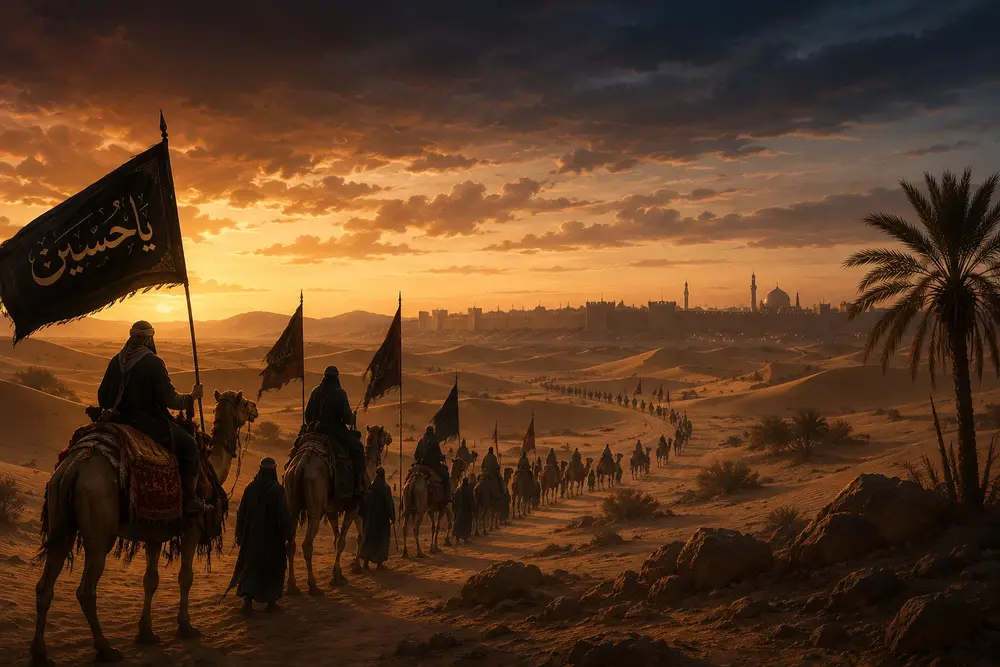
Yazid ordered that the captives be sent to him in Damascus, the seat of the Umayyad caliphate. According to several historical reports, the caravan left Kufa around the 19th of Muharram and reached Damascus near the beginning of the month of Safar, though other narrations place their arrival closer to the time of Arbaeen. The journey covered a long and difficult distance, with the captives — among them Sayyida Zainab (s.a.), Sayyida Umm Kulthum (s.a.), Sayyida Sakina (s.a.), and the young Imam Muhammad al-Baqir (a.s.) — treated with the same harshness shown to captives of war, despite being the family of the Prophet (PBUH).
At every stop along the way, the severed head of Imam Hussain (a.s.) and the heads of his martyred companions were carried ahead of the caravan on spears, intended by the Umayyad regime as a display of victory and a means of humiliating the Ahlul Bayt (a.s.) before the public. Yet this very act became the means by which the truth of Karbala began to spread, as crowds gathered in every town to witness the captives and hear of what had happened.
In the Court of Yazid
When the caravan reached Damascus, the captives were presented before Yazid ibn Muawiya in his court, amid celebrations meant to mark what the Umayyads saw as their triumph. It was here that Imam Zain al-Abideen (a.s.), though still in chains and gravely ill, addressed the gathering and reminded those present of his lineage as the grandson of the Prophet Muhammad (PBUH), exposing the true nature of what had taken place at Karbala. Enraged, Yazid is reported to have ordered the Imam’s execution, but once again it was Sayyida Zainab (s.a.) who intervened and saved his life.
Sayyida Zainab (s.a.) then delivered her own historic sermon in the court of Yazid. Far from being broken by grief and captivity, she spoke with the eloquence of her father, Imam Ali (a.s.), condemning Yazid’s tyranny to his face and declaring that no scheme of his could ever erase the memory or the message of her brother’s sacrifice. This sermon is remembered in Shia history as one of the turning points that began to shift public sentiment against the Umayyad dynasty, sowing the seeds of later uprisings such as the revolt of Mukhtar al-Thaqafi. A full account of this sermon and her broader mission is available in the Biography and Mission of Syeda Zainab (s.a.), and the foundational events that led to this moment are covered in The Day of Ashura — History, Martyrdom of Imam Hussain, and Significance in Islam.
According to some Shia historical accounts, Yazid eventually grew uneasy at the turmoil this public outcry was creating across the Islamic lands and feared for the stability of his own rule. He ordered the release of the captives and, according to certain reports, even permitted a gathering — a majlis — to be held in Damascus itself, where Sayyida Zainab (s.a.) spoke of the events of Karbala before the women of the city, some of whom were said to be secret followers of the Ahlul Bayt (a.s.).
The Return Journey and Arbaeen
After their release, the Ahlul Bayt (a.s.) began the long journey back toward Madina. Shia tradition holds that on this return journey, the caravan passed through Karbala itself, arriving at the site of the martyrdom on the 20th of Safar — exactly forty days after Ashura. This day is commemorated as Arbaeen or Chehlum, and it is regarded as one of the most significant days in the Shia religious calendar, second in importance only to Ashura itself.
At Karbala, the surviving family stood once again at the graves of Imam Hussain (a.s.) and his companions, mourning them in the very place where they had fallen. It was, according to tradition, the first formal majlis and ziyarat ever held at the site, setting the precedent for the Arbaeen pilgrimage that continues to this day, now drawing millions of visitors from around the world each year. The chronology of this journey, along with the scholarly debate among historians over its exact route and timing, is explored further in Arbaeen (Chehlum) — The 40th Day After Ashura (20th Safar).
Imam Zain al-Abideen (a.s.) and the Continuation of Imamate
With the martyrdom of Imam Hussain (a.s.), the responsibility of Imamate passed to his surviving son, Ali ibn Hussain, known as Imam Zain al-Abideen (a.s.) and also as Imam al-Sajjad (a.s.). Though he had been unable to fight at Karbala due to illness, he became, in Shia belief, the divinely appointed Fourth Imam from that very day. His survival through the imprisonment, the marches to Kufa and Damascus, and the threats on his life in Yazid’s court was, in Shia theology, not a matter of chance but a matter of divine protection, ensuring that the chain of Imamate would not be broken.
In the years that followed, Imam Zain al-Abideen (a.s.) carried forward the message of Karbala not through the sword, but through worship, patience, and teaching — most famously through his collection of supplications known as Sahifa Sajjadiya. He continued this mission until his own martyrdom by poisoning on the 25th of Muharram, 95 AH, on the orders of the Umayyad ruler Walid ibn Abdul Malik. His life and legacy after Karbala are detailed in Shahadat of Imam Sajjad (A.S.) — Legacy of Patience After Karbala, and a broader biography of the Fourth Imam can be found in The Fourth Imam, Ali Ibn Al Husayn, Zainul Abedeen (a.s.).
The Legacy of What Followed Ashura
According to Shia scholars, the events after Ashura were as central to the survival of Imam Hussain’s (a.s.) message as the battle itself. Had the captives not been marched through Kufa and Damascus, the truth of Karbala may never have reached the wider Muslim world. It was the eloquence of Sayyida Zainab (s.a.) and Imam Zain al-Abideen (a.s.), delivered from a position of captivity and grief, that turned what the Umayyads intended as a humiliation into a public reckoning with the crimes committed against the family of the Prophet (PBUH).
This is why, fourteen centuries later, the mourning of Muharram does not end on the 10th. It continues through the days of captivity, through Arbaeen, and through the remembrance of Imam Zain al-Abideen’s (a.s.) patience, as part of a single continuous story of sacrifice and truth. For those seeking to honor this legacy, visiting the shrine of Imam Hussain (a.s.) carries immense spiritual merit in Shia tradition, as outlined in Ziyarat of Karbala — Rewards and Merits of Visiting the Grave of Imam Hussain (a.s.), and reciting Ziyarat Ashura remains a daily practice recommended by the Imams (a.s.) for remembering this sacrifice.
This article is written based on historical and religious accounts as recorded in Shia sources and the books of Fiqah-e-Jafria. Exact dates for certain events, such as the precise length of the captives’ imprisonment in Kufa and the date of their arrival in Damascus, are subject to differing reports among historians, and readers are encouraged to consult their local Marja-e-Taqleed or scholars of Fiqah-e-Jafria for matters of religious ruling and practice.