
Shia Quran Academy for Adults & Beginners: It’s Never Too Late to Start
A lot of adults carry a quiet sense of guilt about never having properly learned to read the Quran — maybe it wasn’t taught at home, maybe life got in the way, or maybe early lessons felt rushed and intimidating. If any of that sounds familiar, here’s the good news: starting as an adult beginner is far more common than you’d think, and a good Shia Quran academy will build a course around exactly where you are, not where you “should” be.
This guide covers what to expect from adult-focused Quran learning, how a structured beginner program actually works, and how to choose an academy that won’t make you feel behind.
Why Adults Hesitate to Start
Before getting into the how, it’s worth naming the why-not, because it’s usually the same handful of reasons:
- Embarrassment about starting from zero at an older age
- Time constraints from work, family, or other responsibilities
- Not knowing where to begin — Arabic alphabet? Tajweed? Translation?
- Past negative experiences with strict or impatient teachers
- Uncertainty about finding a Shia-specific teacher who understands Fiqah e Jafria practice
A well-run academy addresses every one of these directly — starting with patient, one-on-one teaching rather than group classes designed for children.
What a Beginner-Focused Shia Quran Academy Should Offer
If you’re evaluating options, here’s what a genuinely adult-friendly program looks like:
1. A Judgment-Free Starting Point
Good teachers assume nothing. Whether you’ve never opened a Quran or you can read a little but want to correct years of mispronunciation, the first session should simply assess your current level — not assume you already know the basics.
2. Noorani Qaida, Taught Without Condescension
Noorani Qaida is the standard starting point for anyone learning to read Arabic script for Quran recitation, and yes, adults use it too. A good teacher moves through it efficiently with adult learners rather than using material paced for six-year-olds. You can browse a downloadable copy of the Noorani Qaida on the downloads page to see the material for yourself before your first class.
3. Flexible, Real-World Scheduling
Adult students have jobs, children, and time zones to work around. A serious academy will offer scheduling flexibility rather than fixed class times — something that becomes especially important for students learning from the UK, USA, Canada, Australia, or across Europe, all juggling different time zones with their teacher.
4. One-on-One Attention
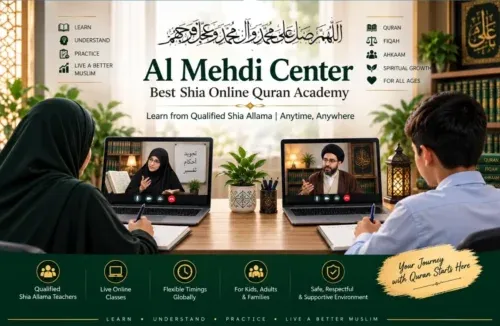
Group classes rarely work well for adult beginners, since pacing has to serve the whole group. One-on-one sessions with a Shia Quran teacher online let the lesson move at your pace specifically — repeating a tricky letter as many times as you need, without anyone waiting on you.
5. Fiqah e Jafria Grounded Teaching
For Shia adult learners, it also matters that Tajweed and recitation are taught within the correct fiqhi context. At Al Mehdi Online Quran Center, courses are built around authentic Fiqah e Jafria teachings, so the religious grounding is consistent with your practice, not generic.
What the First Few Weeks Typically Look Like
- Assessment class – your teacher listens to your current reading (or starts from the Arabic alphabet if you’re at zero) and outlines a simple plan.
- Noorani Qaida basics – letter shapes, sounds, and short vowels, moving at an adult pace.
- Early Tajweed introduction – once letters feel comfortable, basic pronunciation rules are introduced gradually.
- Short verses and Surahs – applying what you’ve learned to real Quranic text, building confidence quickly.
- Consistency check-ins – your teacher adjusts pacing based on how much practice time you realistically have during the week.
There’s no fixed timeline that fits everyone — some adults progress through Noorani Qaida in a few weeks, others take a couple of months, and both are completely normal.
Is Online Learning as Effective as In-Person for Adults?
For adult learners specifically, online classes often work better than in-person options. There’s no commute, no scheduling around a physical center’s hours, and many adults find it easier to make mistakes and ask “basic” questions over a private video call than in a classroom setting. All that’s genuinely needed is a stable internet connection and a quiet 30–45 minutes.
You can read more about how the full class structure works on the Shia Online Quran Center page, or see the range of available courses — including Tajweed, Noorani Qaida, and Fiqah e Jafria studies — on the courses page.
How to Choose the Right Academy as a Beginner
- Ask if they offer a free trial class before you commit financially
- Confirm they offer one-on-one, not only group sessions
- Ask directly whether teachers are experienced with adult beginners specifically, not just children
- Confirm the academy teaches within your specific fiqh (Fiqah e Jafria, for Shia students)
- Check that scheduling genuinely accommodates your time zone and routine
Frequently Asked Questions
Is it too late to start learning Quran as an adult? No. Plenty of adult students begin from complete scratch and progress steadily with consistent one-on-one guidance. Age has far less impact on progress than consistency does.
Do I need to already know Arabic to start? Not at all. Noorani Qaida is specifically designed to teach the Arabic alphabet and basic reading rules from zero, for both children and adults.
How much time do I need to commit each week? Most beginner programs are built around 2–3 short sessions per week, often 30 minutes each, with light practice in between — manageable alongside a full work or family schedule.
Can I request a female or male teacher specifically? Yes, reputable academies, including Al Mehdi Online Quran Center, offer both male and female Shia Quran teachers, and you can request whichever you’re more comfortable with.
What if I stop and start again due to a busy schedule? That’s normal, and a good teacher will simply pick up where you left off. Progress isn’t lost by pausing — it’s lost by not starting again.
If you’ve been putting this off, the first step is simply a conversation with a teacher who won’t judge where you’re starting from. Book a free trial class or sign up here to get matched with a Shia Quran teacher suited to complete beginners.