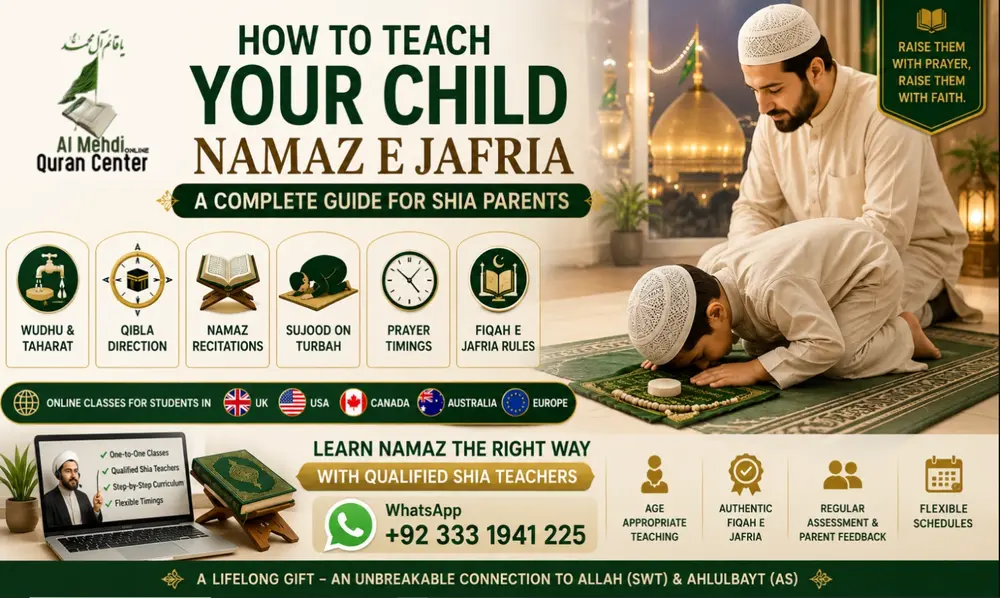
One of the most important duties of a Shia Muslim parent is ensuring their child learns to pray — not just any prayer, but Namaz e Jafria as taught by the Ahlulbayt (AS) and following the rulings of Fiqah e Jafria. This is a responsibility that cannot be delayed or left to chance.
But for Shia families living in the UK, USA, Canada, Australia, and Europe — where access to qualified Shia teachers is limited — teaching children proper Namaz often feels overwhelming. This guide will help you understand what your child needs to learn, at what age, and how to access the right teaching.
At What Age Should a Child Start Learning Namaz?
In Islamic tradition, children should begin learning Namaz from around 7 years old, with it becoming obligatory at the age of puberty (Buloogh). However, starting early — even at age 5 or 6 — is highly recommended to build habit and familiarity.
The Prophet (PBUH) and Ahlulbayt (AS) have emphasised the importance of raising children with prayer from a young age. Imam Ali (AS) is reported to have said: “Teach your children prayer before they reach the age of seven.”
The key stages are:
- Ages 5–7: Introduction to Wudhu, basic Arabic letters, and short surahs
- Ages 7–10: Learning full Namaz actions, recitations, and understanding their meaning
- Ages 10–12: Mastering all Wajibaats of Namaz, learning rules of Shia Fiqh
- Buloogh (puberty): Full obligation begins — the child must pray correctly
What Does a Child Need to Learn for Namaz e Jafria?
Teaching Namaz e Jafria is more than just memorising motions. Here’s a complete breakdown of what your child needs to know:
1. Tahaarat (Purification)
Before Namaz, your child must understand:
- Wudhu (ablution) — the correct Shia method, step by step
- Ghusl (ritual bath) — when it is required
- Tayammum — when water is not available
- Which actions break Wudhu and require it to be repeated
2. Qibla Direction
Children must understand how to find the direction of Qibla (towards the Kaaba in Makkah). In the UK this is South-East, in the USA it varies by location, in Australia it is North-West.
3. The Correct Recitations
The core recitations of Namaz that every Shia child must memorise and understand:
- Surah Al-Fatiha (Surah Al-Hamd) with correct Tajweed
- Surah Al-Ikhlas (or any other short Surah for the second Rakat)
- Tasbeehaat e Arba’a — the four glorifications in Ruku and Sujood
- Salawat on the Prophet and Ahlulbayt (AS)
- The correct form of Tashahud and Salaam
4. Actions of Namaz e Jafria
The physical actions of Shia prayer differ in some respects from other schools. Key points in Fiqah e Jafria include:
- Praying with hands at the sides (not folded)
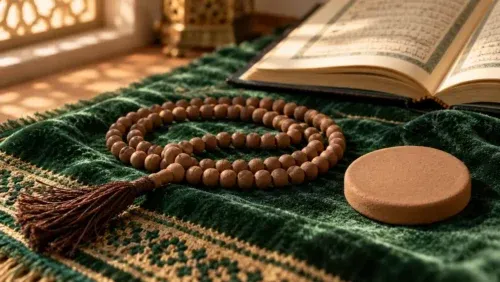
- Performing Sujood on Turbah (Mohr) — a piece of earth, usually made from soil of Karbala
- The specific sequence of Qiyam, Ruku, Sujood, and Tashahhud
- Difference between Wajib (obligatory) and Mustahab (recommended) acts
5. Timing of Prayers
Children must learn the correct times of the five daily prayers according to Shia Fiqh:
- Fajr (before sunrise)
- Dhuhr and Asr (combined window from midday)
- Maghrib and Isha (combined window after sunset)
Understanding that Shia Muslims may combine Dhuhr with Asr, and Maghrib with Isha, is also important.
6. Common Mistakes to Avoid
Many children (and adults) learn Namaz incorrectly due to lack of proper teaching. Common mistakes include:
- Incorrect pronunciation of Arabic recitations (changes the meaning entirely)
- Forgetting a Wajib act (which may invalidate the prayer)
- Not performing Sujood on Turbah
- Making Namaz too fast without proper stillness (Itminan)
Why Teaching Namaz at Home Isn’t Enough
Many parents try to teach their children Namaz themselves — and while parental involvement is invaluable, there are real limitations:
- Parents may themselves have gaps in their own knowledge of Fiqah e Jafria rulings
- Children often don’t take parental teaching as seriously as they would a dedicated teacher
- Without a structured curriculum, important topics get missed
- Pronunciation errors in Arabic can go unnoticed without an expert ear
- Children need consistency and accountability — a dedicated class time achieves this
This is why enrolling your child with a qualified Fiqah e Jafria teacher is so important, even in addition to teaching at home.
The Role of the Turbah (Mohr) – What Children Must Understand
One of the most distinctive aspects of Shia Namaz is the requirement to perform Sujood on a Turbah — a small tablet of pure earth. The most meritorious Turbah is made from the soil of Karbala.
Children raised in Western countries often ask: “Why do we use Turbah? Our friends at school don’t.”
Teaching the reason is important:
- The Prophet (PBUH) performed Sujood on earth (reported in both Shia and Sunni hadith)
- Ahlulbayt (AS) specifically recommended Turbah of Karbala due to its spiritual significance
- It is a beautiful, visible connection to Imam Hussain (AS) and Karbala in every prayer
A child who understands the why behind Shia practices will hold onto their faith much more strongly as they grow up.
How Al Mehdi Online Quran Center Teaches Namaz e Jafria
At Al Mehdi Online Quran Center, our Fiqah e Jafria – Namaz, Ahkaam & Wajibaats course covers everything above in a structured, age-appropriate way:
- One-on-one sessions with a qualified Shia teacher
- Taught in English, Urdu, Arabic or Persian — whichever the child is most comfortable with
- Step-by-step curriculum from Tahaarat through to complete Namaz
- Regular assessment and feedback to parents on progress
- Available for students in UK, USA, Canada, Australia, and Europe
- Class times that fit around school and family schedules
We have helped hundreds of children across the world learn to pray correctly according to Fiqah e Jafria — many of them UK, USA, and Canadian-born children who had never learned properly before.
Take Action Today
Your child’s Namaz is a lifelong gift — an unbreakable connection to Allah (SWT) and the Ahlulbayt (AS). The best time to start was yesterday. The second best time is today.
👉 Book a Free Trial Class for Your Child — Our teacher will assess your child and begin teaching from the very first session.
📞 WhatsApp: +92 333 1941 225
📧 Email: admin@mehdiqurancenter.com
Frequently Asked Questions
Q: My child is 12 and has never learned Namaz. Is it too late? Absolutely not. Many of our students start at 12, 14, or even as adults. A motivated student of any age can learn to pray correctly within a few months.
Q: Can I sit in on the classes to learn alongside my child? Yes! Many parents join their child’s trial class to see the teaching method. Some parents end up enrolling themselves too.
Q: Do you provide a Turbah / Sajda Gah? We don’t supply physical items, but we can advise on where to purchase a good quality Turbah of Karbala online.
Q: How long does it take for a child to learn complete Namaz? With 3–4 classes per week, most children can learn the basics of Namaz e Jafria within 3–4 months and will be performing all five prayers independently.
Al Mehdi Online Quran Center has been serving the Shia community since 2012. Our Fiqah e Jafria courses have helped families across the UK, USA, Canada, Australia, and Europe raise children with a strong, authentic Shia Islamic identity.