The history of Islam is a tapestry woven with the threads of sacrifice, intellect, and divine patience. Among the most pivotal figures in this history is the seventh Imam of the Ahlulbayt, Imam Musa al-Kazim (a.s.). Known as the “Sage of Baghdad,” his life serves as a testament to the power of spiritual resilience against the backdrop of imperial tyranny.
At Mehdi Quran Center, we believe that understanding the lives of the Imams is essential to understanding the Holy Quran itself. As the “Speaking Quran,” their lives provide the practical application of the divine verses.
Part I: The Dawn of the Seventh Light (Biography)
Birth and Lineage
Imam Musa ibn Ja’far (a.s.) was born on the 7th of Safar, 128 AH, in the village of Al-Abwa, situated between the holy cities of Mecca and Medina.1 His lineage is the purest of the pure:
- Father: Imam Ja’far al-Sadiq (a.s.), the founder of the Ja’fari school of jurisprudence.
- Mother: Lady Hamidah al-Barbariyya (Khatun), whom Imam al-Sadiq described as “purified from every impurity like gold.”2
His birth occurred during the transition of power from the Umayyads to the Abbasids—a turbulent time when the Muslim world was seeking a return to the authentic teachings of the Prophet Muhammad (s.a.w.).
The Titles of the Imam
The Imam is rarely referred to by just his name. His titles define his character:
- Al-Kazim: “The one who restrains his anger.”3 Living under the most provocative and insulting conditions, he never reacted with malice.
- Bab al-Hawa’ij: “The Door to the Fulfillment of Needs.” For centuries, both Shias and Sunnis have sought his intercession in times of distress.
- Al-Abd al-Salih: “The Pious Servant.” This was the title used by his jailers, who were moved to tears by his devotion.
Part II: The Golden Era of Knowledge (The Imamate)
The Imamate of Imam Musa al-Kazim (a.s.) lasted for 35 years.4 He took the mantle of leadership after the martyrdom of his father in 148 AH.
Preserving the Ja’fari School
Following the massive educational movement started by Imam Baqir (a.s.) and Imam Sadiq (a.s.), Imam Musa al-Kazim (a.s.) faced a different challenge.5 The Abbasid caliphs began to sponsor “State Islam,” promoting court scholars to deviate the masses from the Ahlulbayt.
The Imam responded by:
- Establishing a secret network of representatives (Wukala) across the Islamic world.6
- Training thousands of students in Hadith, Kalam (theology), and Fiqh (jurisprudence).7
- Correcting the rising philosophical deviations and extremist ideologies of the time.
The Ethics of the Imam
It is narrated that a man in Medina used to constantly insult the Imam.8 The followers of the Imam wanted to punish the man, but the Imam forbade them. Instead, he visited the man’s farm, helped him with his work, and gave him a gift of gold. The man, overwhelmed by the Imam’s kindness, became one of his most devoted followers. This is the essence of being “Al-Kazim.”
Part III: The Tyranny of Harun al-Rashid
The most significant portion of the Imam’s life was spent during the reign of Harun al-Rashid. While history books often paint Harun as a patron of the arts, his treatment of the Prophet’s progeny was brutal.
Harun feared the Imam for three main reasons:
- Legitimacy: The people saw the Imam as the rightful successor to the Prophet, while Harun was seen as a worldly king.
- Charity: The Imam was known for “The Bags of Musa,” where he would secretly distribute gold and food to the poor of Medina.9
- Intellectual Dominance: In every debate held at the palace, the Imam’s representatives proved the superiority of the Ahlulbayt’s knowledge.
The Debate at the Prophet’s Tomb
In a famous historical incident, Harun al-Rashid visited the tomb of the Prophet (s.a.w.) and said, “Salutations to you, O Messenger of Allah, O my cousin!” (to show his familial link).
Imam Musa al-Kazim (a.s.) stepped forward and said, “Salutations to you, O Messenger of Allah, O my Father!”
Harun’s face turned pale with rage. This public acknowledgment of the Imam’s direct lineage was a threat to Harun’s political authority.
Part IV: The Darkness of the Dungeons
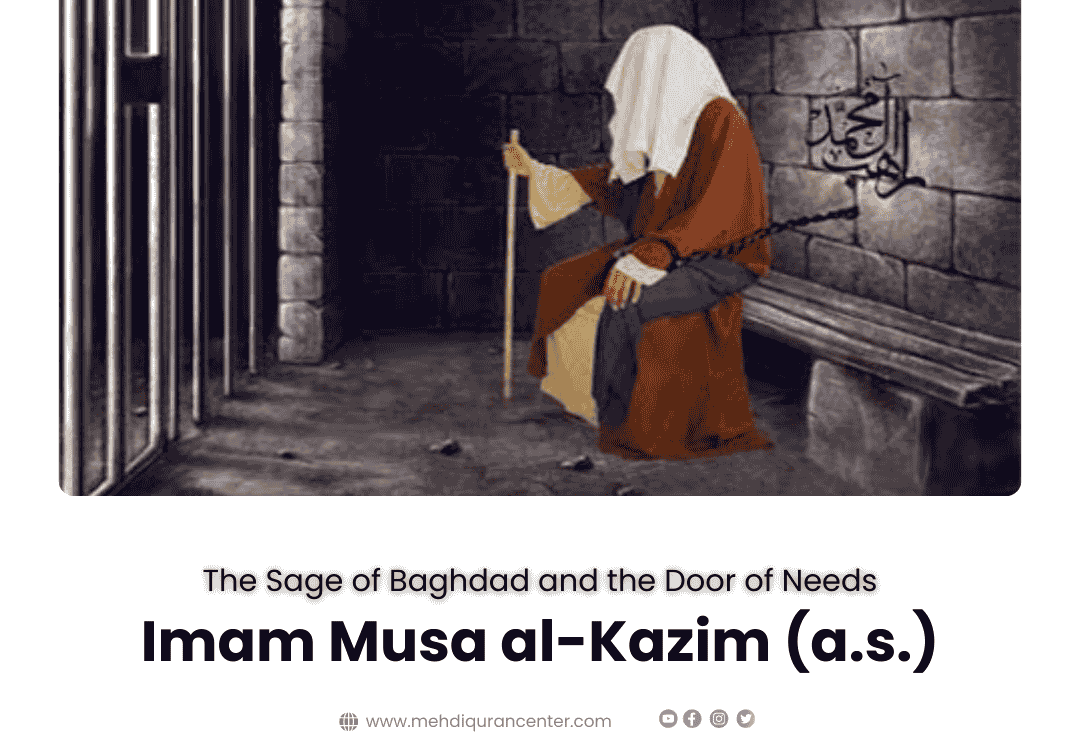
The Imam spent the final years of his life in various prisons. Harun moved him frequently, fearing that the Imam’s piety would convert the prison guards.
| Prison Location | Governor/Custodian | Impact of the Imam |
| Basra | Isa ibn Ja’far | Isa wrote to Harun: “Take him back, or I will release him. I have only heard him pray and ask for forgiveness.” |
| Baghdad | Fadhl ibn Yahya | Fadhl treated the Imam with respect, which led to Harun ordering Fadhl to be lashed. |
| Baghdad (Final) | Sindi ibn Shahak | A cruel, cold-hearted man who eventually carried out the poisoning. |
Even in the narrow, dark cells of Sindi ibn Shahak, the Imam found peace. He famously said, “How long I have asked Allah for a place where I could do nothing but worship Him.”
Part V: The Martyrdom (Shahadat) of Imam Musa al-Kazim (a.s.)
The 25th of Rajab marks one of the saddest days in Islamic history. Harun al-Rashid, realizing that the Imam’s influence was growing even from within the prison, decided to end his life.
The Poisoned Dates
Sindi ibn Shahak was ordered to provide the Imam with poisoned dates. The Imam, knowing his time had come, partook of the dates. The poison was potent and slow-acting, causing the Imam intense abdominal pain for three days.
The Bridge of Baghdad
On the 25th of Rajab, 183 AH, the Imam breathed his last.10 To humiliate the Shias, Sindi ordered the Imam’s body to be placed on the Bridge of Baghdad (Jisr al-Karkh). He called out to the people, “This is Musa ibn Ja’far whom the Shias claim will not die!”
However, the plan backfired. The sight of the Imam’s fragile body, still bearing the marks of chains, ignited a fire of devotion. A massive funeral procession followed, led by the Imam’s son, Imam Ali al-Rida (a.s.).
Part VI: The Legacy of Bab al-Hawa’ij
Today, the Kadhimiya Shrine in Baghdad stands as a testament to the Imam’s victory. While the palaces of Harun al-Rashid have turned to dust, the shrine of the Imam attracts millions of pilgrims every year.11
Lessons for the Modern Era
- Self-Restraint: In an age of social media outrage, the Imam’s ability to “swallow anger” is a vital lesson in emotional intelligence.12
- Spiritual Freedom: He proved that a person can be physically in chains but spiritually free.
- Education: Even in prison, the Imam ensured that his companions recorded his sayings, preserving the deen for us.
Why Learn About the Imam at Mehdi Quran Center?
At Mehdi Quran Center, we don’t just teach the recitation of the Quran; we teach the Tafsir and the History that brings the verses to life. The patience of Imam Musa al-Kazim (a.s.) is the perfect example of the Quranic verse:
“And those who restrain anger and pardon the people – and Allah loves the doers of good.” (Surah Ali ‘Imran 3:134)
Our Services:
- Online Quran Classes: Tajweed and Tarteel for all ages.13
- History of Ahlulbayt: Dedicated sessions on the lives of the 14 Infallibles.
- Fiqh Classes: Understanding the laws of the Ja’fari School.
Conclusion
The Shahadat of Imam Musa al-Kazim (a.s.) is not just a story of grief; it is a story of ultimate triumph. He taught us that the truth cannot be imprisoned and that the light of Allah can never be extinguished by the breath of tyrants.
As we commemorate the 25th of Rajab, let us pray to Allah to grant us the strength to follow in the footsteps of the 7th Imam. May we be among those who restrain their anger and serve the creation of Allah with the same devotion as the “Sage of Baghdad.”
Frequently Asked Questions (FAQs)
1. Why is Imam Musa al-Kazim called Bab al-Hawa’ij?
He is called the “Door to the Fulfillment of Needs” because many believers throughout history have found their prayers answered after seeking his intercession (Tawassul).
2. Where is Imam Musa al-Kazim (a.s.) buried?
He is buried in Kadhimiya, Baghdad, Iraq, alongside his grandson, the 9th Imam, Muhammad al-Jawad (a.s.).14
3. What is the significance of 25th Rajab?
This is the day of the Imam’s martyrdom. It is observed by Shias worldwide with mourning ceremonies (Majalis) and processions.