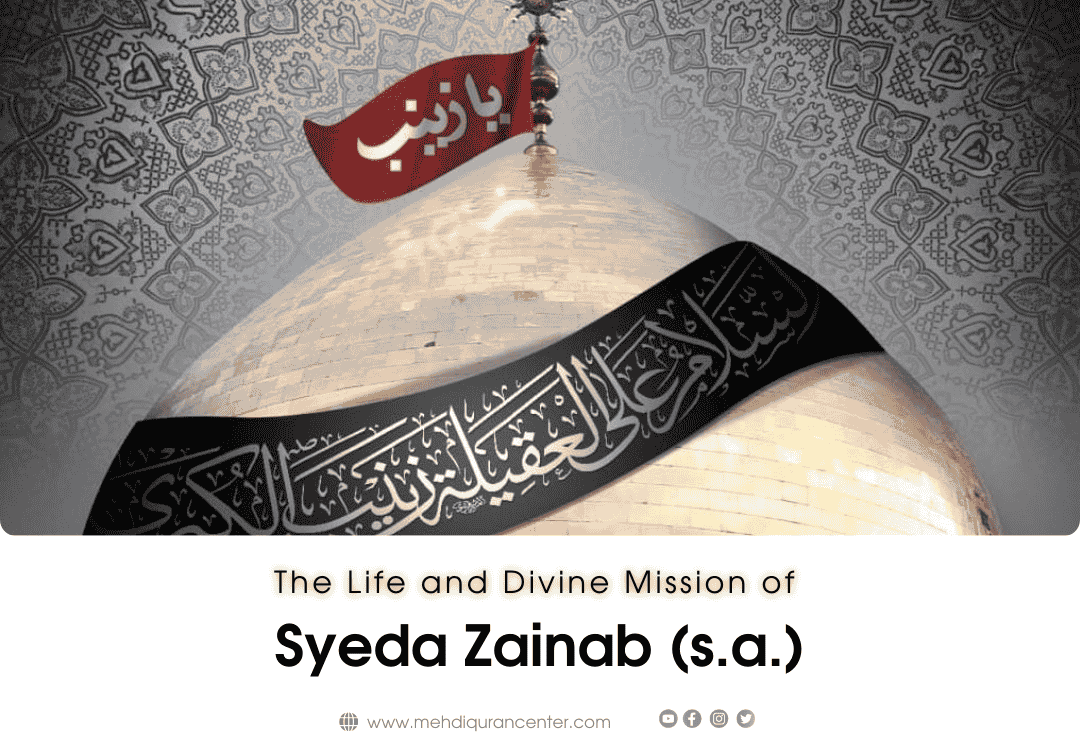
The history of Islam is incomplete without the mention of the “Heroine of Karbala,” Syeda Zainab bint Ali (s.a.). She was not merely a witness to tragedy; she was the architect of its survival. Born into the heart of the Prophet’s household, she inherited the courage of her father, the piety of her mother, and the eloquence of her grandfather.
This 3,000-word comprehensive exploration delves into her miraculous birth, her early life, and the strategic missions she undertook to ensure that the message of Imam Hussain (a.s.) remained eternal.
1. Biography of Syeda Zainab (s.a.)
To understand her mission, one must first look at the foundation upon which her personality was built. Syeda Zainab (s.a.) was born on the 5th of Jamadi al-Awwal in the 5th year of Hijrah in Medina.
At a Glance: Biography Table
| Attribute | Details |
| Full Name | Zainab bint Ali ibn Abi Talib |
| Titles | Al-Aqilah (The Wise), Sani-e-Zahra, Heroine of Karbala |
| Father | Imam Ali ibn Abi Talib (a.s.) |
| Mother | Syeda Fatima al-Zahra (s.a.) |
| Grandfather | Prophet Muhammad (s.a.w.w.) |
| Born | 5th Jamadi al-Awwal, 5-6 AH (Medina) |
| Died | 15th Rajab, 62 AH (Damascus, Syria) |
| Spouse | Abdullah ibn Ja’far al-Tayyar |
Her Naming by the Prophet (s.a.w.w.)
Tradition holds that when she was born, the Prophet (s.a.w.w.) was away. Upon his return, he wept as he held the infant, naming her Zainab (meaning “Adornment of the Father”). Gabriel (a.s.) informed the Prophet of the immense trials she would face, and from that day, she was prepared for a destiny that would save the religion of Islam.
2. The Mission of Syeda Zainab (s.a.): More Than a Witness
While the men of the Ahlulbayt fought with their swords in Karbala, Syeda Zainab (s.a.) fought with her words, her intellect, and her patience. Her mission can be divided into three distinct phases.
Phase 1: The Guardian of the Imamate
After the martyrdom of Imam Hussain (a.s.), the mantle of leadership fell upon the ailing Imam Ali ibn Hussain (Zain al-Abidin). At various points, the Umayyad forces intended to kill the last surviving son of Hussain.
- The Mission: Zainab (s.a.) physically shielded the Imam, challenging the oppressors and declaring that they would have to kill her first. By doing so, she ensured the survival of the chain of Imamate.
Phase 2: The Media of Karbala (Propagating the Truth)
Yazid’s strategy was to paint the Ahlulbayt as “rebels” (Kharijites) against the state.
- The Mission: During the journey from Karbala to Kufa and then to Damascus, Zainab (s.a.) turned every marketplace and court into a pulpit. She spoke to the masses, reminding them who they were—the family of the Prophet—and exposing the cruelty of the ruling regime. Without her speeches, Karbala would have been buried in the sands of the desert.
Phase 3: The Destruction of the Umayyad Narrative
In the court of Yazid, when the tyrant was at the height of his perceived victory, Zainab (s.a.) delivered a sermon so powerful it shook the foundations of the palace.
- The Famous Declaration: “Plan your stratagems and make your utmost endeavors… but by God, you will never be able to erase our remembrance or kill our inspiration.”
3. Key Sermons: The Eloquence of Ali (a.s.) Reborn
Scholars often remark that when Syeda Zainab (s.a.) spoke in the courts of Kufa and Damascus, the people thought Imam Ali (a.s.) had been resurrected. Her eloquence was not just about vocabulary; it was about Haqq (Truth).
The Sermon of Kufa
She addressed the people of Kufa who were weeping for the captives. She rebuked them for their betrayal, comparing their tears to “silver on a grave”—beautiful on the outside but rotten within. This speech incited the first ripples of guilt and revolution among the locals.
The Sermon in Yazid’s Court (Damascus)
This is considered the most significant mission of her life. She stood as a captive in chains yet spoke with the authority of a queen. She dismantled Yazid’s claim to power by highlighting his lack of Taqwa (God-consciousness) and his desecration of Islamic values.
4. Comparison: The Roles of Hussain (a.s.) and Zainab (s.a.)
To understand her mission, we use the famous Shia saying: “Karbala would have died if it weren’t for Zainab.”
| Feature | The Mission of Imam Hussain (a.s.) | The Mission of Syeda Zainab (s.a.) |
| Action | Sacrifice of Life (Blood) | Sacrifice of Comfort (Tears and Words) |
| Goal | To wake up the Ummah from slumber | To inform the Ummah of the truth |
| Method | Jihad through the Sword | Jihad through Eloquence (Zaban) |
| Result | Martyrdom for Islam | Victory of the Message over the Tyrant |
5. The Legacy: Zainab (s.a.) as a Role Model
In the modern era, Syeda Zainab (s.a.) remains the ultimate symbol of female empowerment and social justice.
- Strength in Adversity: She showed that a woman can lead a revolution even while facing the greatest personal grief.
- Intellectual Jihad: She taught the world that the “Pen” and the “Tongue” are often more lasting than the “Sword.”
- Protecting the Oppressed: Her life is a manual for standing up against contemporary tyrants, regardless of the cost.
The Eternal Victory
Syeda Zainab (s.a.) was not just a mourner; she was a conqueror. She entered Damascus as a prisoner and left it as the victor of history. Her mission ensures that whenever we say “Ya Hussain,” we are actually hearing the echo of Zainab’s voice.