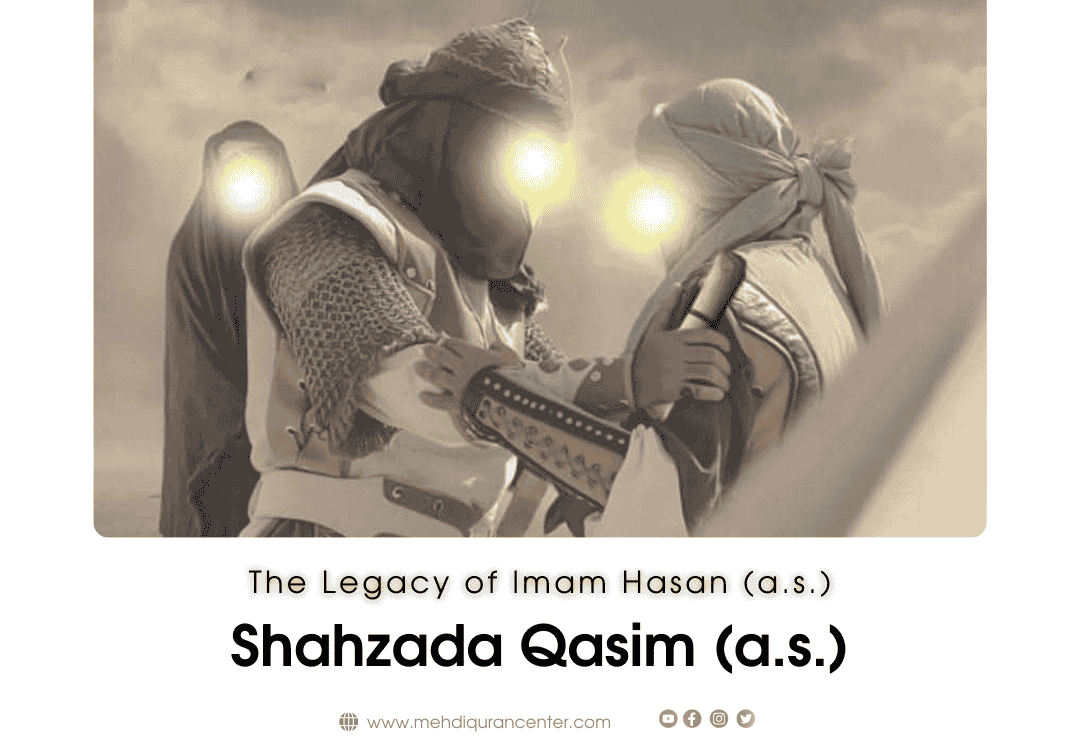
The landscape of Karbala is a constellation of heroes, but among them, Shahzada Qasim ibn Hasan (a.s.) shines with a unique, youthful radiance. At only thirteen years of age, he redefined the concept of bravery, proving that the spirit of the Ahlulbayt is not bound by years, but by divine conviction.
In this 3,000-word comprehensive biography, we explore the life of the son of Imam Hasan (a.s.), his upbringing under the shadow of the Prophet’s family, and his immortal role in the tragedy of Karbala.
1. Biography of Shahzada Qasim (a.s.)
Shahzada Qasim (a.s.) was born in Medina, approximately two to three years before the martyrdom of his father, Imam Hasan al-Mujtaba (a.s.). He was the literal embodiment of his father’s beauty and his grandfather Ali’s (a.s.) courage.
At a Glance: Biography Table
| Attribute | Details |
| Full Name | Qasim ibn Hasan ibn Ali ibn Abi Talib |
| Father | Imam Hasan al-Mujtaba (a.s.) |
| Mother | Syeda Umm-e-Farwa |
| Uncles | Imam Hussain (a.s.) and Hazrat Abbas (a.s.) |
| Birth Date | Circa 47 AH (Medina) |
| Martyrdom | 10th Muharram, 61 AH (Karbala) |
| Age at Karbala | 13 Years |
| Title | Teenage martyr of Karbala |
An Orphan Under the Care of Hussain (a.s.)
After the martyrdom of Imam Hasan (a.s.) by poison, Qasim became an orphan at a very tender age. Imam Hussain (a.s.) took Qasim under his wing, loving him more than his own children. Qasim grew up watching the piety of Hussain (a.s.) and the gallantry of Abbas (a.s.). He was trained in the art of calligraphy, theology, and swordsmanship, preparing him for a day he knew would define the fate of Islam.
2. The Journey to Karbala: A Devoted Nephew
When Imam Hussain (a.s.) refused to pledge allegiance to Yazid and left Medina, Shahzada Qasim (a.s.) was among the first to stand by his side. Throughout the journey—from Medina to Mecca, and finally to the scorching plains of Iraq—Qasim’s only concern was the protection of his uncle.
The Night of Ashura: “Sweeter Than Honey”
On the eve of the 10th of Muharram, Imam Hussain (a.s.) gathered his companions. He informed them that everyone remaining would be martyred the next day. Qasim, sitting in a corner, wondered if his young age would exclude him from this honor.
He approached his uncle and asked, “O Uncle, will I also be among the martyrs?”
Imam Hussain (a.s.) looked at the young boy and asked, “O Qasim, how do you find death?”
Qasim’s response has echoed through history:
“Ahla min al-Asal” (It is sweeter than honey).
This statement revealed that Qasim did not view death as an end, but as a glorious return to his father and grandfather.
3. The Mission on the Day of Ashura
When the day of Ashura arrived, one by one, the companions and family members fell. Qasim approached Imam Hussain (a.s.) several times for permission to fight, but the Imam kept refusing, saying, “You are the memory of my brother Hasan.”
The Sealed Letter of Imam Hasan (a.s.)
Qasim returned to his mother, Syeda Umm-e-Farwa, in tears. She remembered an amulet (Ta’wiz) or a letter tied to Qasim’s arm by his father before he died. The letter read:
“O Qasim, a day will come when my brother Hussain is surrounded by enemies. On that day, you must represent me and sacrifice your life for him.”
Upon seeing this written evidence of his brother’s will, Imam Hussain (a.s.) wept and finally granted Qasim permission. He dressed Qasim in his father’s cloak and tied a small turban on his head.
4. The Valor of the Young Lion
Shahzada Qasim (a.s.) entered the battlefield on a horse that seemed too large for his small frame. The Umayyad soldiers mocked him for his age, but their laughter turned to terror as he began to fight.
- The Combat: Despite being weakened by three days of extreme thirst, Qasim fought with the agility of a hawk. He broke through the enemy ranks, showcasing the DNA of Ali ibn Abi Talib (a.s.).
- The Martyrdom: While he was adjusting his sandal strap—refusing to let even a minor detail be out of order in the presence of death—an enemy soldier struck him from behind. As he fell, he cried out, “O Uncle, come to my aid!”
The tragedy was compounded when the enemy cavalry trampled over his body as Imam Hussain (a.s.) rushed to save him. When the Imam reached him, he found the young boy’s body in a state that shattered his heart.
5. Comparison: The Youth of Karbala
Shahzada Qasim represents the “Youthful Jihad” of the Ahlulbayt.
| Feature | Shahzada Qasim (a.s.) | Shahzada Ali Akbar (a.s.) |
| Age | 13 Years Old | 18-25 Years Old |
| Relation to Hussain (a.s.) | Nephew | Son |
| Defining Quality | The Legacy of Imam Hasan (a.s.) | The Likeness of the Prophet (s.a.w.w.) |
| Core Message | Death for Truth is Sweet | Standing for Justice is Obligatory |
6. The Legacy: A Message for Today’s Youth
Shahzada Qasim (a.s.) is the patron of every young person standing against peer pressure, injustice, and falsehood. His life teaches us:
- Loyalty over Age: You are never too young to serve a noble cause.
- Character over Comfort: He chose the “honey” of martyrdom over the comfort of a palace.
- Respect for Elders: His absolute devotion to his uncle is a masterclass in Islamic etiquette (Adab).
| Question | Short Answer |
| How old was Qasim in Karbala? | Shahzada Qasim (a.s.) was approximately 13 years old. |
| What did Qasim say about death? | He famously said death for the sake of Allah is “Ahla min al-Asal” (Sweeter than honey). |
| Who was Qasim’s mother? | His mother was the noble lady Syeda Umm-e-Farwa. |
| Why is Qasim called the “Orphan of Hasan”? | Because his father, Imam Hasan (a.s.), was martyred when Qasim was a young child. |
The Spiritual Significance: The Amulet and the Will
One of the most heart-wrenching and strategically significant moments in the life of Shahzada Qasim (a.s.) involves the “Written Will” of his father. This part of his biography highlights the foresight of the Imams of the Ahlulbayt.
The Mystery of the Amulet
As the tragedy of Karbala reached its peak, Qasim was distressed because his uncle, Imam Hussain (a.s.), was hesitant to let him fight. It was his mother, Syeda Umm-e-Farwa, who reminded him of a secret.
Before the martyrdom of Imam Hasan (a.s.), he had tied an armlet (Ta’wiz) onto Qasim’s arm and told him, “Open this only when the world becomes dark for you.”
The Content of the Will
When the scroll was opened, it contained a direct command to Qasim:
“O my son Qasim! There will come a day when my brother Hussain will be surrounded by thousands of enemies. On that day, you must represent me. Do not let me be ashamed before Allah and His Prophet.”
This document changed the entire dynamic. It was no longer just a nephew asking his uncle for permission; it was a vassal fulfilling a divine contract. When Imam Hussain (a.s.) read his brother’s handwriting, he wept, realizing that Hasan (a.s.) had planned his participation in Karbala years in advance.
The Battle and the Unique Martyrdom
Shahzada Qasim’s time on the battlefield was brief but left an indelible mark on military history. Despite being dehydrated, his strikes were compared to the lightning of Zulfiqar.
The Sandals of Qasim (a.s.)
A specific detail recorded by historians is that during the heat of the battle, one of Qasim’s sandal straps broke. In an act of extreme defiance and composure, he bent down to fix it. He refused to look disheveled or panicked in front of the enemy. It was in this moment of fixing his shoe that an enemy soldier, Amr ibn Sa’id al-Azdi, struck him.
The Trampling of the Body
The most agonizing part of his biography is his final moments. As Qasim fell and called for his uncle, Imam Hussain (a.s.) rushed to him like a predatory lion. The enemy, in a state of panic, fled, and in their retreat, their cavalry trampled over the body of Qasim.
When the dust settled, the Imam found Qasim’s chest crushed. Historians mention that the Imam’s lamentation over Qasim was one of the loudest heard in Karbala, as he cried, “It is hard on your uncle that you called him and he could not help you, or he helped you but it did not benefit you.”