
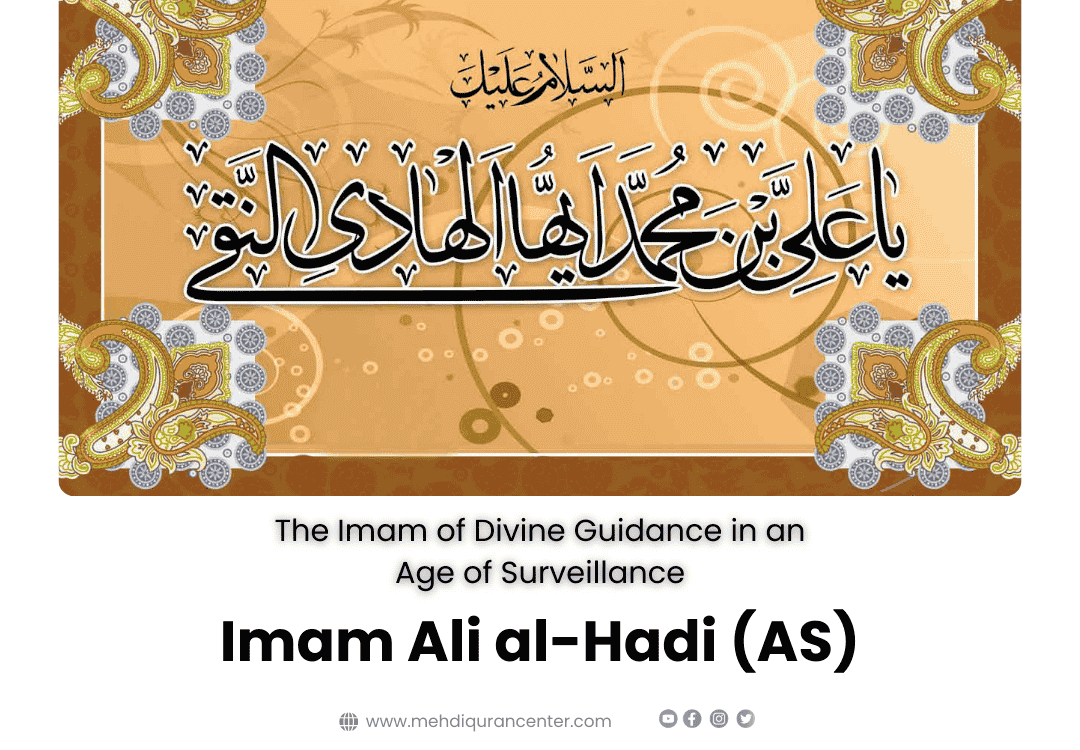
Imam Ali al-Hadi (AS), the tenth Imam from the Ahl al-Bayt of the Prophet Muhammad (ﷺ), lived during one of the most restrictive and oppressive periods of Islamic history. Despite intense political surveillance, forced relocation, and systematic isolation imposed by the Abbasid caliphate, he preserved the spiritual, theological, and ethical foundations of Islam with remarkable resilience. Known as al-Hadi, meaning “the guide”, his life embodied guidance through wisdom, restraint, and unwavering devotion to truth.
Imam al-Hadi (AS) represents a model of silent resistance, where leadership was exercised not through public authority but through moral clarity, scholarly excellence, and deep spiritual influence that transcended physical confinement.
Lineage and Family Background
Imam Ali al-Hadi (AS) was born into the noble household of the Prophet (ﷺ). His father was Imam Muhammad al-Jawad (AS), renowned for his exceptional wisdom at a young age, while his mother, Lady Samana al-Maghribiyya, was known for her piety, intelligence, and devotion. Through his lineage, Imam al-Hadi (AS) was directly descended from Imam Ali ibn Abi Talib (AS) and Lady Fatima al-Zahra (AS), placing him firmly within the spiritual heart of Islam.
He was also known by the titles al-Hadi and al-Naqi, both reflecting his moral purity and role as a divinely guided leader.
Birth and Early Life
Imam Ali al-Hadi (AS) was born in the year 212 AH, corresponding to 828 AD, in the village of Surayya near Madinah. From early childhood, his extraordinary intellect, composure, and spiritual awareness distinguished him from others. Under the guidance of his father, Imam al-Jawad (AS), he received comprehensive instruction in Quranic sciences, jurisprudence, theology, and ethics.
Even as a young man, scholars and followers recognised in him the signs of divine leadership, particularly after the martyrdom of his father when he assumed the Imamate at a very young age.
Imamate and Historical Context
Imam al-Hadi (AS) became Imam at approximately eight years of age, during a time when the Abbasid caliphate had grown increasingly suspicious of the Imams of the Ahl al-Bayt. His Imamate lasted for over three decades and coincided with the reigns of multiple Abbasid caliphs, including al-Mu‘tasim, al-Wathiq, al-Mutawakkil, and their successors.
The Abbasid authorities viewed Imam al-Hadi (AS) as a political threat due to his moral authority and influence among the people. As a result, he was forcibly relocated from Madinah to Samarra, where he lived under constant surveillance. This period marked a shift in the Imams’ leadership style, moving from open teaching to discreet guidance through trusted representatives.
Meaning and Significance of His Titles
The title al-Hadi signifies one who guides towards truth, while al-Naqi reflects purity and freedom from moral corruption. These titles were not symbolic but descriptive of his character. Imam al-Hadi (AS) guided his followers through clarity of belief, refinement of character, and steadfast adherence to divine principles, even when direct access to him was severely restricted.
Scholarly and Theological Contributions
Despite the oppressive conditions in Samarra, Imam al-Hadi (AS) played a crucial role in safeguarding Islamic doctrine. He addressed theological deviations that were spreading under Abbasid patronage, including exaggerated rationalism and distorted beliefs regarding divine attributes.
His letters and teachings clarified essential matters of faith, including the nature of God’s justice, human responsibility, and the role of the Imamate. Many of these teachings were transmitted through a structured network of representatives, a system that later prepared the Shia community for the era of occultation.
Imam al-Hadi (AS) also contributed significantly to Islamic ethics, emphasising sincerity in worship, humility before God, and detachment from worldly power.
Spiritual Depth and Worship
Imam al-Hadi (AS) was known for his intense devotion and night prayers. Even his adversaries acknowledged his spiritual presence and moral integrity. Numerous supplications attributed to him, including the famous Ziyarat al-Jami‘a al-Kabira, remain central to Shia devotional life and provide profound insights into the theology of the Imamate.
His worship was not isolated from social responsibility but deeply connected to justice, compassion, and moral reform.
Life Under Abbasid Surveillance
The Abbasid caliph al-Mutawakkil subjected Imam al-Hadi (AS) to severe restrictions, including house arrest, constant monitoring, and repeated attempts at humiliation. Despite this, the Imam maintained dignity and composure, never compromising his principles.
Ironically, the very measures intended to diminish his influence instead amplified his spiritual authority, as people recognised the contrast between oppressive power and righteous leadership.
Martyrdom
Imam Ali al-Hadi (AS) was poisoned in the year 254 AH, corresponding to 868 AD, during the reign of the Abbasid caliph al-Mu‘tamid. His martyrdom was the culmination of years of systematic persecution aimed at silencing the voice of divine guidance.
He was buried in Samarra, the city where he had been held under surveillance for much of his life. His shrine, shared with his son Imam Hasan al-Askari (AS), remains one of the most significant spiritual sites in the Islamic world.
Legacy and Historical Impact
The legacy of Imam al-Hadi (AS) lies in his successful preservation of Islamic leadership under extreme repression. He strengthened the institutional structure of the Shia community, reinforced theological clarity, and ensured continuity of guidance in anticipation of future challenges.
His life demonstrates that spiritual authority does not require political power and that true guidance often flourishes under constraint.
Relevance in the Modern World
In an age of misinformation, authoritarianism, and moral confusion, Imam al-Hadi (AS) offers a timeless example of principled leadership. His life teaches that patience, knowledge, and ethical integrity are the most effective responses to injustice.
He reminds us that guidance is not always loud, but it is always transformative.
Imam Ali al-Hadi (AS) was the embodiment of divine guidance during one of the darkest chapters of Islamic governance. Through scholarship, spirituality, and unwavering moral strength, he preserved the essence of Islam for future generations. His life remains a powerful testament to the enduring strength of truth in the face of oppression.