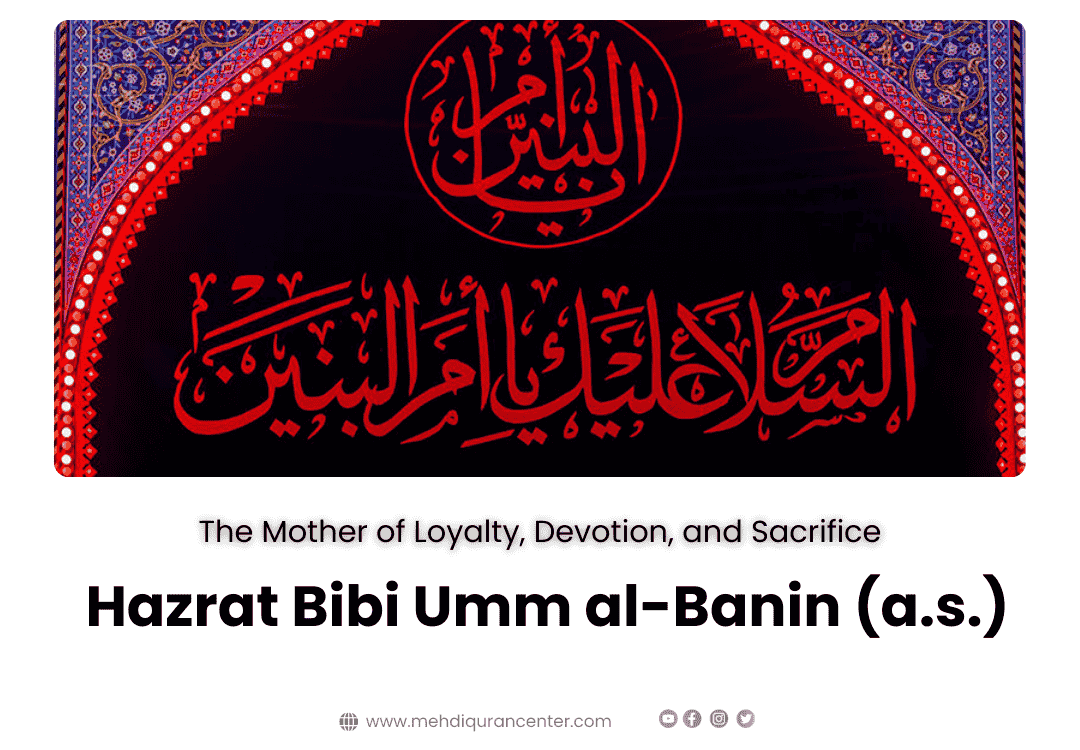
In the rich and sacred tapestry of Islamic history—particularly within the Shia tradition—few personalities shine with the brilliance, devotion, and selflessness of Hazrat Bibi Umm al-Banīn (a.s.). Known for her unwavering loyalty to Ahlul Bayt (a.s.), her unmatched motherhood, and her spiritual depth, she remains one of the most beloved female icons after the Noble Ladies of the Prophet’s Household: Bibi Fatima az-Zahra (a.s.), Bibi Zainab (a.s.), and Bibi Umm Kulthum (a.s.).
Her life is a powerful testament to service, sacrifice, and complete submission to the will of Allah (SWT). Most famously, she raised **Hazrat Abbas (a.s.)—the Moon of Bani Hashim—**who became the symbol of loyalty in Karbala and the standard-bearer of Imam Hussain (a.s.).
This comprehensive blog explores her noble lineage, her marriage into the holy household, her extraordinary motherhood, her life after Karbala, and her lasting spiritual influence on Shia communities worldwide.
1. Her Noble Lineage and Birth
Hazrat Bibi Umm al-Banīn (a.s.), whose birth name is widely recorded as Fatimah bint Hizam al-Kilabiyyah, came from the highly respected tribe of Banu Kilab, renowned for:
- Courage and valor
- Pure Arab lineage
- Unmatched loyalty and moral integrity
Her father, Hizam ibn Khalid, was known as a chieftain of great honor. Her mother, Tamadur, descended from families praised for bravery and eloquence.
Why Her Lineage Matters
In Arabia, especially during the early Islamic centuries, tribal virtues were deeply cherished. Imam Ali (a.s.) chose Umm al-Banīn (a.s.) specifically because:
- Her tribe was renowned for bravery
- Her ancestry emphasized loyalty
- She would raise children who would serve the cause of Imamate with pure devotion
Her noble roots prepared her for the unique destiny Allah reserved for her—being the mother of four sons who would later defend Imam Hussain (a.s.) in Karbala.
2. Marriage to Imam Ali (a.s.): A Union of Purity and Wisdom
After the martyrdom of Bibi Fatima az-Zahra (a.s.), Imam Ali (a.s.) eventually remarried for the sake of family stability. According to Shia historians, Imam Ali (a.s.) requested a wife who possessed the qualities of loyalty, bravery, and sincerity, and who would honor the memory of Bibi Fatima (a.s.).
A Marriage Built on Spiritual Understanding
When she entered Imam Ali’s household, her first and most heartfelt request was:
“Do not call me Fatima, for the children of Zahra become sorrowful when they hear this name.”
This single act alone demonstrates her extraordinary sensitivity, respect, and love for the Imam’s children—especially Hasan (a.s.), Hussain (a.s.), Zainab (a.s.), and Umm Kulthum (a.s.).
Her humility and empathy earned her immediate love within the holy household.
3. Her Title: “Umm al-Banīn”—Mother of the Sons
She was blessed with four sons from Imam Ali (a.s.):
- Hazrat Abbas (a.s.), the Moon of Bani Hashim
- Abdullah ibn Ali
- Ja’far ibn Ali
- Uthman ibn Ali
Each of her sons was raised with deep devotion toward the Imams, particularly Imam Hussain (a.s.). They inherited her courage and their father’s unmatched nobility.
Because she became the mother of these four exceptional sons, she was lovingly given the title:
“Umm al-Banīn” — The Mother of the Sons.
But spiritually, she was far more than a biological mother; she was a mother of loyalty, motherhood, and sacrifice to the Ummah.
4. Her Relationship with Imam Hussain (a.s.)
According to Shia traditions, Hazrat Umm al-Banīn (a.s.) loved Imam Hussain (a.s.) more than her own children.
She would teach her sons:
“Your life is a sacrifice for Imam Hussain (a.s.).”
This was not merely a slogan—it became the reality of Karbala.
Her Spiritual Insight
Bibi Umm al-Banīn (a.s.) possessed a level of spiritual wisdom rarely seen. She understood:
- The divine station of Imamate
- The necessity of protecting Ahlul Bayt
- The destiny of Karbala foretold by the Holy Prophet (saww)
Thus, she prepared her sons physically, emotionally, and spiritually to stand with Imam Hussain (a.s.).
5. Raising Hazrat Abbas (a.s.): The Masterpiece of Her Motherhood
Among her noble sons, Hazrat Abbas (a.s.) became the embodiment of loyalty and courage.
What She Instilled in Him
From childhood, she nurtured values in Abbas (a.s.) that shaped his destiny:
- Absolute loyalty to Imam Hussain (a.s.)
- Supreme humility
- Chivalry and bravery
- Love for the oppressed
- Devotion to the cause of Islam
One famous narration states that she would say to little Abbas:
“My son, never leave Hussain (a.s.), for he is the Imam of your time.”
Her training produced a warrior unmatched in history, whose sacrifice at Karbala still ignites the hearts of believers.
6. Her Influence in Karbala (Even Without Being Present)
Although she did not physically attend Karbala, her spiritual presence and contribution were profound.
Why She Did Not Go
Historians mention:
- Her age
- The need for her to remain in Madinah
- The wisdom of Allah that she would become the voice of the tragedy afterward
Despite this, she played a crucial role:
(1) She prepared her sons for martyrdom
Every word she spoke to them reinforced their duty to the Imam.
(2) She supported the caravan with her prayers
It is said she spent the nights in supplication.
(3) She remained emotionally connected to the events
Her heart traveled with her sons.
Her motherhood shaped the very heroes who defended Imam Hussain (a.s.) until their last breath.
7. After Karbala: The Mother of Martyrs’ Grief
When the news of Karbala reached Madinah, her reaction became one of the most heartfelt moments in Islamic history.
Her First Question Was Not About Her Sons
She asked:
“Tell me about Hussain (a.s.).”
Only when she was assured of Imam Hussain’s (a.s.) martyrdom did she ask about Abbas (a.s.) and her other sons.
Her Famous Lines of Grief
Upon hearing the complete tragedy, she recited moving elegies (marsiyas) that caused Madinah to weep.
She said:
“All my sons and everything I had is a sacrifice for Hussain (a.s.).”
This statement alone displays:
- Supreme submission to the Imamate
- Acceptance of divine decree
- Her maternal greatness beyond ordinary measure
Her house became a centre of mourning, and she became one of the earliest supporters of the Shia tradition of Azadari.
8. Umm al-Banīn (a.s.) as a Pioneer of Azadari
One of her most significant contributions is her role in establishing and strengthening the culture of mourning (Azadari) for Imam Hussain a.s.
How She Strengthened Azadari
- She organized gatherings for mourning in Madinah
- She taught people the spiritual importance of Karbala
- She recited elegies that highlighted the tragedy’s moral lessons
- She transformed grief into a path of spiritual reflection
Her mourning gatherings quickly spread and became the foundation for what later grew into the widespread Shia tradition of Muharram majalis.
9. Her Titles and Spiritual Status
Hazrat Umm al-Banīn (a.s.) is honored with numerous titles that reflect her status:
1. Umm al-Banīn (Mother of the Sons)
For giving birth to four brave sons.
2. Umm al-Wafa (Mother of Loyalty)
Her sons’ loyalty stemmed from her upbringing.
3. Umm al-Qamar (Mother of the Moon)
Because she was the mother of Abbas (a.s.), the radiant Moon of Bani Hashim.
4. The Mother of Martyrs
All four of her sons were martyred in Karbala.
5. Supporter of Ahlul Bayt (a.s.)
Her life remains proof of her unwavering love and devotion.
Shia scholars regard her as:
- A woman of great taqwa
- A spiritual mother of believers
- A symbol of absolute loyalty to the divine leadership
10. Her Personality: Humility, Strength, and Spirituality
Hazrat Umm al-Banīn (a.s.) possessed a rare combination of virtues:
Humility
She never sought status or recognition despite her marriage to Imam Ali (a.s.).
Spiritual Strength
Her acceptance of her sons’ martyrdom for Imam Hussain (a.s.) reflects a heart connected deeply to Allah.
Emotional Intelligence
Her empathy for the children of Fatima (a.s.) remains legendary.
Courage
She belonged to a tribe that honored bravery, and she passed this strength to her sons.
Wisdom
She understood the lofty station of Ahlul Bayt (a.s.) and aligned her life accordingly.
11. Her Death and Burial
Hazrat Umm al-Banīn (a.s.) passed away on the 13th of Jumada al-Thani, according to Shia sources, in the city of Madinah.
She is buried in Jannat al-Baqi, the sacred cemetery that holds the graves of:
- Imam Hasan al-Mujtaba (a.s.)
- Bibi Fatima’s (a.s.) children
- Prominent companions and pious individuals
Her grave, like many in Baqi, remains unmarked due to historical demolition, yet millions of devotees worldwide send their salutations to her noble soul.
12. Her Legacy in Shia Communities Today
The influence of Hazrat Umm al-Banīn (a.s.) remains immense across Shia cultures.
Common Practices in Her Honor
- Majalis dedicated to her life
- Recitations of her marsiyas
- Naming daughters after her
- Special prayers and nawafil seeking her intercession
- Visiting Jannat al-Baqi during Ziyarat
Her duas, especially for mothers and families facing hardship, are considered spiritually powerful.
13. Lessons from Her Life (For Modern Readers)
Hazrat Umm al-Banīn (a.s.) teaches timeless lessons that apply beautifully in the modern world:
Lesson 1: The Power of Selfless Motherhood
Her sons were not just her children—they were servants of the Imam.
She reminds us that righteous upbringing shapes nations.
Lesson 2: Loyalty Above All
Her loyalty to Imam Ali (a.s.) and Imam Hussain (a.s.) defines true devotion.
Lesson 3: Respecting the Sacred
Changing her name to avoid hurting Bibi Fatima’s (a.s.) children shows emotional maturity rarely seen.
Lesson 4: Strength in Sorrow
She transformed her grief into a mission for the cause of truth.
Lesson 5: Supporting Divine Leadership
Her role affirms that supporting the rightful Imams is a lifelong duty.
FAQs
Q1: Who was Hazrat Umm al-Banīn (a.s.)?
A noble wife of Imam Ali (a.s.), and mother of Hazrat Abbas (a.s.), known for her loyalty, bravery, and selflessness.
Q2: What is her real name?
Her real name was Fatimah bint Hizam al-Kilabiyyah.
Q3: Why is she important to Shia Muslims?
Because of her unwavering love and support for Ahlul Bayt (a.s.), her role in raising Hazrat Abbas (a.s.), and her contributions to Azadari.
Q4: Where is she buried?
In Jannat al-Baqi, Madinah.
Q5: What are her key virtues?
Loyalty, piety, humility, courage, spiritual insight, and motherhood.
Hazrat Bibi Umm al-Banīn (a.s.) is one of the brightest lights in the history of Islam. Her life is a profound example of devotion, spiritual intelligence, motherhood, and sacrifice. Through her noble sons, especially Hazrat Abbas (a.s.), she gifted the world the greatest example of loyalty ever witnessed in Karbala.
She remains a guiding beacon for every believer—especially mothers—who strive to raise children devoted to faith, justice, and truth.
May Allah (SWT) elevate her rank and grant us the ability to follow her noble footsteps.
Salam upon Umm al-Banīn (a.s.), the mother of loyalty and courage.