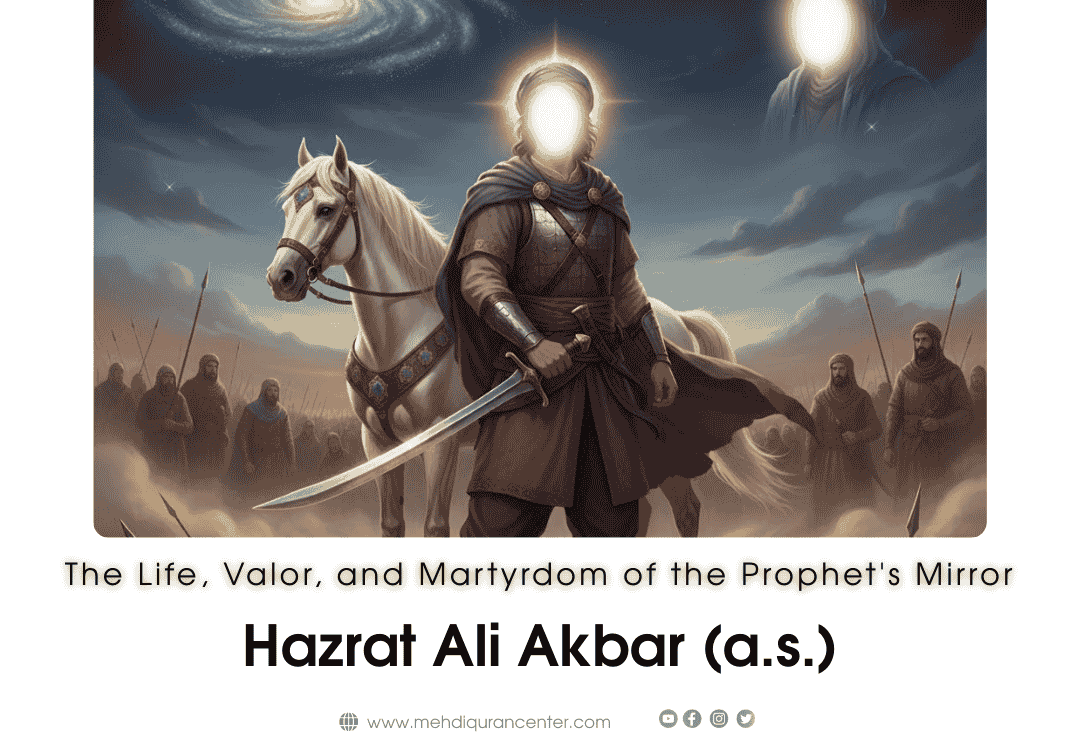
The plains of Karbala bore witness to unparalleled sacrifice, and among the luminous figures who shone brightest was Hazrat Ali Akbar ibn Hussain (a.s.). He was not just the eldest son of Imam Hussain (a.s.); he was a living embodiment of the Prophet Muhammad (s.a.w.w.), so striking in his resemblance that Imam Hussain (a.s.) would often look at him to remember his grandfather.
This article delves into the blessed biography of Ali Akbar (a.s.), exploring his noble birth, his formative years under the guidance of his father, and his pivotal, heart-wrenching role in the tragedy of Karbala.
1. Biography of Hazrat Ali Akbar (a.s.)
Hazrat Ali Akbar (a.s.) was born in Medina on the 11th of Sha’ban, in the 33rd year of Hijrah. His lineage traced directly back to the noblest households in Islam, a convergence of purity and unparalleled valor.
At a Glance: Biography Table
| Attribute | Details |
| Full Name | Ali al-Akbar ibn Hussain ibn Ali ibn Abi Talib |
| Father | Imam Hussain ibn Ali (a.s.) |
| Mother | Syeda Umm-e-Layla (Layla bint Abi Murrah ath-Thaqafi) |
| Grandfather (Paternal) | Imam Ali ibn Abi Talib (a.s.) |
| Grandmother (Paternal) | Syeda Fatima al-Zahra (s.a.) |
| Great-Grandfather | Prophet Muhammad (s.a.w.w.) |
| Born | 11th Sha’ban, 33 AH (Medina) |
| Martyrdom | 10th Muharram, 61 AH (Karbala) |
| Age at Karbala | Approximately 18-25 years old (historians vary) |
| Title | Shabi-e-Payambar (Resembler of the Prophet) |
Early Life and Upbringing
Ali Akbar (a.s.) grew up in the golden era of the Imams, nurtured by the piety of his father, Imam Hussain (a.s.). He inherited the profound wisdom of his great-grandfather, the Prophet (s.a.w.w.), the courage of Imam Ali (a.s.), and the patience of Imam Hasan (a.s.).
- Education: He was tutored directly by Imam Hussain (a.s.) in Quranic sciences, Hadith, Fiqh, and Islamic ethics. His eloquence was renowned, a trait inherited from the Ahlulbayt.
- Physical Resemblance: His physical resemblance to the Prophet Muhammad (s.a.w.w.) was legendary. Historians note that his features, gait, and even the tone of his voice were so similar to the Holy Prophet that people would often mistake him for the Prophet reborn. This was a tremendous source of comfort and remembrance for Imam Hussain (a.s.).
2. The Journey to Karbala: A Pillar of Support
When Imam Hussain (a.s.) decided to leave Medina, refusing to pledge allegiance to Yazid, Ali Akbar (a.s.) stood as his father’s unwavering support. He was not just a son but a trusted advisor, a military strategist, and a moral compass for the caravan.
The Dream and the Declaration
During the journey, at a place called Tha’labiya, Imam Hussain (a.s.) briefly dozed off on his horse. Upon waking, he recited “Inna Lillahi wa Inna Ilayhi Raji’un”. Ali Akbar (a.s.), riding nearby, immediately asked about the meaning of his father’s utterance.
Imam Hussain (a.s.) informed him that he had seen a dream where a caller announced, “You are going towards death.”
Ali Akbar (a.s.), without a moment’s hesitation, replied:
“O Father! Are we not on the path of truth? If so, we care not whether death finds us or we find death.”
This declaration solidified his conviction and exemplified the unwavering resolve of the Ahlulbayt against oppression. It served as a powerful affirmation for his father and the rest of the caravan.
3. The Role in Karbala: More Than Just a Fighter
On the day of Ashura, the 10th of Muharram, 61 AH, after most of the companions and other members of the Hashimite family had been martyred, the turn came for the core family.
Permission to Fight
Ali Akbar (a.s.) approached his father, Imam Hussain (a.s.), seeking permission to go to the battlefield. This was one of the most difficult moments for the Imam. As Ali Akbar (a.s.) walked towards the battlefield, Imam Hussain (a.s.) raised his hands to the sky, crying out:
“O Allah! Be a witness to these people, for a youth who resembled Your Prophet (s.a.w.w.) the most in appearance, character, and speech is going towards them. Whenever we desired to see Your Prophet, we would look at him.”
This poignant statement underscores the immense personal sacrifice Imam Hussain (a.s.) was making. It was not just a son, but the very image of his beloved grandfather he was sending to his death.
The Battle Prowess
Ali Akbar (a.s.) was a formidable warrior. Despite acute thirst and fatigue, he fought with the ferocity of his grandfather, Imam Ali (a.s.). He charged into the enemy ranks, scattering them and proving that even in extreme duress, the spirit of truth cannot be subdued. Historians record that he killed a significant number of Yazid’s soldiers.
4. The Martyrdom: A Shattered Mirror
After fighting valiantly, Ali Akbar (a.s.) returned to his father, utterly exhausted and parched. He cried, “O Father, thirst has consumed me, and the weight of the armor has exhausted me. Is there a sip of water?”
Imam Hussain (a.s.) wept and said, “My son, soon you will meet your grandfather, the Messenger of Allah, and he will quench your thirst with a cup from his hand from which you will never be thirsty again.”
He went back to the battlefield, fighting until he was surrounded. Murra ibn Munqidh al-Abdi struck him a fatal blow on the head. As he fell from his horse, he called out, “O Father, my salaam to you! This is my grandfather, the Messenger of Allah, conveying his salutations to you!”
The Imam’s Despair
Imam Hussain (a.s.) rushed to his son. The sight of Ali Akbar’s (a.s.) mutilated body, pierced by spears and swords, broke the Imam’s heart. It is said that at this moment, a pillar of Imam Hussain’s patience gave way. He cradled his son’s head and cried:
“After you, O Ali Akbar, there is no life left in this world!”
He carried his son’s body, bit by bit, to the camp, where the women of the Ahlulbayt, especially his mother Syeda Umm-e-Layla, mourned in heart-wrenching agony.
5. Comparison: The Pillars of Karbala’s Sacrifice
Ali Akbar (a.s.) stands as a unique symbol among the martyrs of Karbala.
| Feature | Hazrat Ali Akbar (a.s.) | Shahzada Qasim (a.s.) | Hazrat Abbas (a.s.) |
| Relation to Hussain (a.s.) | Eldest Son | Nephew (Son of Hasan) | Half-Brother |
| Age at Karbala | 18-25 (Youth) | 13 (Child/Adolescent) | 33-34 (Adult) |
| Defining Quality | Resemblance to Prophet (s.a.w.w.) | Fulfillment of Father’s Will | Unwavering Loyalty (Flag Bearer) |
| Impact of Martyrdom | Personal grief for Imam, loss of Prophet’s image | Testament to youthful zeal and conviction | Loss of Imam’s protector and hope |
The Enduring Legacy of Ali Akbar (a.s.)
The life and martyrdom of Ali Akbar (a.s.) offer profound lessons for humanity, especially the youth of today:
- Identity and Conviction: He knew his identity and purpose, demonstrating that true strength comes from firm belief, not just physical might.
- Filial Piety: His unwavering obedience and respect for his father, even unto death, is an unparalleled example of Islamic parental honor.
- Sacrifice for Truth: He willingly gave his life, reminding us that there are values more precious than life itself, particularly the preservation of divine guidance.
His story continues to inspire millions, making him an eternal symbol of youthful sacrifice for truth and justice.