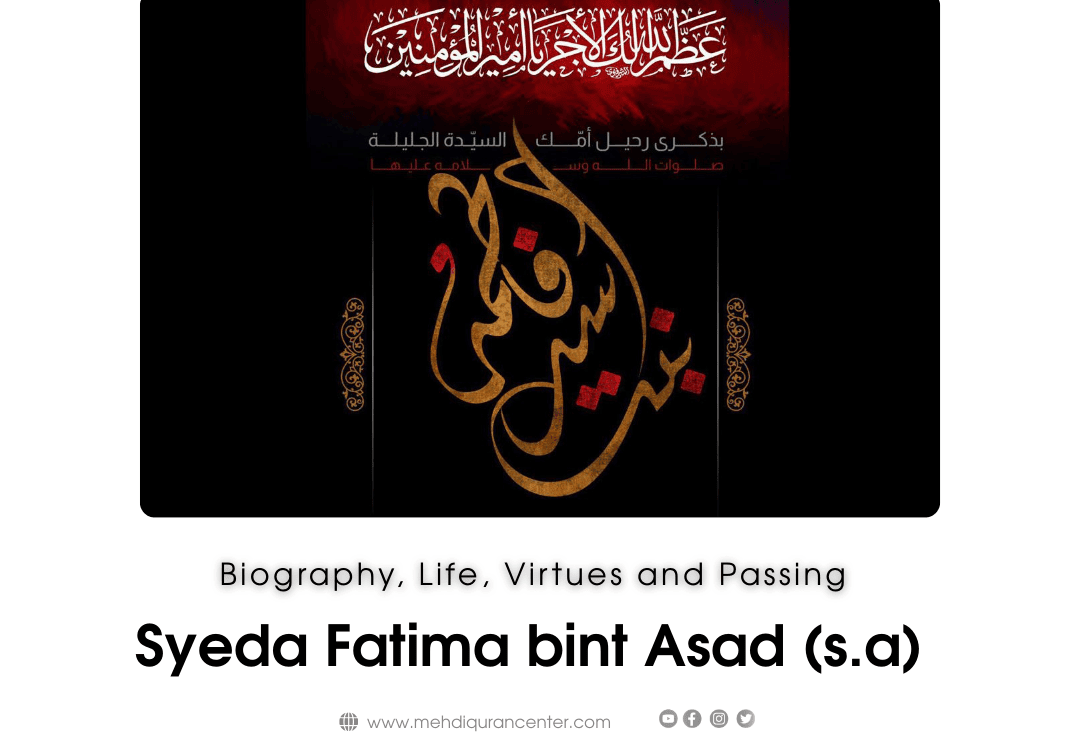
Among the noble women of early Islam, the name of Syeda Fatima bint Asad (s.a) shines with dignity, sacrifice, and unwavering faith. She holds a unique and honoured position in Islamic history as the mother of Ali ibn Abi Talib (a.s) and the guardian and second mother of Muhammad (s.a.w.w). Her life bridges the pre-Islamic era and the dawn of Islam, and her character reflects loyalty, patience, courage, and devotion to Allah.
She was not only the wife of Abu Talib ibn Abd al-Muttalib, the chief of Banu Hashim, but also one of the earliest women to embrace Islam. She nurtured the Prophet (s.a.w.w) during his youth and later witnessed her own son, Imam Ali (a.s), become the standard-bearer of faith. Her passing was marked by extraordinary honour from the Prophet himself, demonstrating her exceptional rank in the eyes of Allah and His Messenger.
This comprehensive biography explores her lineage, upbringing, relationship with the Prophet, motherhood, virtues, faith, and her death — along with her lasting legacy.
Lineage and Early Life
Syeda Fatima bint Asad (s.a) was born into the noble clan of Banu Hashim in Makkah. Her father was Asad ibn Hashim, making her a cousin of Abdullah ibn Abd al-Muttalib. This noble lineage meant she belonged to one of the most respected families among Quraysh.
She grew up in a society dominated by tribal pride, idol worship, and social injustice. Yet even before Islam, she was known for her purity, modesty, and noble conduct. Her upbringing in the house of Hashim instilled within her values of generosity, hospitality, and honour — traits that later became hallmarks of the early Muslim community.
She married Abu Talib, the respected guardian of the Prophet (s.a.w.w) after the death of Abd al-Muttalib. Together, they built a household that would become central to Islamic history.
Guardian and Second Mother of the Prophet (s.a.w.w)
One of the most remarkable aspects of her life is her role in raising the Prophet Muhammad (s.a.w.w). After the passing of his grandfather, Abdul Muttalib, the young Muhammad came under the care of Abu Talib. In reality, however, it was Fatima bint Asad (s.a) who cared for him like her own child.
The Prophet later said that she treated him with greater affection than she showed her own children. Despite the financial hardships faced by Abu Talib’s household, she ensured that Muhammad (s.a.w.w) was never deprived of love or care.
It is reported that she would feed him before her own children and prioritise his comfort. The Prophet never forgot her kindness. Even decades later in Madinah, he remembered her sacrifices with deep emotion.
Her house became the first environment where the future Messenger of Allah experienced maternal love after the loss of his own mother, Aminah bint Wahb.
The Blessed Birth of Imam Ali (a.s)
One of the greatest honours granted to Fatima bint Asad (s.a) was the miraculous birth of her son, Imam Ali (a.s).
4
According to widely reported traditions in Shia history, she experienced labour pains near the Kaaba. She prayed to Allah for ease and, by divine command, the wall of the Kaaba opened. She entered and remained inside for three days, where Imam Ali (a.s) was born.
This event marks Imam Ali (a.s) as the only person born inside the Holy Kaaba — a sign of his elevated rank in Islam.
This miraculous event also highlights the spiritual station of his mother. Allah chose her as the vessel for bringing into the world the Commander of the Faithful.
Acceptance of Islam
When the Prophet (s.a.w.w) declared his prophethood, Fatima bint Asad (s.a) was among the earliest women to accept Islam. Her faith was firm, despite the intense persecution faced by the Muslims in Makkah.
While Quraysh tortured and boycotted the believers, she remained steadfast. She endured the harsh years of social and economic boycott in the Valley of Abu Talib (Shi’b Abi Talib). Those were years of hunger and hardship, yet her faith did not weaken.
Her belief was not merely emotional attachment to the Prophet; it was conscious conviction in the truth of his message.
Migration to Madinah
After years of persecution in Makkah, Muslims were commanded to migrate to Madinah. Fatima bint Asad (s.a), despite her advanced age, undertook the difficult journey.
Migration in those days was not a simple travel experience. It meant leaving behind one’s home, property, tribe, and security. Yet she willingly made this sacrifice for Islam.
Her migration (Hijrah) elevated her spiritual rank further. The Prophet deeply appreciated her devotion.
Her Status in the Eyes of the Prophet (s.a.w.w)
When she passed away in Madinah, the Prophet’s actions demonstrated her lofty status.
The Prophet personally entered her grave before burial. He lay down inside it and prayed for her. When asked why he honoured her in such a special way, he replied that after his own mother, she was the most caring woman toward him.
He removed his own shirt and used it as her shroud — a powerful symbol of gratitude and love.
He prayed:
“O Allah, forgive my mother Fatima bint Asad, widen her grave, and grant her ease.”
She was buried in Jannat al-Baqi in Madinah — a resting place of many noble companions and family members of the Prophet.
Her Children
Fatima bint Asad (s.a) and Abu Talib were blessed with several children:
- Talib
- Aqeel
- Jafar (known as Jafar al-Tayyar)
- Ali ibn Abi Talib (a.s)
- Daughters including Umm Hani
Each of her sons played significant roles in early Islamic history. Jafar (a.s) became a martyr in the Battle of Mu’tah. Aqeel was known for his knowledge of Arab lineage. Imam Ali (a.s) became the fourth Caliph and the first Imam according to Shia belief.
Raising such righteous children reflects her nurturing character and strong faith.
Her Virtues and Qualities
1. Faith (Iman)
She was among the earliest believing women, enduring persecution and migration for Islam.
2. Patience (Sabr)
She endured poverty during the boycott and hardship during migration.
3. Loyalty
Her loyalty to the Prophet and Islam never wavered.
4. Motherhood
She was a biological mother to Imam Ali (a.s) and a spiritual mother to the Prophet.
5. Generosity
Despite limited resources, she prioritised the comfort of others.
Her Rank in Shia Tradition
In Shia Islam, Fatima bint Asad (s.a) holds a highly revered status. She is regarded as a pure and righteous believer whose life prepared the way for the leadership of Imam Ali (a.s).
Her connection to the Ahlul Bayt (a.s) makes her part of the sacred household’s heritage.
Lessons from Her Life
Her life teaches timeless lessons:
- Raising righteous children shapes history.
- Supporting truth may require sacrifice.
- Quiet service can hold immense spiritual value.
- Gratitude should be shown to those who nurture us.
Her Death
Fatima bint Asad (s.a) passed away in 4 AH (approximately 625 CE) in Madinah.
Her funeral was led personally by the Prophet. His visible grief indicated her high spiritual status. Scholars narrate that very few women received such honour during burial.
Her grave remains in Jannat al-Baqi, though like many graves there, it is simple and unmarked today.
Syeda Fatima bint Asad (s.a) lived a life of dignity, sacrifice, and faith. She nurtured the Prophet of Islam, gave birth to the Lion of Allah, endured persecution, migrated for faith, and passed away honoured by the Messenger himself.
Her biography is not merely historical narration; it is a guide for mothers, believers, and anyone striving for closeness to Allah.
Through her patience, loyalty, and love, she secured a place among the noble women of Islamic history. Her legacy continues through the virtues of Imam Ali (a.s) and the teachings of the Ahlul Bayt (a.s).
May Allah elevate her ranks and allow us to follow in her path of sincerity and devotion. Ameen.