The 13th of Rajab marks one of the most significant dates in the Islamic calendar. It is the birth anniversary of Imam Ali ibn Abi Talib (a.s.), the cousin and son-in-law of Prophet Muhammad (s.a.w.w.), the first Imam of the Shia school of thought, and the fourth Caliph of the Muslim Ummah.1
For millions around the globe, this day is not merely a historical milestone but a celebration of justice, wisdom, and divine courage.
The Miraculous Birth inside the Kaaba
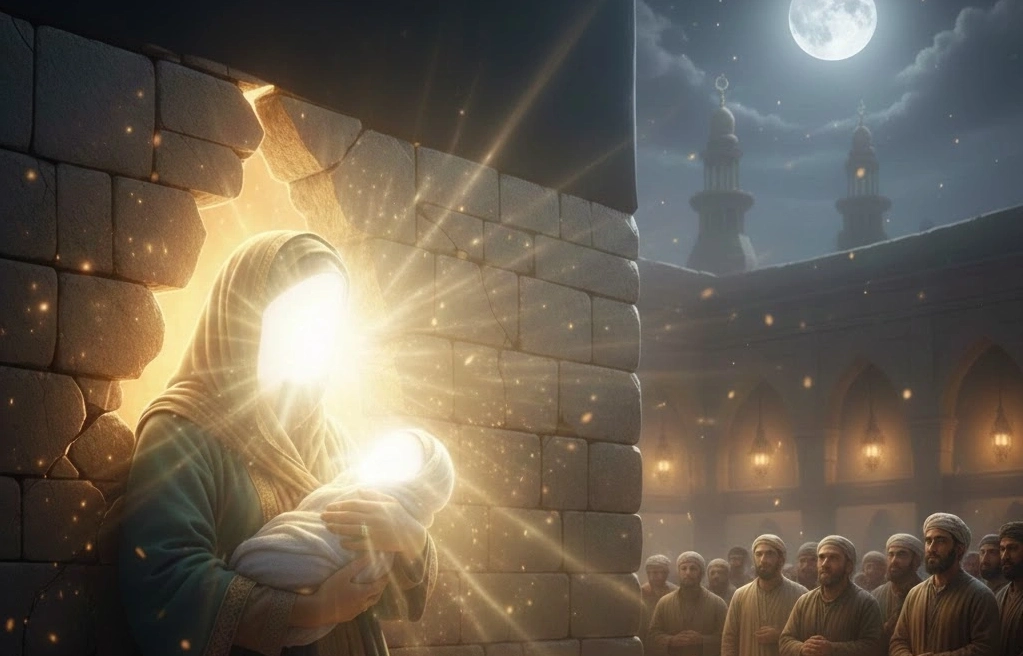
According to authentic Shia traditions and many Sunni historical accounts, Imam Ali (a.s.) was born in the year 600 AD inside the Holy Kaaba in Mecca.2 This is a distinction held by no one else in human history—neither before him nor after him.
The Split of the Wall
When Fatima bint Asad (a.s.), the mother of Ali, felt the pains of childbirth, she approached the Kaaba.3 Tradition holds that the wall of the Kaaba miraculously split open (Rukn-al-Yamani) to allow her entry. She remained inside for three days as a guest of Allah, emerging on the third day cradling the infant Ali.
“O People! A child is born today in the House of God, who will be the protector of the Faith and the destroyer of idols.”
The Proximity to the Prophet (s.a.w.w.)
Imam Ali’s upbringing was unique. He was raised under the direct supervision of Prophet Muhammad (s.a.w.w.). This close bond forged a spiritual and intellectual unity often described in the famous Hadith:
“I am the city of knowledge, and Ali is its gate.”
Key Milestones in Ali’s Life:
- The First Muslim: Ali (a.s.)4 was the first male to embrace Islam and accept the Prophet’s mission.5
- The Night of Hijrah (Laylat al-Mabit): When the pagans plotted to assassinate the Prophet, Ali risked his life by sleeping in the Prophet’s bed, allowing the Messenger to migrate safely to Medina.6
- The Hero of Battles: From Badr and Uhud to the legendary victory at Khaybar, Ali’s sword, Zulfiqar, was the shield of Islam.7
Imam Ali (a.s.) and the Concept of Wilayah
In the Shia school of thought, the 13th of Rajab is a reminder of Wilayah (Divine Authority). The Prophet (s.a.w.w.) formally announced Ali as his successor at Ghadir Khumm, stating: “Of whomsoever I am the Mawla (Master), this Ali is his Mawla.”8
Attributes of the Imam:
- Justice (Adalah): He was known as the “Voice of Human Justice.” He never prioritised his kin over the law.
- Eloquence: His sermons, letters, and aphorisms collected in Nahj al-Balagha (The Peak of Eloquence) remain a masterpiece of Arabic literature and philosophy.9
- Asceticism (Zuhd): Despite being the ruler of a vast empire, he lived the simplest of lives, wearing coarse clothes and eating dry bread.
13 Rajab Traditions and Celebrations
Shia communities worldwide celebrate this day with immense joy. Typical observances include:
- Majalis & Jashn: Gatherings where poets recite Manqabat (poetry in praise of the Imam) and scholars lecture on his life.
- Acts of Charity: Feeding the poor and helping the orphaned, following the Sunnah of the “Father of the Orphans.”10
- Visiting Najaf: Hundreds of thousands of pilgrims gather at the Shrine of Imam Ali in Najaf, Iraq, to pay their respects.
The Legacy of the “Lion of God”
The life of Imam Ali (a.s.) serves as a timeless blueprint for leadership and morality. Whether it was his treatment of prisoners of war or his instructions to governors (like the famous letter to Malik al-Ashtar), his principles focus on the inherent dignity of every human being.
| Title | Meaning |
| Asadullah | The Lion of God |
| Haidar-e-Karrar | The Valiant Attacker |
| Murtaza | The Chosen One |
| Amir al-Mu’minin | Commander of the Faithful |
The birth of Imam Ali (a.s.) on 13 Rajab is a beacon of hope. He remains a symbol of the struggle against oppression and the embodiment of the perfect human being (Al-Insan al-Kamil).11 By studying his life, we learn that true power lies in humility and true victory lies in the service of God and humanity.
The Wisdom of the Gate of Knowledge: Iconic Quotes
⚖️ On Justice and Leadership
Imam Ali (a.s.) is widely regarded as the pioneer of social justice. His words serve as a manual for ethical governance.
- “He who acts unjustly shall be punished for his injustice by his own conscience.”
- “A state can survive with disbelief (Kufr), but it cannot survive with injustice (Zulm).”
- “Be an enemy to the oppressor and a helper to the oppressed.” (Part of his final will).
🧠 On Knowledge and Intellect
As the “Gate of the City of Knowledge,” the Imam emphasized the superiority of the mind over material wealth.
- “Knowledge is better than wealth; for knowledge guards you, while you have to guard wealth.”
- “The most shameful ignorance is to be ignorant of one’s own faults while finding fault in others.”
- “A man’s worth is proportional to his ambitions.”
🤝 On Friendship and Social Conduct
These quotes are highly shareable on social media and resonate with universal human values.
- “A friend is not a friend until he guards his brother in three occasions: in his misfortune, in his absence, and at his death.”
- “The most helpless of people is the one who cannot find a few brothers (friends), and even more helpless is the one who finds them but loses them.”
- “Live among people in such a manner that if you die they weep over you, and if you are alive they crave for your company.”
💎 The “Peak of Eloquence”: Short SEO-Friendly Aphorisms
For quick-read sections or “Quote of the Day” features, use these powerful one-liners:
- “Patience is to victory what the head is to the body.”
- “The tongue is a hidden part of a person; it is the interpreter of the heart.”
- “Opportunities pass away like the clouds; so, make use of good opportunities.”
- “The best form of devotion is to conceal it.”
📝 How to Use These Quotes for SEO
- Use Blockquotes: In your blog post, use the
<blockquote>tag. This tells search engines this is a significant excerpt. - Add Alt-Text to Images: If you create graphics with these quotes, use alt-text like “Imam Ali quote on justice from Nahj al-Balagha.”
- Internal Linking: Link these quotes to the 13th Rajab narrative, explaining that this wisdom was born in the Kaaba and perfected through the Prophet’s (s.a.w.w.) teachings.
Comparison: Knowledge vs. Wealth (A Famous Teaching)
In one of his most famous discussions, Imam Ali (a.s.) gave ten reasons why knowledge is superior to wealth. Here are the top three to include in your article:
| Aspect | Knowledge | Wealth |
| Protection | Knowledge protects you. | You must protect your wealth. |
| Legacy | Knowledge is the legacy of Prophets. | Wealth is the legacy of Pharaohs. |
| Growth | Knowledge increases by sharing. | Wealth decreases by spending. |