
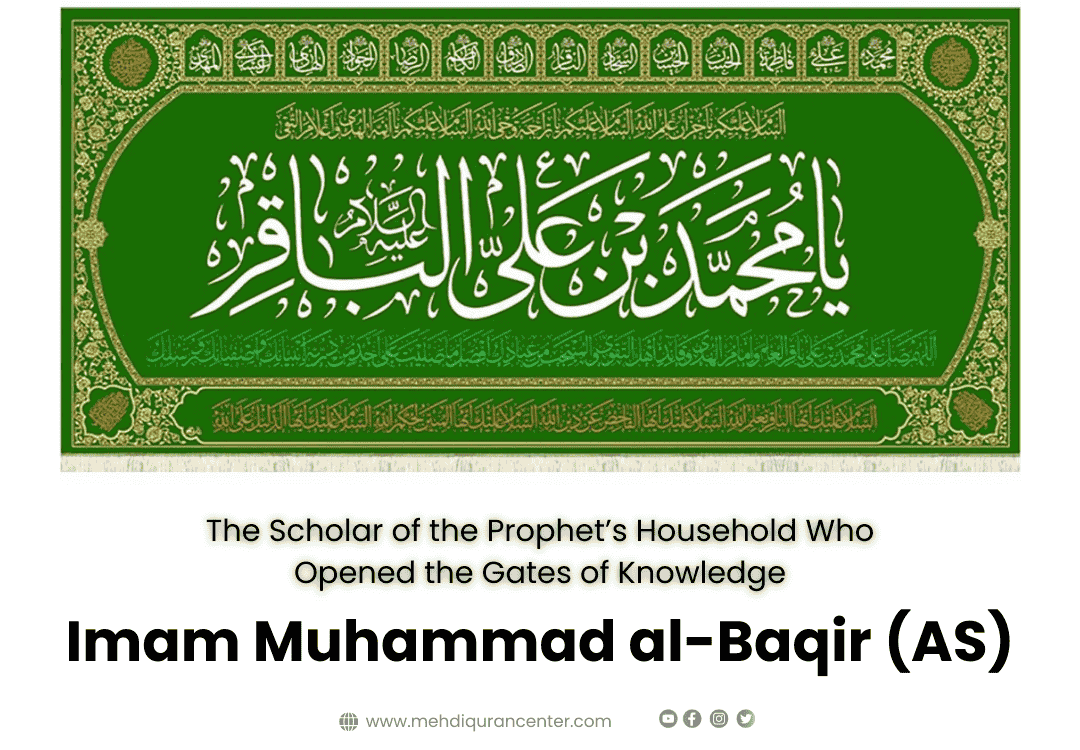
Imam Muhammad al-Baqir (AS) occupies a unique and elevated position in Islamic history as the Imam who transformed a period of political suppression into an age of intellectual revival. Renowned for his vast knowledge, clarity of thought, and moral authority, he became the foundation upon which later Islamic scholarship flourished. His title al-Baqir, meaning “the one who splits open knowledge,” reflects his unparalleled ability to uncover the depths of divine wisdom.
At a time when Islamic teachings were threatened by distortion, political propaganda, and fabricated traditions, Imam al-Baqir (AS) preserved the authentic message of the Prophet Muhammad (ﷺ) through education rather than confrontation. His legacy continues to shape Islamic jurisprudence, theology, and ethics across centuries.
Lineage and Family Background
Imam Muhammad al-Baqir (AS) was born into the purest lineage of Islam, combining the bloodlines of both Imam Hasan (AS) and Imam Husayn (AS). His father was Imam Ali Zayn al-Abidin (AS), the survivor of Karbala and a model of patience and worship, while his mother, Fatima bint Hasan ibn Ali (AS), was the granddaughter of Imam Hasan (AS). This unique ancestry made Imam al-Baqir (AS) the first Imam descended from both grandsons of the Prophet (ﷺ), a distinction that carried immense spiritual and moral weight.
He was also known by his agnomen Abu Ja‘far, a name that later became synonymous with scholarly authority and reliability in Islamic tradition.
Birth and Early Years
Imam Muhammad al-Baqir (AS) was born in Madinah in 57 AH, corresponding to 675 AD. Historical sources record his birth as either the first of Rajab or the third of Safar. His childhood unfolded in the shadow of Karbala, and as a young boy he witnessed the suffering inflicted upon his family by tyranny and injustice.
Growing up under the guidance of Imam Zayn al-Abidin (AS), he was immersed in Quranic knowledge, prophetic traditions, and spiritual discipline. His exceptional intellect became evident at a young age, and even senior scholars of Madinah recognised his deep understanding and wisdom.
Imamate and Leadership
Imam al-Baqir (AS) assumed the position of Imamate at the age of thirty-eight, following the martyrdom of his father. His Imamate lasted for nineteen years, during which he guided the Muslim community through one of the most intellectually fragile periods in Islamic history. He lived for fifty-seven years, dedicating the majority of his life to teaching, reform, and preservation of the faith.
Rather than leading armed resistance against the Umayyad rulers, Imam al-Baqir (AS) adopted a strategic and transformative approach. He understood that reviving authentic knowledge was the most effective way to counter oppression and corruption. Through teaching circles in Madinah, he trained a generation of scholars who would later shape Islamic thought.
Meaning and Significance of the Title “Al-Baqir”
The title al-Baqir was not honorary but descriptive. It signified one who opens knowledge and exposes its hidden dimensions. Imam al-Baqir (AS) did not merely transmit information; he explained meanings, contexts, and wisdom behind religious teachings. His explanations reconciled apparent contradictions and restored coherence to Islamic law and theology at a time when confusion was widespread.
This title was acknowledged even by those outside the Shia tradition, reflecting the universal recognition of his scholarship.
Scholarly Contributions
Imam Muhammad al-Baqir (AS) is regarded as the true initiator of systematic Islamic scholarship within the Ahl al-Bayt. His teachings formed the intellectual groundwork later expanded by his son, Imam Ja‘far al-Sadiq (AS).
In the field of jurisprudence, he clarified legal principles directly from the Quran and authentic Sunnah, distinguishing them from Umayyad-sponsored fabrications. He emphasised justice, intention, and ethical responsibility in legal rulings, ensuring that law remained a means of moral refinement rather than political control.
In Quranic exegesis, Imam al-Baqir (AS) offered explanations that combined historical context with spiritual depth. He taught that the Quran possesses layers of meaning, and that true understanding requires both knowledge and purity of heart. Many early tafsir narrations trace their origins to his lessons.
In theology, he addressed complex debates surrounding divine justice, human free will, and the nature of faith. His balanced approach protected Islamic belief from extremes and philosophical distortions that were emerging at the time.
Role in Moral and Spiritual Reform
Imam al-Baqir (AS) consistently taught that knowledge without character is meaningless. He emphasised humility, sincerity, and service to others as the true signs of faith. His lifestyle reflected simplicity and devotion, despite his elevated status.
He warned against scholars who pursued knowledge for power or prestige and taught that the purpose of learning was to bring people closer to God and justice.
Interaction with Contemporary Scholars
Many prominent scholars of the early Islamic period either studied under Imam al-Baqir (AS) or acknowledged his authority. His influence extended beyond sectarian boundaries, and his teachings were respected across the Muslim world. This broad recognition highlights his role as a unifying intellectual force rather than a divisive figure.
Political Pressure and Persecution
The Umayyad rulers, particularly Hisham ibn Abdul Malik, perceived Imam al-Baqir (AS) as a serious threat. His influence did not rely on armies but on minds, which made it far more enduring. Attempts were made to intimidate, discredit, and silence him, yet his calm dignity and intellectual mastery only increased public admiration.
Ultimately, the Umayyad regime chose assassination as its final response.
Martyrdom
Imam Muhammad al-Baqir (AS) was poisoned on the seventh of Zilhajj in 114 AH, corresponding to 733 AD, on the orders of Hisham ibn Abdul Malik. His martyrdom marked another tragic chapter in the persecution of the Ahl al-Bayt.
He was laid to rest in Jannat al-Baqi in Madinah, beside his forefathers Imam Hasan (AS) and Imam Zayn al-Abidin (AS), and later alongside his son Imam Ja‘far al-Sadiq (AS).
Jannat al-Baqi and Enduring Memory
Although the physical shrines at Jannat al-Baqi were destroyed, the spiritual presence of Imam al-Baqir (AS) remains deeply rooted in Islamic consciousness. His grave continues to be a symbol of resilience, knowledge, and sacrifice.
Legacy and Influence
The greatest legacy of Imam Muhammad al-Baqir (AS) lies in the survival of authentic Islamic teachings. At a time when truth was endangered, he preserved it through education. His efforts ensured that future generations inherited a coherent and principled understanding of Islam.
Modern Islamic scholarship, particularly within jurisprudence and theology, continues to draw upon the foundations he established.
Relevance for Contemporary Life
Imam al-Baqir (AS) teaches that meaningful change begins with understanding. His life demonstrates that patience combined with knowledge can outlast tyranny. In an age of misinformation, his example reminds us that truth requires both depth and integrity.
Imam Muhammad al-Baqir (AS) was not only the fifth Imam but also the pioneer of an intellectual renaissance within Islam. By opening the gates of knowledge, he safeguarded the faith from corruption and ensured its transmission in its pure form. His life remains a timeless guide for those who seek wisdom, justice, and spiritual clarity.